


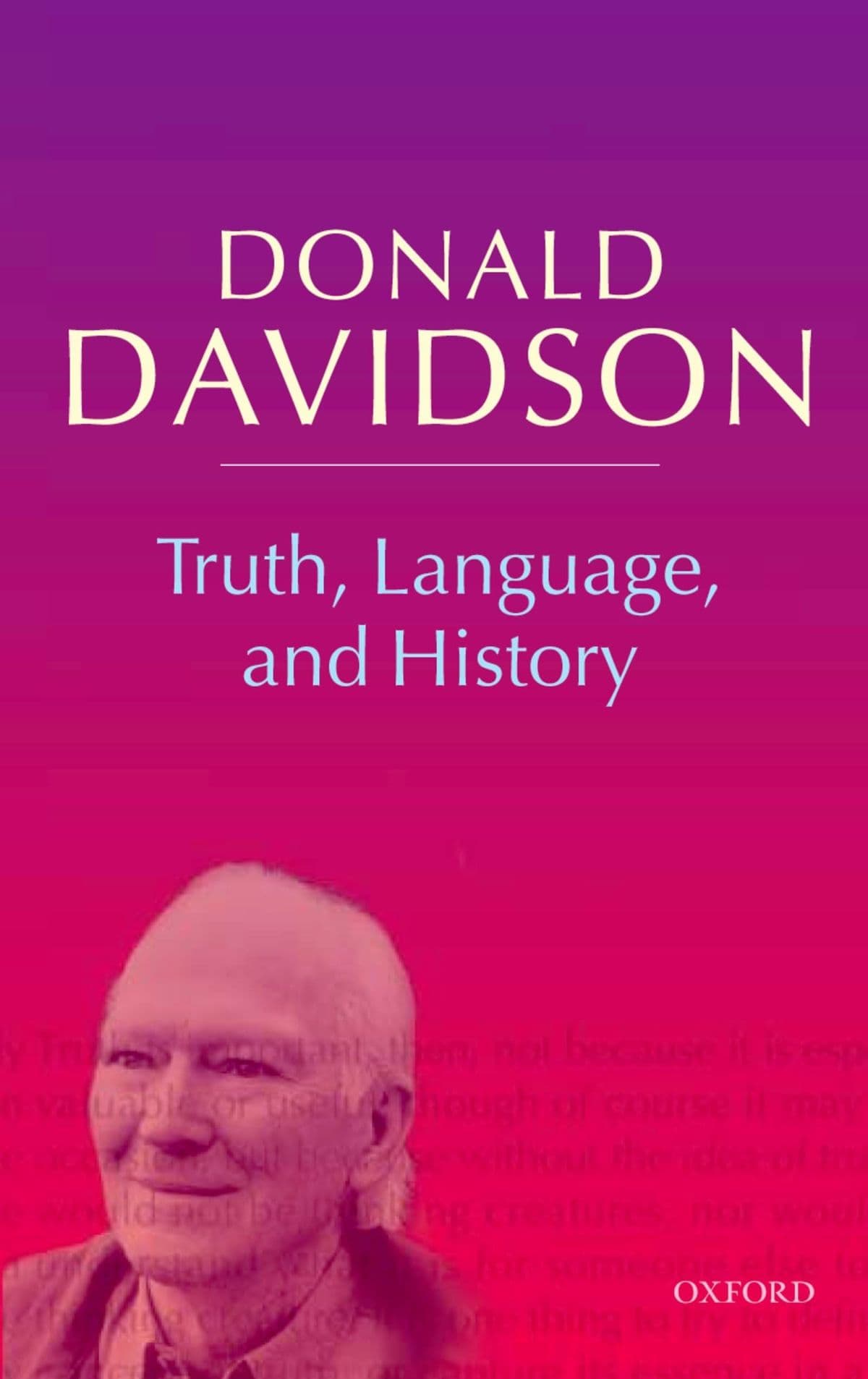
Truth, Language, and History
The final volume of Donald Davidson's collected philosophical essays, it gathers late pieces on how truth, meaning, and mind fit together. Its unifying move is a rejection of the idea that truth needs a theory-independent anchor or a reductive definition. Davidson treats truth as a primitive concept that interpreters rely on whenever they make sense of another speaker, which ties his semantics to radical interpretation and the principle of charity. The essays press this against relativism, conceptual-scheme talk, and Rortyan pragmatism, and they extend the argument into the history of philosophy. The book is best read as a late consolidation of Davidson's interpretive program, not as a single sustained treatise.
Key Insights
✦What does Davidson mean by treating truth as a primitive concept, and what does he reject in doing so?
Davidson holds that truth is too basic to be defined in more fundamental terms. He rejects correspondence theories that need a relation between sentences and facts, coherence theories that reduce truth to a web of belief, and epistemic theories that tie it to justification or ideal inquiry. His argument is that we already depend on the concept of truth when we interpret anyone, so any definition would presuppose what it tries to explain. Tarski's work remains important to him, but as a source of structural constraints on a theory of meaning, not as a definition of truth. The positive upshot is that truth is shown through its role in interpretation rather than analyzed away.
✦How does the book connect truth to radical interpretation and the principle of charity?
Davidson's central methodological idea, developed in earlier essays and reaffirmed here, is that we can only understand a speaker by assigning them mostly true beliefs and a largely coherent outlook. Without that background agreement, there would be no basis for deciding what their words mean or where they disagree with us. This makes charity a condition of interpretation rather than a courtesy. It also explains why truth cannot be dispensed with: the interpreter must use it to link a speaker's utterances to the world they share. The essays use this to argue that meaning, belief, and truth form a single interdependent structure.
✦How does the book argue against conceptual relativism and the idea of incommensurable schemes?
Davidson develops the argument most fully in his earlier essay "On the Very Idea of a Conceptual Scheme," and the late essays defend and extend it. His claim is that the idea of a language or scheme we could not translate is incoherent, because we would have no grounds for counting it as a language at all. Partial failure of translation is a difference in belief, not a difference in scheme. This undercuts Kuhnian readings of incommensurability and Whorfian linguistic relativism as he understands them. Critics such as Hilary Putnam and Bernard Williams have disputed whether the argument is as decisive as Davidson takes it to be.
✦How does Davidson's position differ from Richard Rorty's pragmatist reading of his work?
Rorty admired Davidson and claimed his work as support for a thoroughgoing pragmatism, in which truth is not a topic for philosophical theory and there is no point in talking of correspondence with reality. Davidson accepted parts of this, including the rejection of a scheme-content dualism, but resisted the conclusion that truth is merely what a community lets us say. He maintained that beliefs are about a shared world and that truth is not reducible to social agreement. His essays here, notably the ones engaging Rorty directly, mark where the two diverge: Davidson stays a realist about truth while denying that it can be explained from outside interpretation.
✦What does the "history" in the title refer to, and how does Davidson use it?
The title signals that part of the book moves from systematic argument to engagement with historical figures and traditions, including essays on Plato and other classical sources alongside discussion of how the subject-object picture came to dominate modern philosophy. Davidson uses these readings to show that the problems he addresses have antecedents and that some historical positions anticipate or obstruct his own view. He does not offer a comprehensive history. The essays are better understood as targeted interventions, using the past to clarify what is at stake in contemporary debates about truth and mind.
✦How should a reader approach this book given that it collects essays rather than presenting one sustained argument?
This is a collection of papers written for different occasions, so it lacks the cumulative structure of a treatise. Readers new to Davidson will gain more from starting with the earlier volumes, especially Inquiries into Truth and Interpretation, where the core program is laid out. This book is most useful once that groundwork is in place, since several essays refine, defend, or respond to criticism of positions established earlier. Reading it alongside the secondary literature on Davidson's holism and externalism helps clarify where he is consolidating his view and where he is revising it.
✦What is a common misreading of Davidson's view that truth cannot be defined?
A frequent mistake is to read the claim as a form of deflationism or as a refusal to say anything substantive about truth. Davidson does not hold that truth is trivial or merely a device of semantic ascent. He thinks truth plays an indispensable role in a theory of meaning and interpretation, and that its structure can be illuminated through that role even though it cannot be reduced to something simpler. The position is therefore closer to a primitivist stance with substantive consequences for semantics and the philosophy of mind than to a minimalist dismissal of the question.
Wealthy Psyche is an intellectual archive. We do not host, distribute, or sell book copies — physical or digital. We provide structured knowledge to help you think better, faster.