


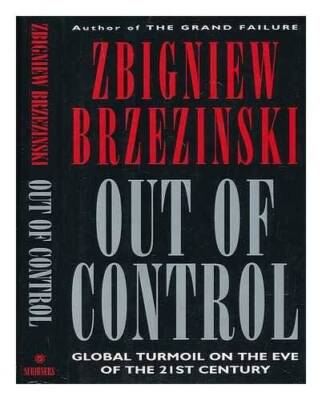
Out of Control: Global Turmoil on the Eve of the 21st Century
 Zbigniew Kazimierz Brzezinski
Brzezinski argues that the post-Cold War world is spiraling toward chaos because material power—technology, economic growth, military capability—has outpaced the moral and ethical frameworks needed to govern it. The collapse of communism removed the era's defining ideological struggle but left a vacuum that liberal democracy may not fill. He identifies two parallel crises: a 'permissive cornucopia' of self-indulgent consumption in the West, and a politically awakening Global South demanding redistribution. The book's core mechanism is that America's global authority depends on moral legitimacy, not raw power—and that legitimacy is eroding from within.
Key Details
Related Books
View AllSimilar books from the same category, ranked by shared topics and reader engagement.

Key Insights — Read in 10 Minutes
What is the central argument of Out of Control, and what does it reject?
Brzezinski argues that the post-Cold War world is becoming ungovernable because humanity's technological and material capacities have outgrown its moral and ethical frameworks. He explicitly rejects the then-fashionable 'end of history' thesis—the assumption that communism's collapse meant liberal democracy had permanently triumphed . His counter-claim is that the Cold War's end removed a stabilizing bipolar structure without replacing it with anything coherent, leaving a world of proliferating regional conflicts, rising inequality, and a West too self-absorbed to exercise real leadership.
What specific concepts did Brzezinski introduce in this book that recur in his later work?
Two concepts from Out of Control became fixtures in Brzezinski's vocabulary. 'Permissive cornucopia' describes a Western society 'in which everything is permitted and everything can be had,' where consumerism and moral relativism erode the civic virtues needed for global leadership . The 'trilateral nexus'—a cooperative framework among North America, Europe, and East Asia—prefigures the enlarged-West concept he developed more fully in Strategic Vision . Both ideas reflect his recurring conviction that geopolitics cannot be separated from questions of cultural vitality and moral purpose.
How did contemporary reviewers assess the book's argument and its relationship to Brzezinski's earlier work?
Reviews were mixed but largely respectful. Kirkus called it 'a brilliant and principled analysis' but noted its dour tone . Foreign Affairs found it lacked the specificity of The Grand Failure and criticized Brzezinski's treatment of spiritual themes as 'neither original nor graceful' . The Library Journal described it as an 'extended thought-piece' uncluttered by footnotes, while Commentary noted it marked a surprising turn: Brzezinski, a hard-line cold warrior, was now warning conservatives that victory had not resolved the deeper crisis .
Why does Brzezinski argue that America's global authority depends on moral legitimacy rather than military or economic power?
Brzezinski distinguishes sharply between power and authority. Power is the capacity to compel; authority is the capacity to lead by example and with consent. He contends that America's hedonistic culture—what he calls the 'permissive cornucopia'—undermines its claim to global leadership because other nations find its values unworthy of emulation . Even if the U.S. retains overwhelming military and economic capability, Brzezinski argues, it cannot exercise effective global authority if its domestic society appears decadent. This link between internal moral health and external influence is the book's most distinctive argument.
What did Brzezinski mean by saying history is accelerating beyond humanity's ability to grasp it?
Brzezinski's title refers to two related forms of loss of control. First, the international system lacks institutions capable of managing acute problems like nuclear proliferation and ethnic conflict. Second, and more fundamentally, technological capacity—the ability to destroy, to alter environments, to engineer life—has grown exponentially, while the moral and ethical criteria for deciding how to use that capacity have decayed . Without 'criteria based on some absolutes,' he argues, exponential growth in capability becomes a dynamic that is inherently out of control. This is a philosophical claim, not merely a policy diagnosis.
How has the book's central warning held up since its 1993 publication?
Brzezinski's diagnosis of post-Cold War disorder has aged better than his proposed remedies. He predicted regional conflicts in Eurasia, weapons proliferation, and a North-South divide over inequality—all of which materialized. His concern about a 'fascist renaissance' in Russia was prescient in outline, though not in specific form. However, his hope that the ecological movement might catalyze a new global ethic of self-denial has not been borne out . The book's moral-cultural argument now reads as more dated than its geopolitical analysis, reflecting the specific anxieties of the early 1990s.
Show 1 more insights
What is a common misconception about Out of Control's relationship to Brzezinski's other books?
Readers often assume Out of Control is a straightforward sequel to The Grand Failure (1989), continuing the story of communism's collapse. In fact, the two books have different purposes. The Grand Failure was an analytical autopsy of a defeated ideology; Out of Control is a warning about what comes after victory. It is also frequently misread as a realist geopolitical text, when its central argument is closer to cultural criticism: Brzezinski contends that geopolitics cannot be understood without reference to moral and spiritual conditions . This makes it an outlier among his major works.
Wealthy Psyche is an intellectual archive. We do not host, distribute, or sell book copies — physical or digital. We provide structured knowledge to help you think better, faster.