


Zbigniew Kazimierz Brzezinski
Zbigniew Brzezinski was the preeminent geostrategist of the late Cold War and post-Cold War era, whose worldview was defined by a relentless opposition to Soviet expansionism and a conviction that America's global primacy was contingent on its mastery of the Eurasian chessboard[reference:0][reference:1]. As National Security Advisor to President Jimmy Carter (1977–1981), he was the architect of a muscular foreign policy that included the covert arming of the mujahideen in Afghanistan and the championing of human rights to undermine the Soviet Union[reference:2][reference:3]. His 1997 book, *The Grand Chessboard*, achieved canonical status by arguing that the U.S. must prevent the emergence of any rival power on the Eurasian landmass to secure its global hegemony[reference:4][reference:5]. A Polish-born professor at Harvard and Columbia, he remained a sharp and influential critic of American foreign policy until his death in 2017[reference:6][reference:7].
.jpg?alt=media&token=568a0ae5-8212-47c7-af03-77f06ca3f607)



✦What is Brzezinski's 'Grand Chessboard' thesis?
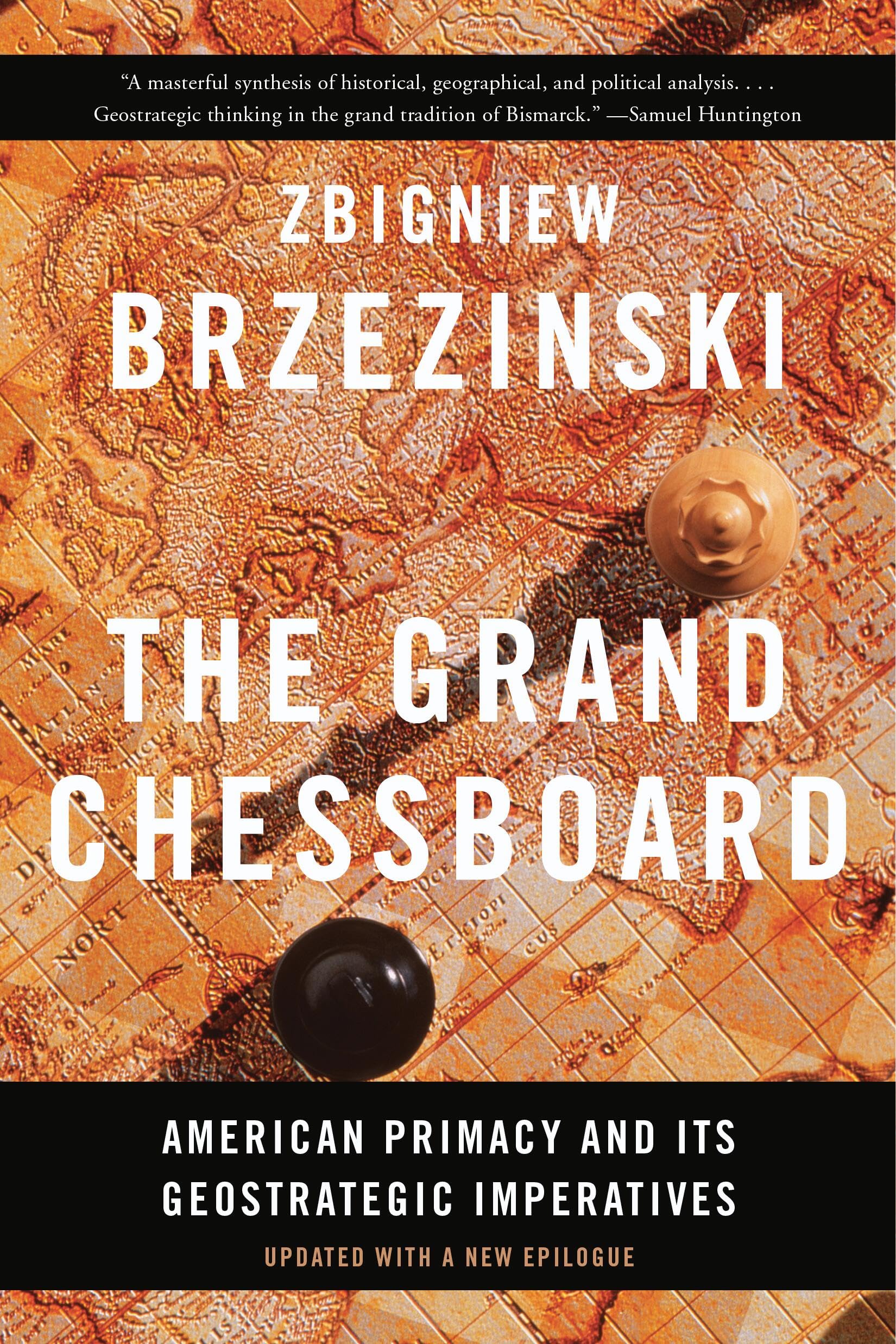
In his 1997 book *The Grand Chessboard*, Brzezinski argued that the Eurasian landmass is the central arena for global power, a 'grand chessboard' on which America's status as the sole global superpower would be won or lost[reference:8]. The book posited that U.S. preeminence would be short-lived unless it could prevent the emergence of a rival power capable of dominating Eurasia and challenging America's global position[reference:9]. He argued that managing the complex geopolitics of Eurasia, particularly through strategic partnerships with key 'geostrategic pivots' like Ukraine, was the primary imperative for U.S. foreign policy[reference:10].
✦What was Brzezinski's role in the Carter administration and the end of the Cold War?
As National Security Advisor from 1977 to 1981[reference:11][reference:12], Brzezinski was the chief architect of a confrontational policy toward the Soviet Union[reference:13]. He was the driving force behind the decision to secretly arm the Afghan mujahideen—a policy he initiated before the Soviet invasion—to give the Soviets their own 'Vietnam'[reference:14][reference:15]. He viewed the conflict as an opportunity to bleed the Soviet Union and hasten its collapse[reference:16]. His hawkish stance often put him at odds with Secretary of State Cyrus Vance, who favored a more conciliatory approach[reference:17].
✦What was the 'Arc of Crisis'?
Brzezinski coined the term 'Arc of Crisis' to describe a region of instability stretching from the Horn of Africa through the Middle East and into South Asia[reference:18]. He believed this zone, encompassing the Persian Gulf and the Indian Ocean, was a critical geopolitical prize in the Cold War[reference:19]. He feared that the Soviet Union would exploit instability there to gain access to vital oil resources and warm-water ports, thereby threatening Western interests and attempting to encircle the United States[reference:20]. This concept guided much of Carter administration policy in the region.
✦How does Brzezinski's geopolitics differ from that of Henry Kissinger?
While both were realist thinkers, their approaches to geopolitics differed significantly. Many analysts contrast Brzezinski's more traditional definition of geopolitics with Kissinger's focus on the balance of power[reference:21]. Brzezinski placed greater emphasis on the 'territorially embedded variables'—like geography, demography, and natural resources—that shape global politics, earning him the title of a neo-classical geopolitical thinker[reference:22]. Kissinger is often seen as a diplomatic tactician, whereas Brzezinski is viewed as a grand strategist focused on the physical and spatial dimensions of power[reference:23].
✦What is a common misconception about Brzezinski's work?
Despite his hawkish reputation, a common misconception is that he was an unthinking advocate of American military power. In fact, he was a prescient critic of U.S. foreign policy excesses, famously warning against the invasion of Iraq in 2003[reference:24]. He also criticized domestic American 'greed' and inequality[reference:25]. He saw geopolitics not as a call to unilateral action, but as a framework for strategic thinking that, if ignored, would lead to the decline of American influence[reference:26]. He believed that strategic vision, not just military might, was essential for global leadership.
✦What are Brzezinski's most influential books?
Brzezinski authored numerous influential works. His 1970 book *Between Two Ages* presciently discussed the impact of technology on global politics[reference:27][reference:28]. His 1986 book *Game Plan* provided a geostrategic framework for the U.S.-Soviet contest[reference:29][reference:30]. However, his most famous work is *The Grand Chessboard* (1997), which outlined his vision for American primacy in a unipolar world[reference:31][reference:32]. He also wrote *The Grand Failure* (1989) on the collapse of communism, and *Second Chance* (2007) on the challenges facing American superpower status[reference:33][reference:34].