


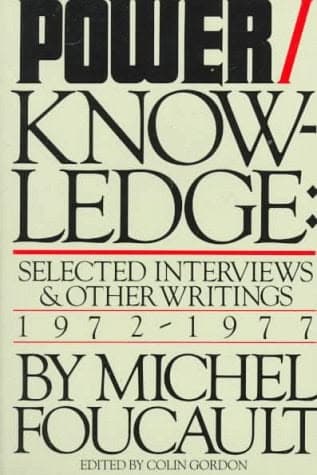
Power/Knowledge: Selected Interviews and Other Writings, 1972–1977
Gordon's edited collection argues that Foucault's scattered interviews and occasional pieces from the 1970s constitute a coherent statement of the power/knowledge nexus. The volume's central claim is that power and knowledge are not separate domains—power produces the fields of knowledge that make domination possible, and knowledge provides the categories through which power operates. The interviews and lectures gathered here, including 'Two Lectures' and 'Truth and Power,' show Foucault working out this thesis in accessible terms, explicitly rejecting the repressive hypothesis and the juridical model of power in favour of a productive, capillary conception of power relations.
Key Insights
✦What is the 'power/knowledge' nexus, and why does Foucault insist on the hyphen?
The hyphen is the argument. Foucault's claim is that power and knowledge are not two separate domains that occasionally interact; they are a single integrated apparatus. Power operates through the production of truths—categories, classifications, and discourses that make some things knowable and others invisible—and knowledge is never neutral but is shaped by and serves the exercise of power. The Wikipedia entry on power-knowledge notes that the hyphen 'alludes to their inherent inextricability' . This is why Foucault rejects the idea that knowledge can be liberated from power by becoming more rigorous or objective. The question is not how to escape power/knowledge but how specific regimes of truth are produced and contested.
✦How did Colin Gordon assemble this volume, and why does its status as a 'non-didactic primer' matter?
Gordon selected and edited the interviews and occasional writings, translating some himself, with the explicit aim of providing access to Foucault's work for English-speaking readers. In his preface, Gordon describes the volume as 'a sort of non-didactic primer' made up of texts in which Foucault explains 'in straightforward and informal terms' the preoccupations that traverse his more difficult books . This editorial purpose shapes the collection: these are not systematic treatises but Foucault speaking in his own voice about his work, often in response to questions. Readers should approach the volume as an introduction and a supplement to the major books, not as a replacement for them. The pieces date from 1972 to 1977, the period of Foucault's most intense engagement with power.
✦What is the 'regime of truth,' and how does it relate to the volume's argument about power?
The regime of truth is Foucault's term for the set of procedures and mechanisms by which a society determines what counts as true. In 'Truth and Power,' one of the volume's central essays, Foucault argues that truth is not outside power but is produced by it: each society has its 'general politics' of truth, the types of discourse it accepts as true and the techniques by which true and false statements are distinguished . This is not a claim that truth is arbitrary or that facts do not exist. It is a claim about the conditions under which statements become credible and authoritative. The regime of truth is one of the most influential concepts in the volume, and it directly informs later work on governmentality and biopower.
✦How does the volume relate to Discipline and Punish and The History of Sexuality?
The volume is best read alongside these two books, not independently of them. Gary Gutting's Cambridge Companion essay notes that Foucault's detailed historical studies of prisons and sexuality are 'connected to a more general conception of power' that many critics found less satisfactory . Power/Knowledge contains Foucault's most sustained attempts to articulate that general conception in accessible terms. The interviews and lectures gathered here clarify concepts that remain implicit or compressed in the historical works: the productivity of power, the rejection of the repressive hypothesis, the distinction between juridical and disciplinary power, and the meaning of biopower. Readers who find Discipline and Punish theoretically elusive should turn to this volume for Foucault's own explanations.
✦What does Foucault mean by saying power is 'productive' rather than 'repressive'?
The claim is that power does not primarily operate by saying 'no,' forbidding, or censoring. It operates by producing: producing subjects, producing desires, producing the categories through which people understand themselves. The repressive hypothesis—the idea that power silences sex, for example—misses how power incites discourse, demands confession, and generates new forms of knowledge and self-understanding. In the volume, Foucault argues that power 'reaches into the very grain of individuals, touches their bodies and inserts itself into their actions and attitudes, their discourses, learning processes and everyday lives' . This is why the critique of power cannot be a simple demand for liberation from repression. It must instead analyze the specific mechanisms through which power produces its effects.
✦Was the volume well received, and how has its status changed since publication?
The volume was welcomed as a valuable introduction to Foucault's thought for Anglophone readers, who had struggled with the difficulty of his major works. Reviewers recognized that Gordon's editorial labour made Foucault more accessible without simplifying him. Over time, however, the volume's status has shifted. It is now less often read as a standalone introduction and more often cited as a source for specific essays, particularly 'Truth and Power' and 'Two Lectures,' which are widely anthologized. Some scholars have noted that the interviews format can encourage a misleading impression of transparency—Foucault is explaining himself, but he is also performing a version of his work for a particular audience. The volume remains indispensable for understanding the 1970s Foucault, but it should be read critically, not as a definitive statement of his position.
Wealthy Psyche is an intellectual archive. We do not host, distribute, or sell book copies — physical or digital. We provide structured knowledge to help you think better, faster.