


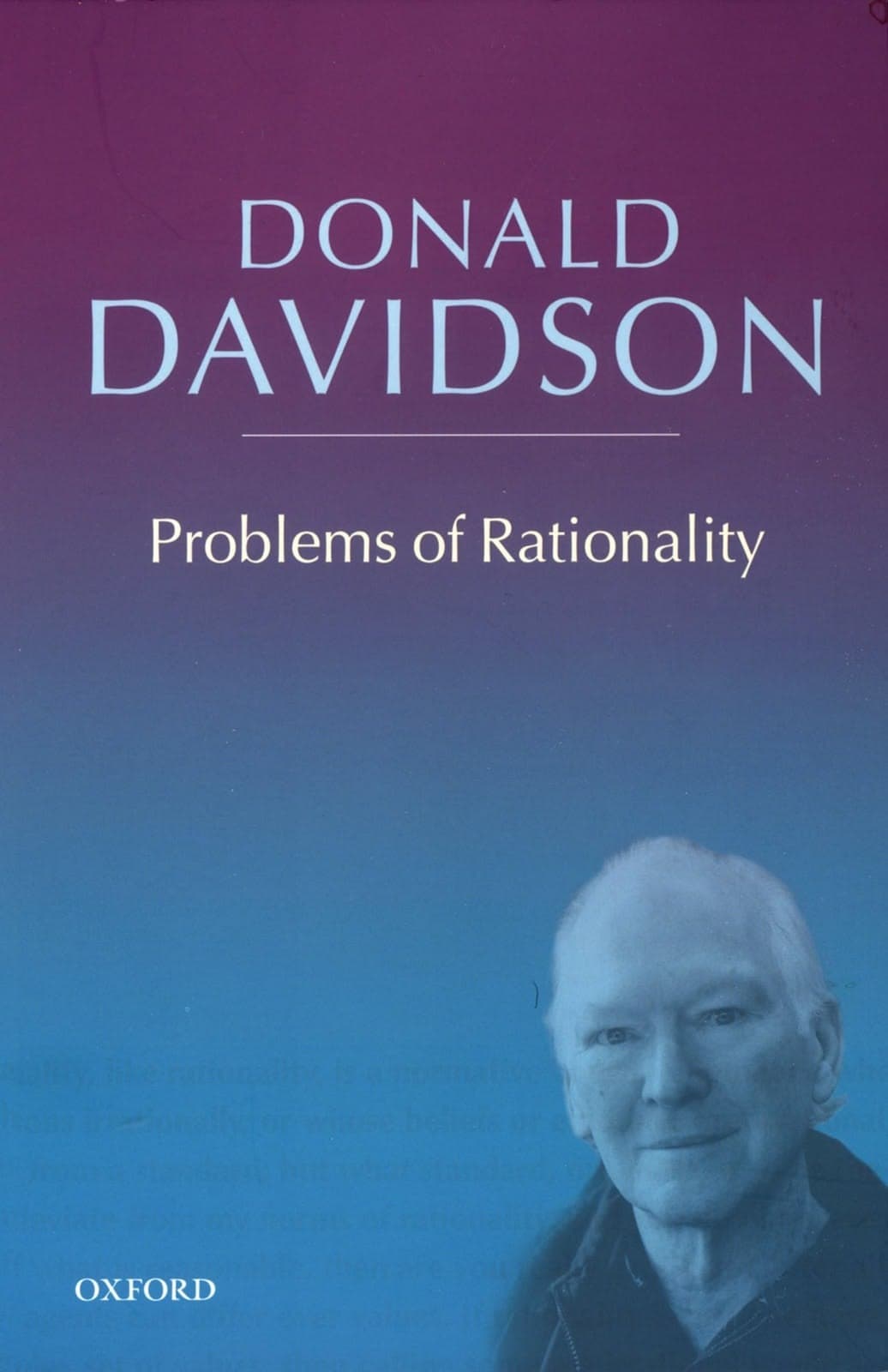
Problems of Rationality

Across three linked sections, Davidson defends a single architectonic claim: rationality is not an optional achievement but a constitutive condition of having a mind at all. The essays extend his unified theory of thought, meaning, and action to value judgments, which he argues are objective in the same way interpretation is; to the minimal conditions for attributing propositional attitudes; and to the apparent contradiction of irrationality, where weakness of will and self-deception require a divided mind that nevertheless remains interpretable as a single intentional system.
Key Insights
✦What is the central claim that unifies the three parts of Problems of Rationality?
The unifying thesis is that rationality functions as a constitutive ideal: we cannot identify an agent's beliefs, desires, or intentions without presupposing a background of largely coherent rational connections among them. From this it follows that value judgments are objective insofar as they are formed within the same space of reasons that makes interpretation possible; that attributing thought to a creature requires treating it as responsive to reasons; and that even irrationality—weakness of will, self-deception—must be explained as a departure from a rationality that remains the default framework. The book is not a collection of topical essays but a sustained attempt to show that these three domains are applications of one interpretive architecture.
✦How does Davidson's treatment of value judgments differ from standard metaethical positions like expressivism or moral realism?
Davidson rejects the framing that generates both expressivism and robust realism. On his account, judgments of value are objective not because they correspond to mind-independent moral facts, nor because they merely express attitudes, but because the distinction between appearance and reality—between what seems valuable and what is valuable—is drawn within the practice of interpretation itself. Objectivity is a feature of rational argumentation, not a separate metaphysical relation. This leads him to undercut the cognitivism/non-cognitivism debate rather than take a side within it, a move that critics have found either liberating or evasive depending on their prior commitments.
✦What does Davidson mean by a 'unified theory of thought, meaning, and action,' and is it meant to be empirically applicable?
The unified theory is a formal reconstruction showing how ascriptions of belief, desire, and meaning are interdependent and must be solved together rather than one at a time. Davidson draws on Tarski-style truth theories and Jeffrey-style decision theory, treating an interpreter as attributing preferences among sentences and correlating them with world conditions. Crucially, he explicitly disclaims practical application: the theory is not a field manual for linguists or a computational model of real-time understanding. It is a conceptual exercise revealing the mutual dependencies among propositional attitudes at a level fundamental enough to show what makes thought intelligible at all. This has frustrated readers seeking testable predictions but clarified the theory's philosophical purpose.
✦How does Davidson explain self-deception without abandoning his claim that agents are fundamentally rational?
Self-deception poses an acute problem because it seems to require holding contradictory beliefs while recognizing the evidence against one of them. Davidson's solution is to posit a division within the mind—not between separate agents or homunculi, but between partially independent structures of belief and desire that remain interpretable as belonging to one person. The self-deceiver is described as holding a wishful belief while also, at some level, acknowledging the countervailing evidence, with the division allowing both to coexist without generating a straightforward contradiction. Critics, including some who otherwise work within Davidson's framework, have questioned whether this division genuinely resolves the paradox or merely relabels it, and whether the account captures the phenomenology of self-deception at all.
✦What is the relationship between this volume and Davidson's earlier essay collections?
Problems of Rationality is the fourth volume of Davidson's collected essays, following Essays on Actions and Events, Inquiries into Truth and Interpretation, and Subjective, Intersubjective, Objective. The first two sections explicitly extend the radical interpretation framework from Inquiries, applying it to value and to the conditions for mental-state attribution. The final section on irrationality engages problems that had occupied Davidson since the early 1970s, notably in 'Paradoxes of Irrationality,' which appears here in revised form. The volume thus functions less as a new departure than as the consolidation of a program, showing how the interpretive approach developed for language and action can be pressed into service across domains that might initially seem resistant to it.
✦How was Problems of Rationality received by Davidson's contemporaries and critics?
Richard Rorty reviewed the volume for Notre Dame Philosophical Reviews, organizing his discussion around the three-part structure and treating the essays on value as the most provocative, since they press Davidson's coherence-based account of objectivity into metaethics. Rorty's own sympathies lay broadly with Davidson's anti-representationalism, but he noted the tension between the deflationary treatment of value objectivity and the expectations of those seeking substantive moral guidance. Other reviewers, including Manuela Ungureanu in Philosophy in Review, engaged the technical apparatus of the unified theory and the plausibility of the divided-mind solution to irrationality. The reception was respectful but not transformative; the book was received as an important consolidation rather than a new philosophical event.
✦Is the 'unified theory' in this book meant to be a scientific theory in any substantive sense?
Davidson addresses this directly in the essay 'Could There Be a Science of Rationality?' His answer is qualified: the unified theory has the formal structure of a scientific theory—few undefined concepts, extensional primitives, demonstrable dependencies—but it does not generate empirical predictions or guide field research. He explicitly distances himself from the idea that interpreters should literally record preferences among sentences. The label 'science' is justified by the theory's systematic character and its capacity to reveal constitutive dependencies, not by its predictive utility. This distinguishes Davidson's project sharply from Quine's more naturalistic ambitions and from later experimental approaches to mindreading, and it has been a persistent source of misunderstanding among readers who expect a computational or empirical model.
Wealthy Psyche is an intellectual archive. We do not host, distribute, or sell book copies — physical or digital. We provide structured knowledge to help you think better, faster.