


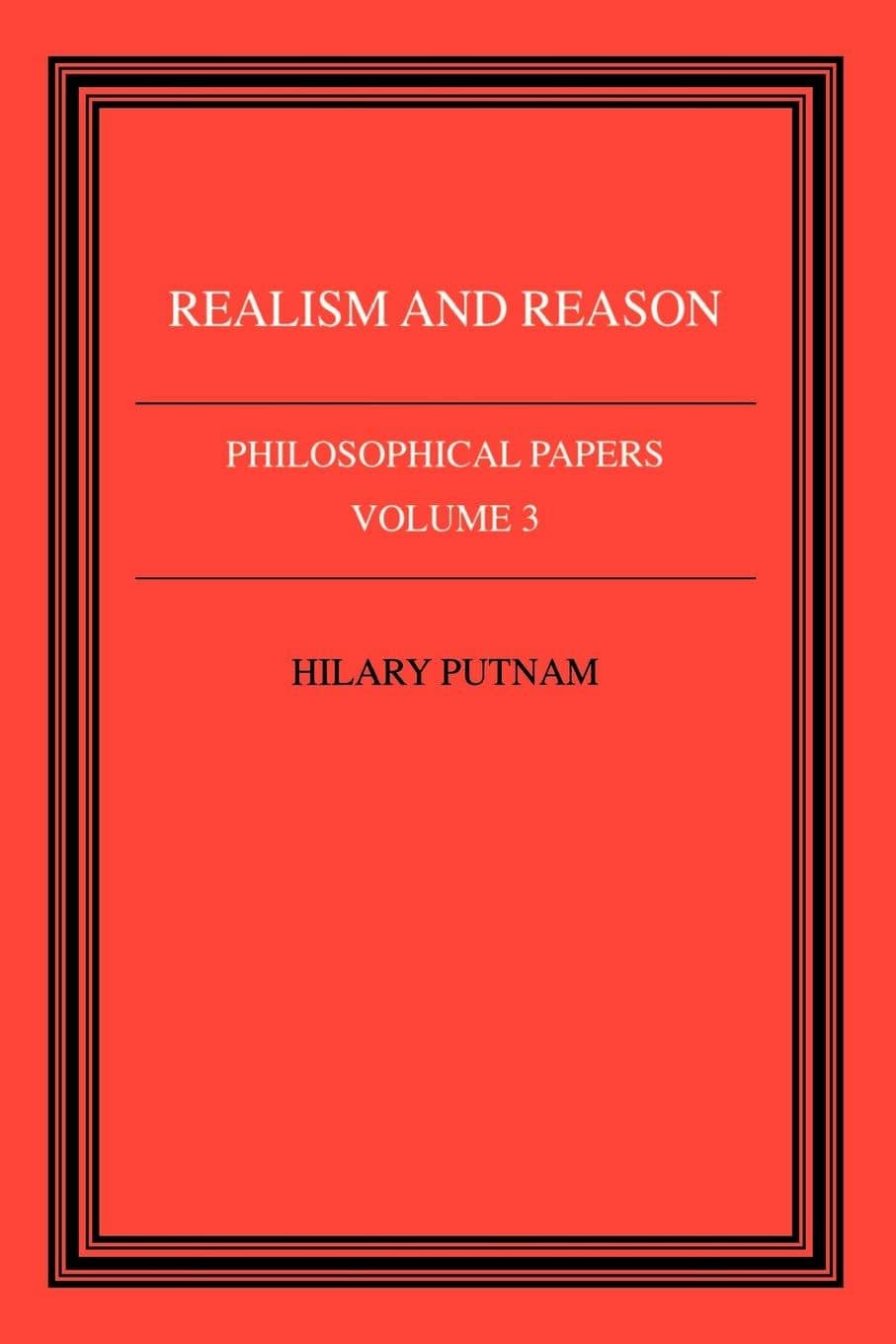
Realism and Reason (Philosophical Papers, Volume 3)

The third volume of Hilary Putnam's Philosophical Papers collects essays from the late 1970s and early 1980s in which he turns against metaphysical realism, the view that there is exactly one true and complete description of a mind-independent world. Its distinctive mechanism is the model-theoretic argument: because a formal theory can be given many interpretations that satisfy all its constraints, he argues that even an ideal theory cannot single out its intended reference by itself. From this he develops internal realism, in which truth is a kind of idealized rational acceptability within a conceptual scheme. The volume is a record of a major shift in his thinking, assembled from separate papers rather than written as a single treatise.
Key Insights
✦What is the model-theoretic argument, and what is it meant to show?
The argument starts from a result in formal logic: any consistent theory with an infinite model has many models, so the theory's sentences can be reinterpreted systematically while every one of them stays true. Putnam applies this to an ideal science that satisfies all operational and theoretical constraints. If such a theory still admits unintended interpretations, then nothing in the theory, or in our use of it, picks out its intended reference. He concludes that the metaphysical realist's idea of a unique correspondence between words and mind-independent things cannot be sustained. Critics have disputed whether the argument proves this or merely assumes that use cannot fix reference.
✦How does internal realism differ from the metaphysical realism it replaces?
Metaphysical realism holds that the world consists of a fixed totality of mind-independent objects and that truth is correspondence between a theory and that totality. Internal realism, as Putnam presents it, says that asking what objects exist makes sense only within a theory or description, and that truth is idealized rational acceptability, not correspondence with a world viewed from nowhere. He insists this is not relativism, since not every description is as good as another and experience constrains inquiry. Readers should compare it with his later natural realism, which he came to regard as a better way to keep objectivity.
✦How does the book relate to the semantic externalism Putnam developed earlier?
Putnam is widely associated with externalism about meaning, the view that the reference of natural-kind terms depends partly on the environment and on a division of linguistic labor. Realism and Reason sits beside that work in the same Philosophical Papers series, and his stance here has created a puzzle for commentators: externalism seems to suppose that the world fixes reference, while the model-theoretic argument seems to deny that anything can. Putnam's reply is that the causal story is itself part of a theory and cannot supply an external guarantee. Scholars continue to debate whether this resolves the tension or sharpens it.
✦How did critics such as David Lewis respond to the argument against realism?
David Lewis answered that Putnam's argument assumes the only constraints on reference are those expressed in the theory, and that reality also contains natural properties that are privileged candidates for what our words refer to. On this response, an interpretation that assigns reference to gerrymandered properties is eliminated by nature itself, not by anything we stipulate. Putnam countered that appealing to natural properties adds more theory, which would be open to the same reinterpretation. The exchange is among the best-known disputes in analytic metaphysics and is a standard route into the literature surrounding the book.
✦What is a volume of collected papers best used for, compared with a single-argument book?
Because Realism and Reason gathers essays composed for different occasions, its themes recur from several angles rather than building to one conclusion. Readers who want the most compact statement of internal realism will find it in Putnam's Reason, Truth and History from the same period, while the papers here offer technical detail and responses to critics. The collection also shows the evolution of his thinking over a few years, including hesitations that a finished treatise would have smoothed over. It is most useful to those already familiar with the main outlines of the debate.
✦What is a common misreading of Putnam's internal realism?
A frequent misreading treats internal realism as idealism or relativism, as though truth were whatever a community or an individual decides. Putnam rejects both. He holds that our conceptual choices do not create the world arbitrarily, that experience and inquiry limit which descriptions are acceptable, and that there are better and worse ways of speaking. What he denies is the further claim that one description captures the world as it is independently of all conceptual contribution. Reading him as denying a real world overlooks the distinction he draws between rejecting a particular philosophical picture and rejecting ordinary realism.
Wealthy Psyche is an intellectual archive. We do not host, distribute, or sell book copies — physical or digital. We provide structured knowledge to help you think better, faster.