


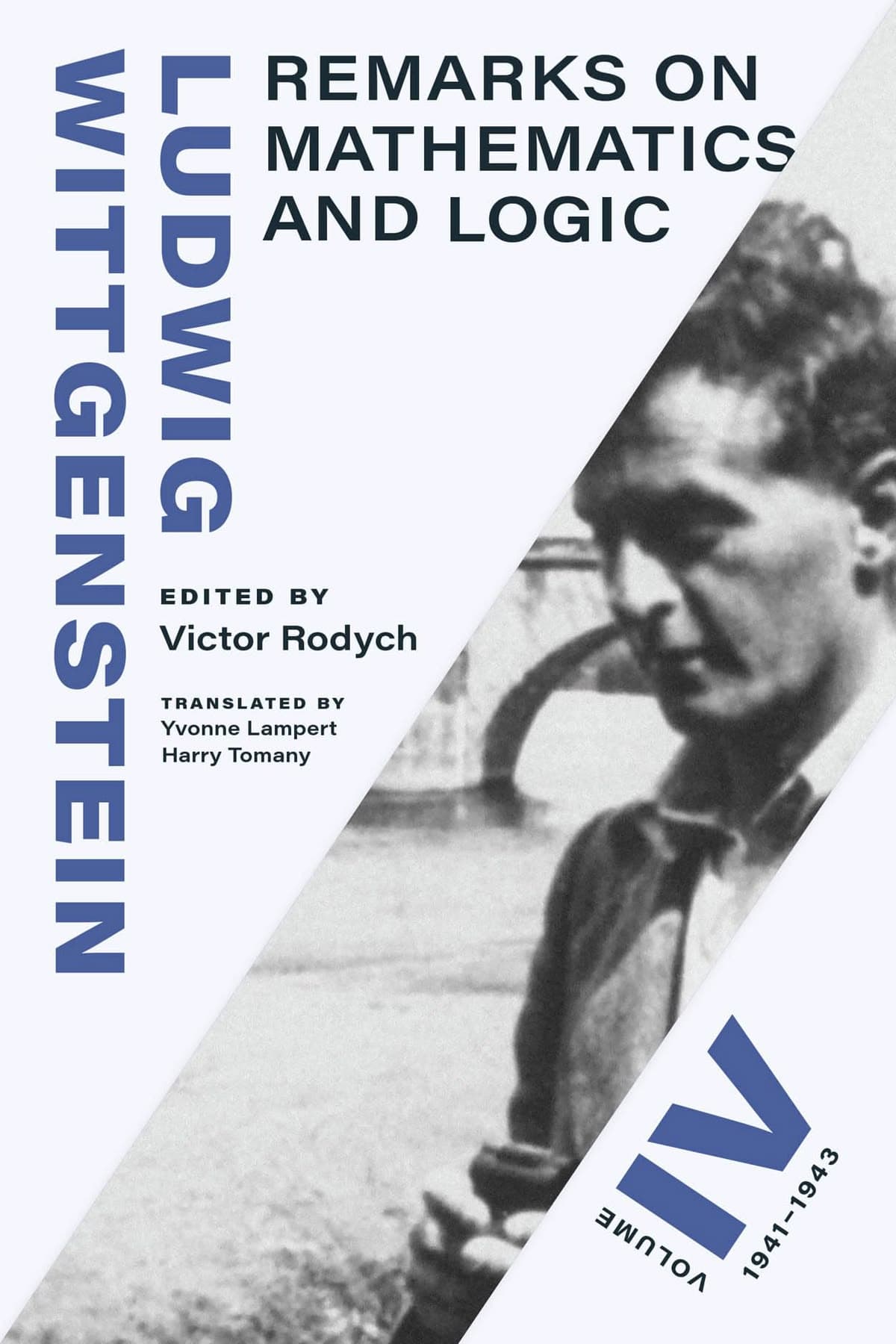
Remarks on the Foundations of Mathematics

Compiled from Wittgenstein's manuscripts and typescripts written between the mid-1930s and the mid-1940s, this collection applies the later philosophy of language-games and rule-following to logic and mathematics. Its central thesis is that mathematical propositions are not descriptions of an abstract realm of objects but norms of description: a proof does not discover a hidden fact but fixes a rule, so that what counts as 'following' the proof is part of the practice it belongs to. From this he questions the philosophical significance of Gödel's incompleteness result, of the law of excluded middle, and of the search for foundations. The text is a set of unrevised remarks, so its argument is suggestive and polemical rather than systematic.
Key Insights
✦How was the book assembled, and why does that affect how it is read?
Wittgenstein did not prepare it for publication. It was edited by G. H. von Wright, Rush Rhees, and G. E. M. Anscombe, who selected passages from several manuscripts and typescripts and arranged them in parts. The editors' choices therefore shape what readers see, and the selection omitted material that scholars later regarded as important. A revised edition in 1978 changed the contents and arrangement. Readers building detailed interpretations should consult the editors' prefaces and, where possible, the manuscripts, since the published sequence is a reconstruction and individual remarks are drafts, some of which he later abandoned or revised.
✦What does Wittgenstein mean by treating mathematical propositions as rules?
He argues that a mathematical proposition, such as an equation, does not report a fact about numbers but expresses a rule for how we describe and calculate. A proof, on this view, changes or fixes our concepts and creates a new rule instead of uncovering something already there. This is meant to dissolve the picture in which mathematicians discover a pre-existing realm. Critics, including Michael Dummett in his essay on Wittgenstein's philosophy of mathematics, have argued that this view comes close to a radical conventionalism, a charge that defenders such as Crispin Wright and Stanley Cavell have contested.
✦What is the controversy over his remarks on Gödel's theorem?
In a passage in the book, Wittgenstein appears to dismiss Gödel's incompleteness result, suggesting that the undecidable sentence has no clear sense or is a paradox-like construction. Many logicians reacted harshly, including Georg Kreisel, who regarded the remarks as a misunderstanding. Later defenders, notably Juliet Floyd and Hilary Putnam in different ways, argued that Wittgenstein was questioning the philosophical interpretation of the theorem and not its mathematical content. Scholars also note that the editors' selection of the remarks affected how they were read, and the dispute continues.
✦How does the book connect to his account of rule-following?
The remarks extend the Investigations' discussion of what it is to follow a rule, applying it to the case of mathematical inference. Wittgenstein asks what makes a step in a calculation correct, and answers in terms of shared practice and agreement in action instead of an external standard or a Platonic fact. This ties the necessity of mathematical propositions to the stability of human techniques. Saul Kripke's influential reading in Wittgenstein on Rules and Private Language drew on this material, and its skeptical interpretation remains debated among specialists.
✦How does his position differ from logicism and formalism?
Wittgenstein rejects the logicist aim, associated with Frege and Russell, of grounding mathematics in logic, and he equally rejects formalism's view that mathematics is a game of symbols without application. He argues that foundational projects misconceive what mathematics needs: it does not rest on a foundation but is held in place by its uses and practices. Mathematics for him gains meaning from its application. Critics have argued that this overlooks the mathematical content of foundational work, while sympathizers see him as exposing a mistaken picture of what such work achieves.
✦What is a common misreading of the book?
A common misreading takes Wittgenstein to claim that mathematics is arbitrary, or that mathematicians can alter results by agreement. His claim is that mathematical necessity belongs to the practice of using rules, not that anyone may decide that two plus two is five. Another misreading treats the book as an attack on mathematics itself, when his target is philosophical pictures of mathematics. Because the text consists of drafts selected by editors, readers should also avoid quoting single remarks as if they were settled doctrines.
Wealthy Psyche is an intellectual archive. We do not host, distribute, or sell book copies — physical or digital. We provide structured knowledge to help you think better, faster.