


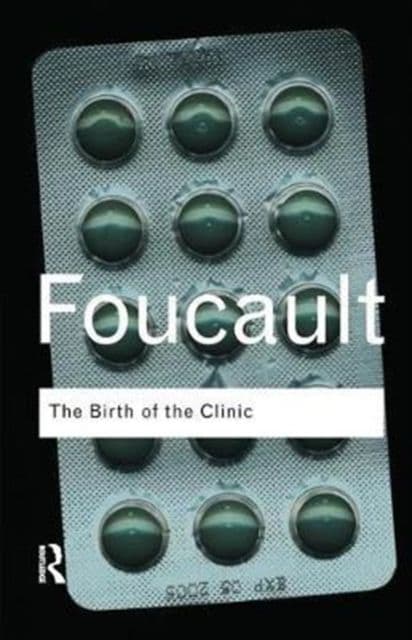
The Birth of the Clinic: An Archaeology of Medical Perception
Foucault's archaeology argues that modern medicine was born not from the discovery of new facts but from a transformation in the physician's 'gaze' (regard). The central claim is that around the turn of the nineteenth century, medical perception shifted from classifying diseases by their place in a nosological table to localizing them within the individual patient's body, made possible by pathological anatomy and the clinic as a teaching hospital. This new clinical gaze treated the body as a surface to be read, producing the patient as an object of knowledge and the physician as a figure of power.
Key Insights
✦What is the 'medical gaze,' and what specific historical shift does it describe?
The medical gaze (regard médical) is Foucault's term for the way physicians perceive the patient and disease. It is not a neutral act of seeing but a historically shaped mode of perception that determines what is visible and what counts as a symptom. Foucault argues that in the late eighteenth century, physicians ceased asking 'What is the matter with you?' and began asking 'Where does it hurt?' . This shift localized disease within the body rather than classifying it by its place in a table of nosological categories. The gaze was made possible by pathological anatomy, which allowed doctors to correlate symptoms with lesions found in organs after death, and by the clinic as a site where patients were observed, taught over, and made visible to medical knowledge .
✦How does the English translation differ from the French original, and why does this matter for readers?
A.M. Sheridan Smith's English translation is a hybrid text. It draws paragraphs from both the first French edition of 1963 and the second, revised edition of 1972, because no complete English translation based entirely on either edition existed at the time . This means Anglophone readers encounter a composite version that does not correspond exactly to any French text Foucault authorized. The translation also made controversial choices: Sheridan rendered 'regard' as 'gaze' (a term one early reviewer found comically close to 'gawk') and coined adjectives like 'tissual' from 'tissue' . Readers should know they are encountering a mediated text, not a transparent rendering of the French original.
✦How was the book received by Anglophone reviewers, and what criticisms were made of its style?
Reception was sharply divided. Peter Caws, reviewing in The New Republic, called the prose acerbic and complained that 'all one can do is grit one's teeth' while reading it, though he conceded there were 'plenty of reasons to read this book' . Alfred Aronson in The Yale Review found it 'extraordinarily difficult to read' while crediting Foucault with attempting a 'minor revolution in medical-history writing' . Roger Hahn in the American Journal of Sociology called it 'a terrible book' that was 'terribly annoying' for its impressionistic style and 'faulty construction,' yet also 'terribly perceptive and suggestive,' concluding it was 'closer to a work of modern art than to a sociological treatise' . The stylistic difficulty, in other words, was inseparable from the book's interpretive ambition.
✦How has later historical scholarship challenged Foucault's chronology of the clinic's birth?
Ronan de Calan has argued that the 'new history of the clinic,' developed mainly after Othmar Keel's 2001 study, 'invites scholars to turn upside down the chronology adopted by Michel Foucault' . De Calan contends that the clinic was not a creation of the Enlightenment or of the late eighteenth-century clinical gaze Foucault describes. Rather, clinical medicine drew on an earlier seventeenth-century medical empiricism, and the clinic existed before the epistemological rupture Foucault posits. If this revisionist chronology is correct, then the clinical empiricism Foucault attributes to the Birth of the Clinic cannot have the characteristics he assigns it. This does not invalidate Foucault's philosophical argument about the gaze, but it complicates the book's status as historical narrative.
✦What is the relationship between this book and Foucault's earlier Madness and Civilization?
The Birth of the Clinic continues the archaeological method of Madness and Civilization but shifts the object of analysis from madness to medicine. Both books trace a rupture in the Classical Age's organization of knowledge and confinement, and both are concerned with how reason constitutes itself by excluding or objectifying its Others. In Madness, the asylum is the institution; in The Birth of the Clinic, it is the hospital and the anatomical theater. The later book is more technical and less polemical, focusing on the conditions of medical perception rather than on the moral exclusion of the mad. But the fundamental question remains the same: how do historically specific practices produce the objects they claim merely to observe?
✦How does the book relate to The Order of Things, published three years later?
The Birth of the Clinic is an archaeological study of a specific domain—medicine—while The Order of Things (1966) offers a broader archaeology of the human sciences as a whole. The later book's analysis of the Classical episteme of representation and the modern episteme of 'man' provides the theoretical framework within which the clinical gaze can be understood as one instance of a more general transformation in the conditions of knowledge. Foucault himself described the three books—Madness and Civilization, The Birth of the Clinic, and The Order of Things—as a series of archaeological explorations, each cutting into a different domain of discourse. Readers seeking the theoretical vocabulary that underpins the clinic study should turn to The Archaeology of Knowledge (1969), where Foucault systematizes the method.
Wealthy Psyche is an intellectual archive. We do not host, distribute, or sell book copies — physical or digital. We provide structured knowledge to help you think better, faster.