


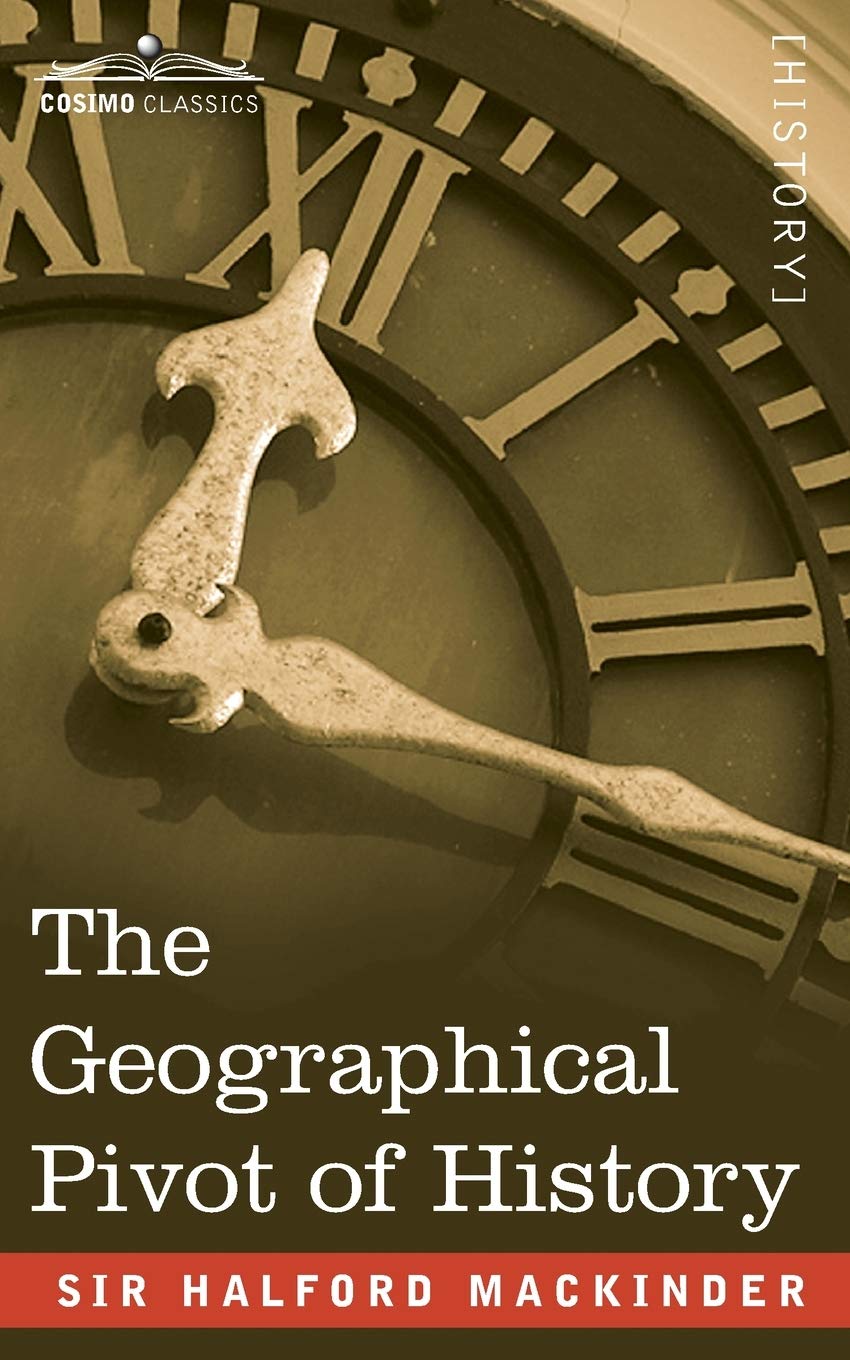
The Geographical Pivot of History
 Halford John Mackinder
Delivered to the Royal Geographical Society in 1904, Mackinder's paper argued that the age of maritime dominance was ending. Railroads had made the Eurasian interior—the 'Pivot Area' or Heartland—a cohesive strategic space with vast resources, beyond the reach of sea power. The central claim: a single power controlling this interior could dominate the World-Island (Eurasia) and thereby the globe. Mackinder framed geopolitics as a closed system where land power and sea power vied for control of finite strategic space.
Key Details
Related Books
View AllSimilar books from the same category, ranked by shared topics and reader engagement.

Key Insights — Read in 10 Minutes
What specific concept did Mackinder introduce in this paper, and how did it differ from his later work?
In the 1904 paper, Mackinder introduced the term 'Pivot Area' to describe the interior of Eurasia—the Arctic-draining river basins and internal drainage regions inaccessible to sea power. He adopted the term 'Heartland' later, in his 1919 book Democratic Ideals and Reality, where he also formulated the famous three-part dictum about East Europe, the Heartland, and the World-Island. The 1904 paper focused on the geological and technological basis of the argument; the later work was more explicitly prescriptive for British policy.
How did Mackinder's argument relate to Alfred Thayer Mahan's theory of sea power?
Mackinder's paper was partly a response to Mahan's thesis that naval dominance determined world history. Mackinder argued that the railroad and other technologies had ended the 'Columbian epoch' of unchallenged maritime supremacy. However, scholars have criticized the popular framing of Mahan and Mackinder as opposing theorists. Their worldviews were more shared than contradictory: both analyzed the strategic rivalry between maritime trading states and continental territorial powers. Mahan even read and commented on Mackinder's paper, initially identifying Russia as the primary threat.
What was the Royal Geographical Society's response when Mackinder first presented this paper?
The paper was delivered on 25 January 1904 and published in The Geographical Journal that April. The discussion that followed included commentary from figures such as Spencer Wilkinson and Thomas Holdich. Contemporary strategists and scholars debated whether Germany or Russia represented the greater threat to the Heartland. Admiral Mahan, present in the audience or commenting shortly after, called it a 'remarkable' paper. The discussion reflects that the paper was immediately taken as a serious strategic contribution.
Has the Heartland thesis been validated or refuted by events since 1904?
The record is mixed. Nazi Germany twice attempted to control Eastern Europe and the Russian interior, and the West intervened both times to prevent this—behavior consistent with Mackinder's logic. During the Cold War, containment policy was partly shaped by his framework. However, no single power has ever achieved the territorial control Mackinder feared. Critics also argue that air power, nuclear weapons, and economic interdependence have undermined the geographical determinism at the paper's core. The thesis remains influential more as a framework for analysis than as a predictive map.
Why do critics describe the paper as geographically deterministic or oversimplified?
One critique holds that Mackinder treated geography as destiny, minimizing political, economic, and technological factors that also shape world power. He equated power potential with sheer territorial extent, which critics note is problematic for regions like Siberia or the Sahara. His use of the Mercator projection has also been criticized for distorting distances and exaggerating the Heartland's isolation. More fundamentally, the binary division of the world into land power and sea power has been called a simplification that obscures the complexity of international relations.
Why does this paper remain cited in discussions of China's Belt and Road Initiative?
The BRI's infrastructure corridors across Central Asia and toward Europe evoke Mackinder's vision of a connected Eurasian interior. Some scholars interpret the BRI as a contemporary realization of Heartland logic, particularly given China's westward expansion into areas Mackinder identified as strategically pivotal. However, applying Mackinder this way is contested. His framework assumed a single power controlling the Heartland militarily; the BRI operates through trade, investment, and infrastructure rather than territorial conquest. Critics warn against reading a 1904 paper as prophecy for twenty-first-century economic statecraft.
Wealthy Psyche is an intellectual archive. We do not host, distribute, or sell book copies — physical or digital. We provide structured knowledge to help you think better, faster.