


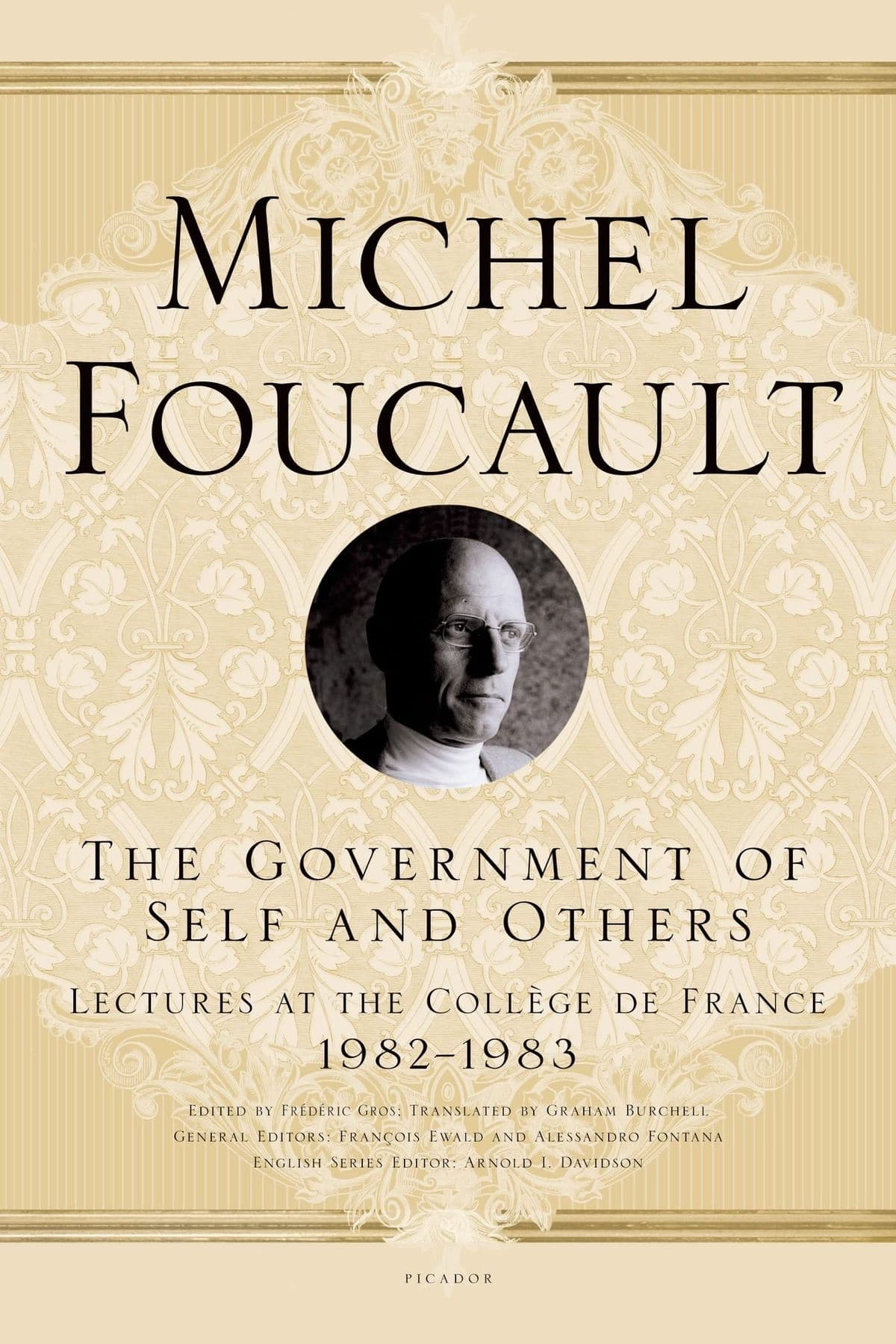
The Government of Self and Others: Lectures at the Collège de France, 1982–1983
Foucault's 1983 lectures inaugurate his inquiry into parrhesia—frank, fearless truth-telling—as the forgotten ethical foundation of Athenian democracy and the hinge between philosophy and politics. The central claim is that parrhesia is not mere free speech but a risky act in which the speaker binds himself to truth and exposes himself to danger, thereby constituting himself as a truth-teller. Through readings of Kant, Euripides' Ion, and Plato's Seventh Letter, Foucault constructs a figure of the philosopher who tests political reality through critique and transforms the self through the practice of truth.
Key Insights
✦What is parrhesia, and why does Foucault treat it as more than just free speech?
Parrhesia is Greek for frank or fearless speech, but Foucault insists it is not reducible to the legal right of isegoria—the equal right to speak in the assembly. Parrhesia is a practice defined by risk: the speaker says what he believes to be true, binds himself to that conviction, and exposes himself to danger (exile, punishment, death) for having spoken . It is also agonistic rather than pedagogical or rhetorical: the parrhesiast does not demonstrate or persuade but hurls the truth at the powerful. Foucault's central interest is in the conditions under which such speech becomes possible and what it does to the speaker. Parrhesia constitutes the speaker as a truth-teller through the act of enunciation itself, making it a technique of ethical subjectivation .
✦Why does Foucault begin the course with Kant's 'What is Enlightenment?', and how does that connect to Greek parrhesia?
The Kant lecture is not a historical prelude but a framing device. Foucault reads Kant's essay as an act of philosophical critique that reflects on the present—on 'the Revolution' as a sign of humanity's aspiration for political self-determination—and on the philosopher's own membership in a 'we' . This modern philosophical practice of critique, Foucault argues, is the heir to ancient parrhesia: philosophy tests political reality, refuses flattery, and constitutes the subject through the courage of truth . The course thus traces a lineage from Athenian democratic truth-telling to the modern philosopher's critical relation to his own present. The Kant lecture establishes that the problem of parrhesia is not antiquarian but concerns what philosophy is and does.
✦How do the Euripides and Plato readings function in the argument about democratic parrhesia?
Euripides' Ion explores parrhesia in the context of Athenian democracy: Ion, a 'nobody' who discovers his Athenian citizenship, can enter the agonistic game of truth-telling and thereby exercise influence over public affairs . Foucault uses the tragedy to show that democratic parrhesia is not merely a right but a practice that introduces a kind of inequality—whoever can truthfully persuade becomes influential—without undermining the constitutional equality of isegoria. The Plato Seventh Letter reading marks a shift: with the decadence of the cities, the courage of truth transforms from addressing the democratic assembly to addressing the soul of the Prince, becoming a personal counsel rather than a public act . Together they trace the trajectory of parrhesia from democratic politics to philosophical pedagogy.
✦What is the editorial history of these lectures, and how does the published text relate to what Foucault actually delivered?
The lectures were delivered at the Collège de France in January–March 1983 and were not prepared by Foucault for publication. The edition was established by Frédéric Gros under the direction of François Ewald and Alessandro Fontana, using audio recordings deposited at the Collège de France and the Institut Mémoires de l'Édition Contemporaine . The editors note that the edition reproduces Foucault's spoken words but excludes the written material he used to support his lectures, and that Foucault's notes were consulted with the permission of Daniel Defert . The French edition appeared in 2008 from Gallimard/Seuil, and Graham Burchell's English translation was published by Palgrave Macmillan in 2010 . Readers should treat the text as a transcript of teaching, not a finished work.
✦How does this course relate to Foucault's other late lecture courses on truth-telling?
The 1983 course is the central panel of a triptych. The 1981–82 course, The Hermeneutics of the Subject, established the framework of the care of the self and the practices through which subjects constitute themselves ethically . The 1983 course, The Government of Self and Others, turns to parrhesia as the political and ethical practice of truth-telling that connects the care of the self to the government of others. The 1984 course, The Courage of Truth, continues the inquiry into parrhesia, focusing on the Cynic tradition and the philosophical life as a test of truth. Together, these courses represent Foucault's final project: a genealogy of the truth-telling subject that links ancient practices to the modern philosopher's critical function. The 1983 course is indispensable for understanding the political dimension of that project.
✦Does the course offer a theory of the philosopher's political role, or is it primarily historical?
It offers both, though the theory is enacted rather than stated. Foucault is not simply reconstructing ancient debates; he is constructing a figure of the philosopher 'in whom he recognizes himself'—a philosopher whose practice is defined by critique, by the courage to tell the truth against flattery and illusion, and by the transformation of the subject through the exercise of truth . The closing passages of the course, quoted in the French edition's summary, describe modern philosophy as a practice that tests its reality against politics, finds its truth-function in critique, and constitutes itself through ascetic self-transformation. This is Foucault's most direct statement of what he took philosophy to be. The course is thus a historical inquiry that is simultaneously a self-definition, a philosopher's account of his own activity.
Wealthy Psyche is an intellectual archive. We do not host, distribute, or sell book copies — physical or digital. We provide structured knowledge to help you think better, faster.