


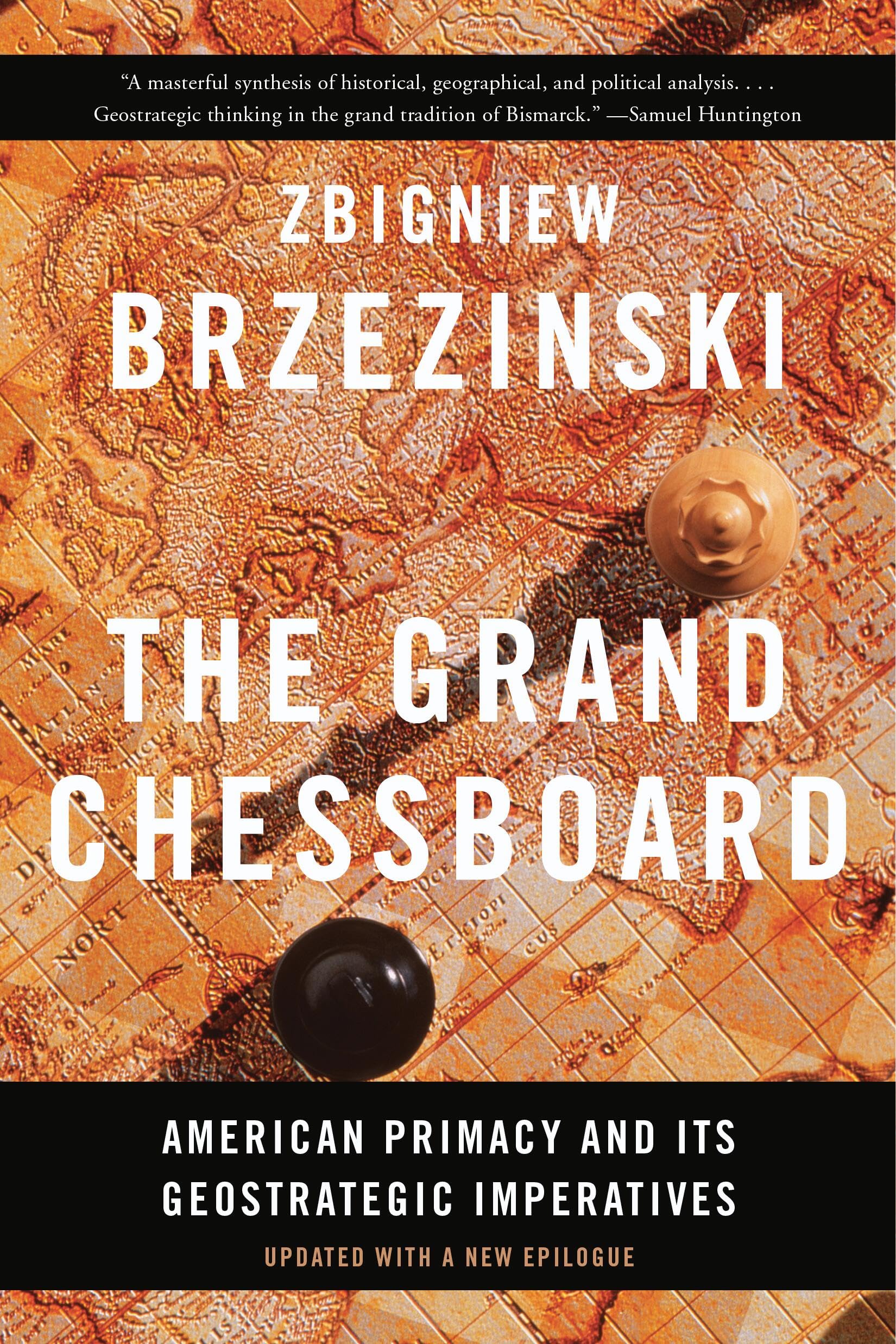
The Grand Chessboard: American Primacy and Its Geostrategic Imperatives
 Zbigniew Kazimierz Brzezinski
Brzezinski argues that the United States, as the first non-Eurasian global power, must actively manage the Eurasian landmass — the 'grand chessboard' — to prevent any rival from dominating it. He identifies 'geostrategic players' (France, Germany, Russia, China, India) and 'geopolitical pivots' (Ukraine, Azerbaijan, South Korea, Turkey, Iran) whose alignment determines the continental balance. The central mechanism is not conquest but 'strategic management': co-opting allies, dividing rivals, and securing key pivots so that no anti-hegemonic coalition can form. Ukraine's independence, he contends, is the critical variable preventing Russia's reconstitution as an imperial power.
Key Details
Related Books
View AllSimilar books from the same category, ranked by shared topics and reader engagement.

Key Insights — Read in 10 Minutes
What specific framework did The Grand Chessboard introduce, and how is it used today?
Brzezinski introduced a two-tier vocabulary for analyzing Eurasian power: 'geostrategic players' (states with capacity and will to reshape the regional order — France, Germany, Russia, China, India) and 'geopolitical pivots' (states whose geography makes them gateways to larger regions — Ukraine, Azerbaijan, South Korea, Turkey, Iran) . Contemporary analysts routinely invoke these categories when assessing alliance dynamics in the Indo-Pacific, Black Sea, and Caucasus regions, even when they reject the normative American-primacy assumption underlying the framework.
How does Brzezinski's argument differ from Mackinder's Heartland thesis?
Mackinder located the pivot of global power in the Eurasian interior — the Heartland — and viewed the coastal rim as secondary. Brzezinski, writing after the Soviet collapse, retained the chessboard metaphor but shifted emphasis to 'strategic management' of the entire Eurasian landmass from outside. Unlike Mackinder's deterministic geography, Brzezinski's argument is policy-prescriptive: the U.S. must actively shape outcomes through alliance-building, institutional integration, and selective intervention, rather than simply defending a geographic chokepoint .
Is it accurate to say The Grand Chessboard directly inspired Putin's invasion of Ukraine?
That claim overstates the evidence. Brzezinski did predict a crisis window of roughly 2005–2010 if Ukraine moved toward NATO . Russian officials have cited the book as proof of American intentions to encircle Russia. However, Brzezinski himself held no government position when he wrote it, and the book is a policy recommendation, not a covert plan. The more defensible reading is that both Brzezinski's analysis and Putin's actions reflect a shared recognition of Ukraine's structural significance — not that the book caused the war.
What did contemporary reviewers identify as the book's main weaknesses?
Helmut Schmidt, reviewing in Die Zeit in October 1997, argued Brzezinski underestimated economic dynamics and the future weight of China, Black Africa, and Latin America, while neglecting the global role of Islam and Hinduism . Craig Snyder, reviewing for H-Teachpol, noted the book reads more like an extended policy essay than a scholarly work — light on references, with unexamined theoretical assumptions . These critiques have aged unevenly: China's rise confirms Schmidt's concern, while the book's influence on policy discourse has vindicated its practical relevance.
How has the book's core thesis held up given subsequent U.S. foreign policy failures?
The thesis that U.S. primacy depends on managing Eurasia has been complicated by the Iraq War, Afghanistan withdrawal, and the rise of a China-Russia partnership that Brzezinski himself flagged as the most dangerous scenario — a coalition of 'complementary grievances' . Critics argue the U.S. squandered the post-Cold War moment Brzezinski described. In a 2012 book, Brzezinski conceded that America wasted the opportunity to shape Eurasia and faced a 'considerably more challenging' environment . The framework's diagnostic value persists even as its prescription has grown harder to execute.
What role does Brzezinski assign to Ukraine, and why does it matter beyond the Russia relationship?
Brzezinski treats Ukraine as the single most consequential geopolitical pivot on the Eurasian chessboard. His argument is structural: without Ukraine, Russia cannot reconstitute itself as a Eurasian empire; with it, Russia regains the demographic, industrial, and geographic depth to challenge American primacy . He also predicted that Russia's choice between European integration and imperial revival would crystallize in the 2005–2015 decade — a forecast that roughly matched the Orange Revolution and the 2014 annexation of Crimea . This specific, checkable prediction is what drives continued interest in the book.
Show 1 more insights
Why did Brzezinski consider America 'the last' global superpower?
Brzezinski argued that American primacy rested on a unique convergence: military reach, economic dynamism, technological leadership, and cultural influence, combined with a network of institutions (NATO, IMF, WTO) that embedded allied dependence . But he also saw this configuration as historically transient. As other powers develop, the structural advantages that enabled sole superpower status erode. His conclusion — that America is 'the first and only truly global superpower, but also the last' — was not a prediction of imminent decline but a claim that the conditions permitting single-power hegemony were historically exceptional and unlikely to recur .
Wealthy Psyche is an intellectual archive. We do not host, distribute, or sell book copies — physical or digital. We provide structured knowledge to help you think better, faster.