


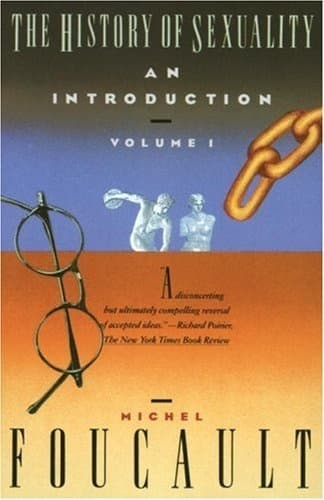
The History of Sexuality, Vol. 1: An Introduction
Foucault's central argument is that sexuality is not a natural drive that power represses but a historical 'dispositif'—a system of discourses, institutions, and practices that produces sex as a problem to be known, managed, and confessed. The book's distinctive mechanism is the inversion of the repressive hypothesis: the Victorian era did not silence sex; it multiplied discourses about it, inciting confession and scientific classification. Power, on this account, is productive rather than prohibitive, and the 'truth of sex' it elicits becomes the mechanism through which modern subjects are constituted and governed.
Key Insights
✦What is the repressive hypothesis, and why does Foucault reject it?
The repressive hypothesis is the widely accepted view that Western societies since the seventeenth century have progressively silenced sex, confining it to the private sphere of the married couple and subjecting it to taboo and censorship. Foucault rejects this narrative on empirical and theoretical grounds. Empirically, the Victorian era saw an explosion of discourses about sex—medical, psychiatric, pedagogical, and legal—that incited people to speak about it, classify it, and confess it. Theoretically, the hypothesis assumes power is prohibitive, when Foucault argues power is productive: it generates the very domain it claims to repress. The repressive hypothesis is not false because repression never happens; it is false as an account of how power operates on sexuality, which is through incitement, not silence.
✦What is the 'dispositif of sexuality,' and how does it differ from the 'dispositif of alliance'?
The dispositif of alliance is the older system of kinship rules, marriage, and inheritance that governed sexual relations in feudal and early modern societies. It is a system of prohibitions and obligations centered on the family as a unit of reproduction. The dispositif of sexuality is the modern system that emerged alongside capitalism, biopower, and the human sciences. It does not simply regulate sex through law; it produces sex as a domain of truth and identity through confession, medical examination, and scientific classification. The dispositif of sexuality operates through four strategic sets: the hysterization of women's bodies, the pedagogization of children's sex, the socialization of procreative behavior, and the psychiatrization of perverse pleasure . The family becomes the hinge between the two dispositifs, transmitting the older alliance structure while serving as the primary site where sexuality is incited and confessed.
✦What is biopower, and how does it relate to sexuality in this volume?
Biopower is Foucault's term for the form of power that emerged in the eighteenth century, concerned with managing populations—their health, birth rates, mortality, and vitality—rather than merely disciplining individual bodies. Sexuality is a privileged object of biopower because it sits at the intersection of individual discipline and population regulation: sexual conduct must be monitored and managed for the health of the social body. Foucault argues that the dispositif of sexuality developed as an instrument of biopower, making sex a matter of public concern, scientific investigation, and state administration . This is why the Victorian era did not silence sex: it intensified discourse about it precisely because sex was becoming a vector of power over life. The volume's final chapter argues that this shift from sovereignty to biopower is one of the most significant transformations in the history of power.
✦Why does Foucault emphasize confession as a mechanism of power?
Foucault argues that confession is the central technique through which Western societies produce truth about sex. Since the Middle Ages, confession has evolved from a religious ritual of penance into a secular practice of self-revelation—in psychoanalysis, medicine, education, and popular culture. The confession does not merely reveal a pre-existing truth; it incites the subject to produce truth about itself, and in doing so, constitutes that subject as a being with a hidden sexual identity. Foucault calls this the 'confessional animal'—modern subjects are compelled to tell the truth about their desires, and this compulsion is a mechanism of power. The confession is productive, not repressive: it creates the very interiority it claims to discover.
✦How was the book received on publication, and how has its reputation changed?
The book was published in France in 1976 and translated into English in 1978 by Robert Hurley for Pantheon . Its reception was electrifying, particularly in the Anglophone world, where it became a foundational text for queer theory and gender studies. Critics in history and classics departments challenged its sweeping historical claims and its reliance on programmatic arguments rather than detailed archival research. Some argued that Foucault's account of the Victorian era was itself a caricature, and that the repressive hypothesis was never as dominant as he claimed. The book's reputation has remained high, but its status has changed: it is now read less as an empirical history than as a theoretical intervention that reframed the questions scholars ask about sexuality, power, and the subject.
✦What is the textual and editorial history of the volume, and how does it relate to the rest of Foucault's project?
Volume One was published as an introduction to a projected six-volume history that Foucault never completed in its original form. The original plan traced the history of sexuality from the sixteenth century to the present, with volumes on the hysterical woman, the masturbating child, the Malthusian couple, and the perverse adult as focal points . After an eight-year silence, Foucault reoriented the project toward antiquity, publishing The Use of Pleasure and The Care of the Self in 1984. The published Volume One thus sits awkwardly in the completed project: it announces a history that was never written in the form promised. Its final chapter, on biopower, was intended as a transition to the volumes on the modern period. Readers should treat the book as both a standalone theoretical statement and the incomplete first panel of a transformed project.
Wealthy Psyche is an intellectual archive. We do not host, distribute, or sell book copies — physical or digital. We provide structured knowledge to help you think better, faster.