


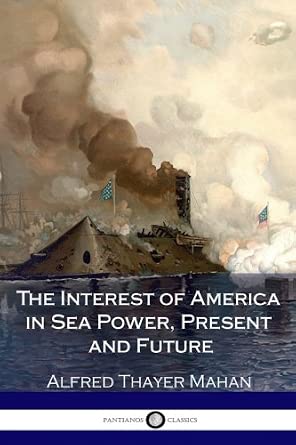
The Interest of America in Sea Power, Present and Future
 Alfred Thayer Mahan
This 1897 collection of essays marked Mahan's shift from historical analysis to direct advocacy for American naval expansion. The book's central argument is that the United States must acquire strategic insular and littoral bases—Hawaii, the Caribbean, and an isthmian canal—to project power across two oceans and protect the sea lanes upon which national prosperity depends. Mahan framed this expansion not as territorial conquest but as the necessary infrastructure of sea power: coaling stations, naval bases, and control of maritime chokepoints. The essays were written for a general audience, urging Americans to embrace their maritime destiny.
Key Details
Related Books
View AllSimilar books from the same category, ranked by shared topics and reader engagement.

Key Insights — Read in 10 Minutes
How did Mahan's argument shift from his earlier historical works to The Interest of America in Sea Power?
The Influence of Sea Power upon History (1890) and its 1892 sequel were historical studies demonstrating sea power's role in past conflicts. The Interest of America in Sea Power, published in 1897, is prescriptive rather than historical. Mahan moves from analyzing what sea power accomplished in the past to advocating what the United States must do in the present: acquire Hawaii, build an isthmian canal, establish Caribbean naval bases, and fund a modern battle fleet. The shift reflects Mahan's growing role as a public advocate, not merely a naval historian.
What specific territories and strategic positions did Mahan argue the United States needed, and why?
Mahan argued for the annexation of Hawaii as a mid-Pacific coaling station and naval base essential for defending the West Coast and projecting power toward Asia. He advocated for Caribbean footholds—Cuba and Puerto Rico—to secure the approaches to a future Central American canal. He also stressed the strategic importance of the Gulf of Mexico and the Caribbean Sea as an 'American Mediterranean' that the United States must control. These positions, he argued, were not imperial luxuries but necessary infrastructure for any nation seeking sea power and global commercial access.
Why did Mahan believe a Central American canal was so important to American sea power?
For Mahan, a canal across the Isthmus would transform the United States into a two-ocean power, enabling rapid concentration of naval forces between the Atlantic and Pacific. Without a canal, the U.S. Navy would be divided between two coasts and incapable of decisive action in either theater. The canal would also enable American commercial vessels to compete more effectively in Asian markets. Mahan saw control over the canal's approaches—the Caribbean and the Gulf of Mexico—as inseparable from the canal itself. This argument directly shaped American policy toward Central America in the following decade.
How does The Interest of America in Sea Power differ from Alfred Thayer Mahan's earlier historical works?
The Influence of Sea Power upon History (1890) and its 1892 sequel were historical studies demonstrating sea power's role in past conflicts. The Interest of America in Sea Power, published in 1897, is prescriptive rather than historical. Mahan moves from analyzing what sea power accomplished in the past to advocating what the United States must do in the present: acquire Hawaii, build an isthmian canal, establish Caribbean naval bases, and fund a modern battle fleet. The shift reflects Mahan's growing role as a public advocate, not merely a naval historian.
How was the book's argument received, and what influence did it have on American policy?
The essays, originally published in magazines such as the Atlantic Monthly and Harper's, were written to build public support for naval expansion. Mahan's friend and admirer Theodore Roosevelt, then Assistant Secretary of the Navy, was already sympathetic to these views. The Spanish-American War of 1898 and the subsequent acquisition of Hawaii, Puerto Rico, Guam, and the Philippines largely realized Mahan's program. He served as a naval advisor to Roosevelt during the war. The book's lasting significance is as a manifesto for the strategic vision that guided American expansion at the turn of the century.
Was Mahan's vision of American sea power primarily about commerce or military strategy?
Mahan subordinated commerce to strategy. Scholars have noted that when he defended the 'Open Door' policy in China, his motives were political and security-related, not commercial. He valued overseas bases for their strategic advantages—coaling, repair, and projection—more than for their direct economic benefits. This reflects the primacy of security and foreign policy considerations in Mahan's thought. The merchant marine mattered because it supported the navy, not as an end in itself. His vision was fundamentally strategic: sea power as the foundation of national security and great-power status.
Show 1 more insights
What were the main criticisms of Mahan's navalist prescriptions?
Critics argued Mahan treated geography and naval power as deterministic, neglecting economic, technological, and political factors. His emphasis on the decisive fleet battle was challenged by Julian Corbett, who argued command of the sea was rarely absolute and could be contested through blockade and cruiser warfare. Some scholars noted his neglect of technological change, particularly the submarine's future threat to commerce. Business interests in the 1890s were initially hostile to expansion, fearing its costs. Mahan's territorial program was also limited: he prioritized strategic positions like Hawaii over broader imperial conquest.
Wealthy Psyche is an intellectual archive. We do not host, distribute, or sell book copies — physical or digital. We provide structured knowledge to help you think better, faster.