


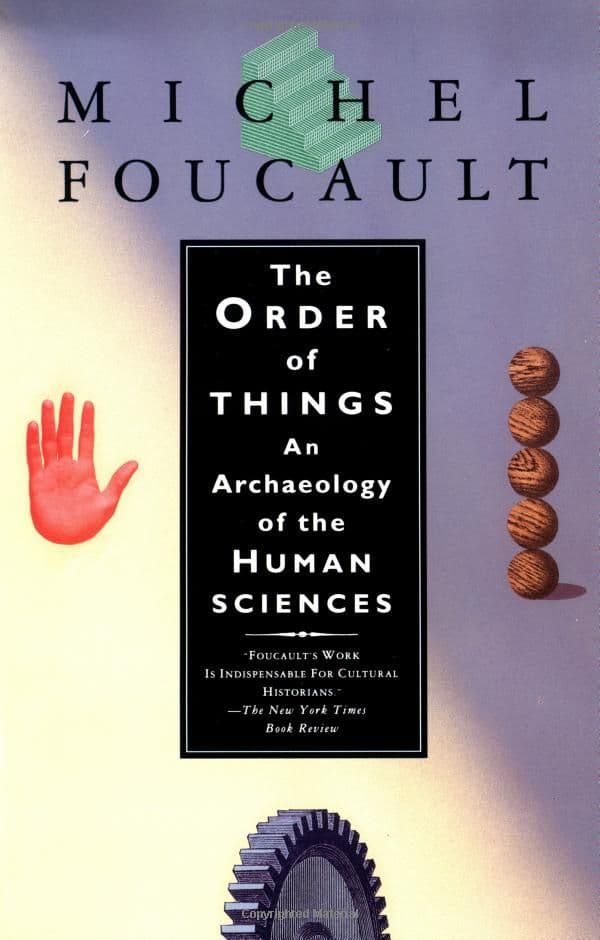
The Order of Things: An Archaeology of the Human Sciences
Foucault's central argument is that every historical period is governed by an episteme—a deep set of assumptions about what can count as truth and discourse—that determines what is thinkable and sayable in the human sciences. The book traces two radical ruptures: from the Renaissance episteme of resemblance, to the Classical episteme of representation and taxonomy, to the Modern episteme in which 'man' emerges as both the subject and object of knowledge. The distinctive mechanism is archaeological analysis: Foucault does not explain change by discovery or progress but by mutations in the deep structure of knowledge itself .
Key Insights
✦What is an episteme, and how does it differ from Kuhn's paradigm?
An episteme is the underlying set of assumptions that defines what counts as truth, what can be conceptualized, and what is acceptable discourse in a given historical period . Foucault analyzes three: Renaissance (resemblance), Classical (representation and taxonomy), and Modern (the emergence of 'man'). The concept is often compared to Thomas Kuhn's paradigm, but the comparison is imperfect. Kuhn limited his analysis to the natural sciences; Foucault applied a similar notion of discontinuous rupture to the human sciences . More importantly, where Kuhn's paradigm is a scientific achievement that organizes research, Foucault's episteme is a deeper, more anonymous structure that operates beneath the conscious awareness of thinkers, determining the very space in which their ideas can take shape.
✦Why does Foucault say 'man' is a recent invention, and what does he mean by the 'end of man'?
Foucault argues that in the Classical episteme, 'man' did not exist as a distinct epistemological object. Thinkers discussed the mind, the body, and the human being, but they did not constitute 'man' as the subject and object of knowledge in the way modern thought does . The modern episteme, emerging around Kant, produced 'man' as a being who is both the condition of knowledge and an empirical object within knowledge. The famous closing image of the book suggests that 'man' may be nearing its end—not that human beings will disappear, but that the epistemological configuration that makes 'man' the central figure of knowledge may dissolve, as the Renaissance and Classical configurations did before it. Foucault's point is structural, not apocalyptic.
✦What is the significance of the opening analysis of Velázquez's Las Meninas?
The analysis of Las Meninas is not an art-historical digression but a demonstration of the Classical episteme's logic. Foucault describes the painting's complex network of gazes, reflections, and hidden subjects to show how representation is organized in the Classical age: everything is arranged in a space of ordered visibility, but the sovereign subject who would ground that order is absent, reflected only as a shadow in the mirror . The painting thus exemplifies the Classical episteme's structure—representation without a constituting subject—while also marking the threshold where that episteme begins to destabilize. Critics have noted that Foucault deliberately ignores the painting's social context and the artist's biography, treating it as a formal diagram of representational logic rather than a historical artefact .
✦What are the main philosophical criticisms of the book's method?
The most persistent criticism is that Foucault does not problematize his own position: he assumes his archaeology stands outside the epistemic orders he studies, which would make it immune to the very historical determination he claims applies to all thought . This is a version of the empirical/transcendental circularity problem. A related criticism concerns change: if epistemes are anonymous structures that determine what can be thought, how can one episteme give way to another? Foucault's later work turned to power and genealogy partly to answer this question, but in The Order of Things the transition between epistemes remains unexplained . Richard Rorty argued that Foucault's archaeology is fundamentally negative, offering 'brilliant redescriptions' but no positive theory of knowledge .
✦How does the book relate to Foucault's later work on power and genealogy?
The Order of Things is a structuralist-adjacent work that analyzes systems of knowledge without reference to power. Foucault's later work, beginning with Discipline and Punish, shifts to genealogy and explicitly connects knowledge to power: systems of knowledge are tied to regimes of social control and the formation of subjects . The Order of Things implicitly raises the question of what causes transitions between epistemes; Foucault's answer in the later work is power, understood as productive and dispersed rather than repressive and centralized. The later Foucault thus addresses a causal question the archaeological method left open. Readers should treat The Order of Things as the culmination of Foucault's archaeological period, not as a summary of his mature position.
✦What was the book's reception in France and the Anglophone world, and how did it shape Foucault's reputation?
The book was a bestseller in France, an unusual outcome for a dense work of epistemology. Jean-Paul Sartre called Foucault 'the last rampart of the bourgeoisie,' a hostile characterization that nonetheless confirmed his centrality to French intellectual life . In the Anglophone world, the anonymous English translation appeared in 1970 from Tavistock, reviewed in Nature as 'exciting and, up to a point, appealing' while noting the argument's rhetorical rather than analytical character . The book made Foucault famous outside academic philosophy, and its closing image of the 'end of man' became one of the most cited passages in twentieth-century thought. Its reception established Foucault as a public intellectual and set the terms for the debates over structuralism, post-structuralism, and the human sciences that dominated the 1970s and 1980s.
Wealthy Psyche is an intellectual archive. We do not host, distribute, or sell book copies — physical or digital. We provide structured knowledge to help you think better, faster.