


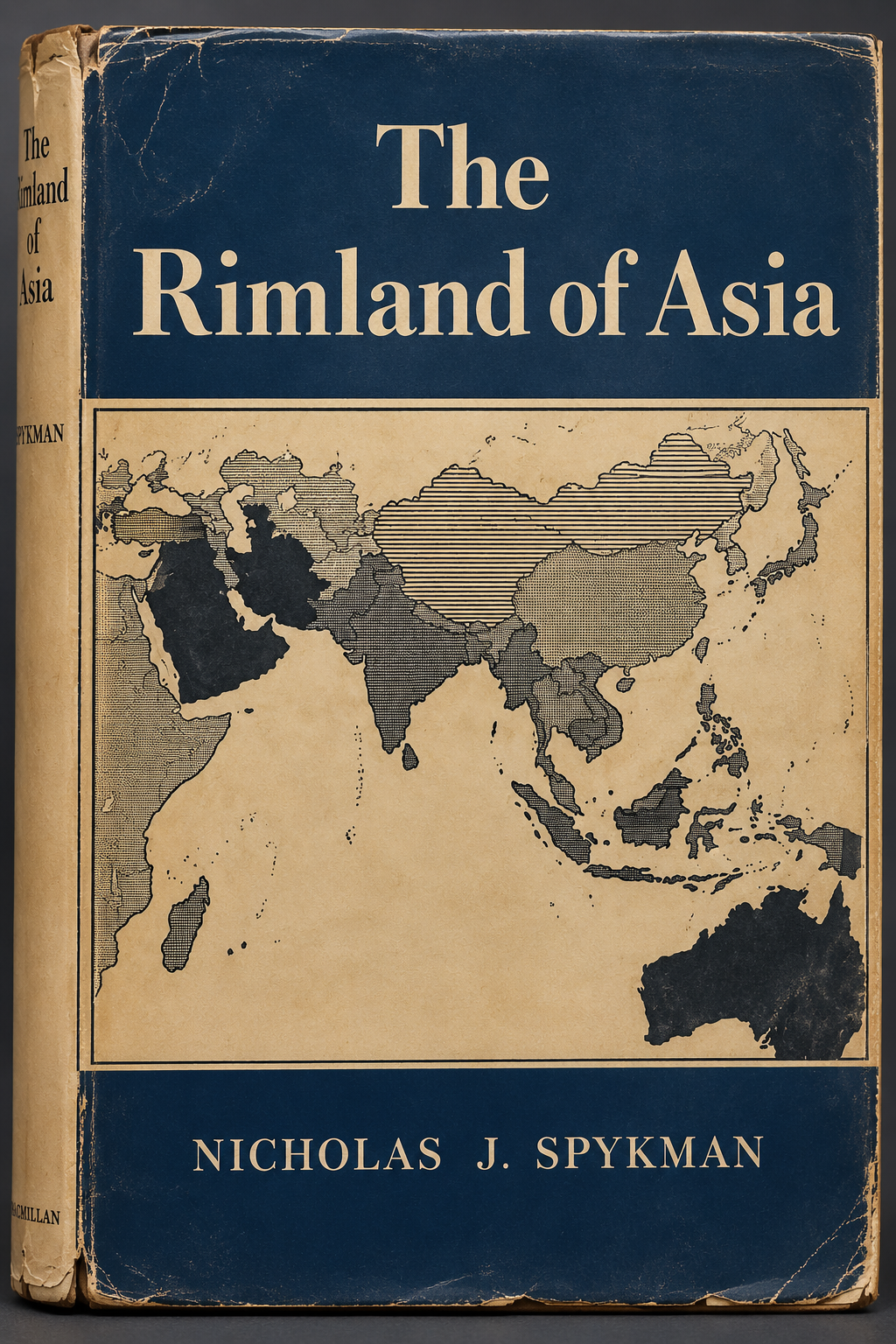
The Rimland of Asia
This work is not a standalone book by Nicholas Spykman but a thematic chapter or extracted essay from his posthumously published 1944 volume The Geography of the Peace. It applies Spykman's Rimland thesis specifically to Asia, arguing that the coastal crescent from the Middle East through India to China and East Siberia—not the Eurasian Heartland—holds the key to continental and ultimately global power. Spykman foresaw China's rise as a continental-maritime power dominating the Asiatic Mediterranean, and urged the United States to maintain a balance of power along this rim to prevent any single state from controlling it.
Key Details
Related Books
View AllSimilar books from the same category, ranked by shared topics and reader engagement.

Key Insights — Read in 10 Minutes
Is 'The Rimland of Asia' a standalone book by Spykman?
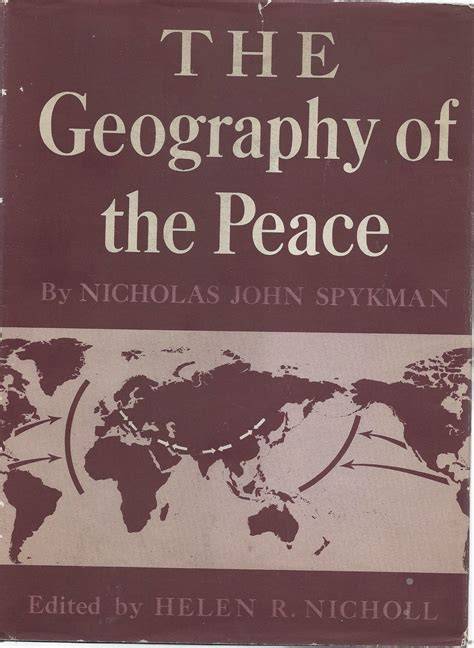
No. The title refers to a section or chapter within Nicholas Spykman's posthumously published 1944 book The Geography of the Peace. That volume was compiled from Spykman's lecture notes and stenographic records after his death in June 1943, with his research assistant Helen Nicholls completing the manuscript. The Asia-focused portion develops his broader Rimland thesis but is not a separate publication. Researchers searching for this title are typically looking for Spykman's specific argument about Asia's coastal rim rather than a distinct monograph.
What is the central argument about Asia in Spykman's Rimland framework?
Spykman argued that the Asian portion of the Rimland—running from the Middle East through India and Southeast Asia to China and East Siberia—holds decisive strategic value because it concentrates population, industrial potential, and access to the marginal seas he called the Asiatic Mediterranean. He contended that a modern, militarized China would dominate this maritime zone, just as the United States dominated the American Mediterranean, and that control of this rim by any single power would threaten the global balance.
How does Spykman's view of Asia differ from Mackinder's Heartland thesis?
Mackinder located the pivot of world power in the interior of Eurasia—the Heartland—and treated the coastal rim as peripheral. Spykman inverted this: he argued the Heartland was a less viable power base due to its agrarian character, transport obstacles, and lack of industrial development. The Rimland, by contrast, concentrated the world's population, resources, and industry, and functioned as the amphibious buffer between land and sea power. For Spykman, whoever controlled the Rimland ruled Eurasia; the Heartland was not the prize Mackinder imagined.
Did Spykman's prediction about China actually come true?
Remarkably, yes—in broad outline. Writing in 1942 when China was a poor wartime ally, Spykman predicted that a modernized, militarized China would become the dominant power in East Asia and threaten Western positions in the Asiatic Mediterranean. He foresaw the fundamental geopolitical logic that later produced the U.S. pivot to Asia, the South China Sea disputes, and the U.S.-China rivalry over maritime access and regional influence. His specific timeline and the balance-of-power mechanisms he prescribed remain debated, but the structural prediction has proven prescient.
What is a common misconception about Spykman's relationship to Cold War containment policy?
Many scholars and textbooks credit Spykman's Rimland theory with directly inspiring George Kennan's containment strategy against the Soviet Union. This attribution is contested. Some researchers argue that containment as actually implemented reflected Mackinder's emphasis on the Heartland as the source of threat, not Spykman's focus on the Rimland. Spykman's policy recommendations—maintaining a balance of power, preserving defeated enemies like Japan as counterweights, and avoiding ideological crusades—diverge in key respects from the universalist anti-communism that containment later became.
Why does Spykman single out the 'Asiatic Mediterranean' as strategically crucial?
Spykman used 'Asiatic Mediterranean' to describe the marginal seas of East Asia—the Sea of Japan, East China Sea, and South China Sea—which control China's access to the Pacific and the sea lanes connecting the Indian and Pacific Oceans. He compared this zone to the Caribbean and the Mediterranean, where control of chokepoints determines commercial and military access. For Spykman, these waters were not merely adjacent to the Asian Rimland; they were the connective tissue that made the Rimland a coherent strategic theater.
Show 1 more insights
How has the Rimland framework been used in contemporary debates about the Belt and Road Initiative?
Analysts regularly invoke Spykman when assessing China's Belt and Road Initiative. The BRI's dual land and maritime corridors are read as an attempt to deepen Chinese influence across the Rimland—through infrastructure, ports, and trade dependencies—without directly controlling territory. Critics of U.S. policy argue that Washington's focus on containing China through alliance networks in the Rimland echoes Spykman's logic, though some contend that contemporary power dynamics involving air, cyber, and economic interdependence exceed what Spykman's geographic framework can capture.
Wealthy Psyche is an intellectual archive. We do not host, distribute, or sell book copies — physical or digital. We provide structured knowledge to help you think better, faster.