



The Social Theory of Georg Simmel
Published in 1925 and based on Spykman's doctoral dissertation, this was the first comprehensive English-language account of Simmel's sociology. Spykman's central argument is that Simmel's method—formal sociology—offers a systematic way to study the recurring forms of social interaction (superordination, subordination, conflict, exchange) independent of their specific content. Spykman traces Simmel's thought through three phases: methodology and the presuppositions of social science, philosophical interpretations of modern culture, and a metaphysics of culture. The book established Spykman's reputation as a sociological theorist before his later shift to geopolitics.
Key Details
Related Books
View AllSimilar books from the same category, ranked by shared topics and reader engagement.

Key Insights — Read in 10 Minutes
Why did Nicholas Spykman, later known as a geopolitician, write a book about Georg Simmel's sociology?
Spykman began his academic career as a sociologist, not a geographer. His doctoral dissertation at the University of Chicago became The Social Theory of Georg Simmel, published in 1925 by the University of Chicago Press . His training in Simmel's conflict functionalism and interactionism provided the intellectual foundation for his later geopolitical realism. Scholars have argued that Spykman's fundamental understanding of world affairs derived from Simmel's theories of social interaction and conflict, which he later transposed onto international politics . The Simmel book is thus not a detour but the seedbed of his mature thought.
What did Spykman argue was Simmel's most important contribution to social theory?
Spykman identified Simmel's conception of sociology as a distinctive science—'formal sociology'—as his key contribution. Simmel argued that sociology should study the forms of social interaction (competition, imitation, division of labor, subordination) abstracted from their specific content. Spykman's book aimed to make this methodology understood and to illustrate Simmel's conception of sociology as a science . He showed that Simmel was primarily a social philosopher interested in a functional understanding of socio-historical realities, and that his work moved through phases from methodology to cultural philosophy to a metaphysics of culture.
How did Simmel's sociology shape Spykman's later geopolitical realism?
Scholars have traced a direct intellectual lineage from Simmel's conflict functionalism to Spykman's realism. Simmel viewed society as a dynamic system of interacting parts, with conflict and competition as normal, productive forces rather than pathologies . Spykman transposed this framework onto international relations: states in an anarchic arena are locked in competitive interaction, and the balance of power is a functional necessity of the system, not a moral choice. His insistence that the struggle for equilibrium must be considered permanent reflects this Simmelian inheritance.
What was the reception of the book when it was first published in 1925?
The book was published by the University of Chicago Press in 1925 and was recognized as the first comprehensive account of Simmel's ideas in English . It established Spykman's scholarly reputation in sociology and led to his appointment at Yale, where he founded the first autonomous Department of International Relations in 1934 . The book was reprinted multiple times, including by Russell & Russell in 1964 and with a new introduction by David Frisby in 2004 . It remains in print and is cited by historians of sociology as a valuable summary of Simmel's thought.
How does this book differ from Spykman's later geopolitical works such as America's Strategy in World Politics?
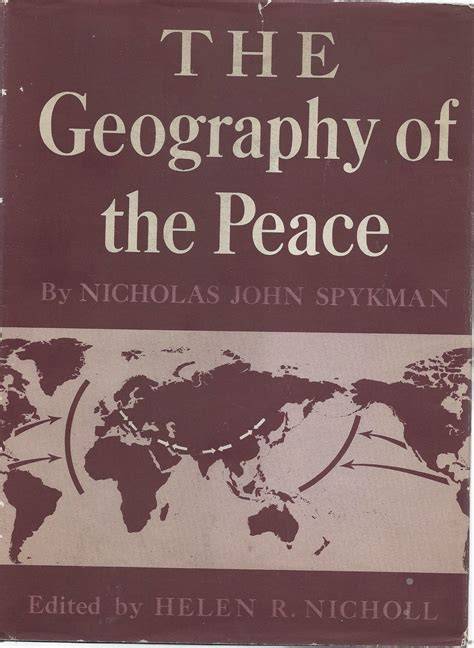
The Social Theory of Georg Simmel is a work of sociological exegesis and methodology, not geopolitics. Its subject is Simmel's formal sociology and the philosophy of social science . By contrast, America's Strategy in World Politics (1942) and The Geography of the Peace (1944) are policy-oriented geopolitical treatises arguing for American engagement in the Eurasian balance of power and introducing the Rimland concept . The 1925 book is abstract and theoretical; the later works are prescriptive and strategic. The continuity lies in the underlying framework—interaction, conflict, and functional balance—but the subject matter and audience are entirely different.
What role did this book play in Spykman's academic career and the founding of Yale's IR department?
The book's success helped establish Spykman as a serious social theorist, and he joined the Yale faculty in the late 1920s. In 1934, he founded Yale's first autonomous Department of International Relations, one of the earliest such departments in the United States . His sociological training informed his approach to teaching international relations, emphasizing systemic interaction and functional analysis rather than legal formalism or moral idealism. The Simmel book was his credential as a theorist; the Yale department was his institutional platform for developing geopolitical realism.
Wealthy Psyche is an intellectual archive. We do not host, distribute, or sell book copies — physical or digital. We provide structured knowledge to help you think better, faster.