

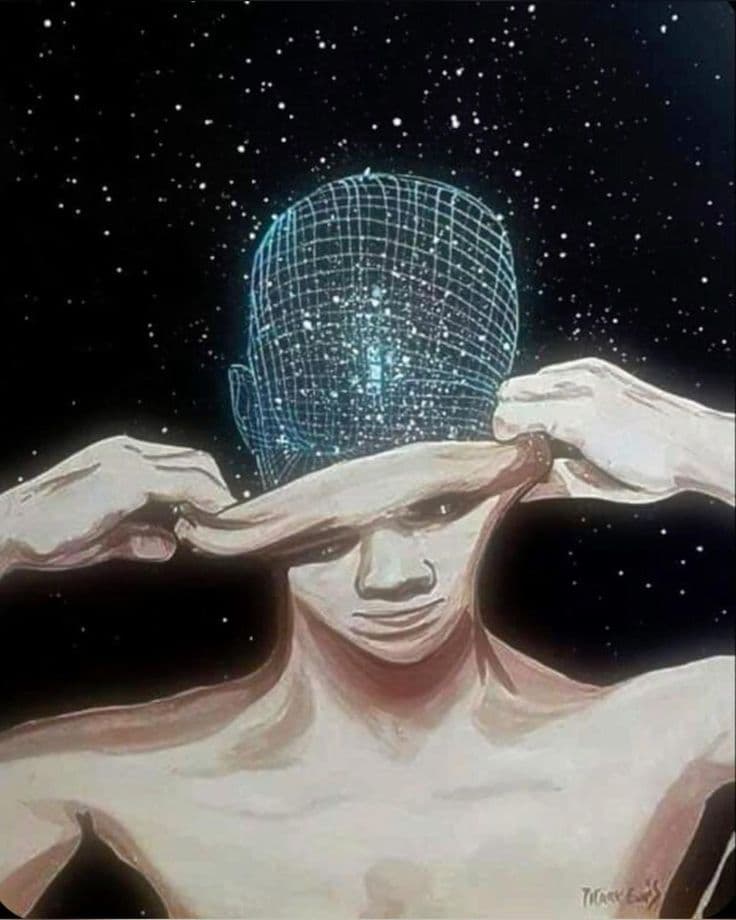
The most sophisticated prison ever built is not made of walls or laws. It is made of thoughts that feel like truths, desires that feel like destiny, and an identity that feels like a self. You wake up each morning already inside a story: who you are, what you lack, what will finally make you whole. That story is the mind. And Advaita Vedanta—perhaps the most radical philosophical scalpel ever forged—does not ask you to improve the story. It asks you to notice that you are not the story at all.
This is not a philosophy of denial or renunciation. It is a philosophy of recognition. The recognition that awareness exists prior to thought, prior to desire, prior to the ache of becoming. And in that recognition, the entire architecture of psychological suffering—including the suffering disguised as ambition—begins to lose its structural integrity.
The Subtle Tyranny of “I’ll Be Happy When”
There is a specific emotional signature to the phrase “I’ll be happy when.” It carries a low-voltage desperation disguised as hope. You have felt it. The next promotion. The next relationship. The next city. The next version of your body. Each time the mind projects fulfillment onto a future moment, it secretly guarantees that fulfillment does not exist now. That is not optimism. That is ontological violence against the present.
The Psychological Mechanism of Deferred Life
When you tell yourself that happiness lies beyond a future achievement, you are not merely planning. You are psychologically abandoning the present. The mind constructs a conditional equation: achieve X, then feel Y. But the brain does not reset after achievement. Dopamine is not a reward for arriving; it is the craving for the next arrival. Neuroscientific research into reward prediction error shows that dopamine release peaks not when you obtain a goal, but when you anticipate it. The attainment itself produces a smaller signal, often followed by a subtle drop—what researchers call the “reward prediction error negativity.”
You experience this as: achievement, then emptiness, then confusion. Then you find a new goal.
Advaita Vedanta describes this not as a failure of willpower but as the natural motion of the ego. The ego is not a thing. It is a movement. A constant reaching toward objects—external or internal—to confirm its own existence. Without desire, the ego feels dissolution. That feeling is precisely what you call fear.
Egoic Desire Cycle | Neurological Correlate | Vedantic Diagnosis |
|---|---|---|
Craving → Anticipation | Dopamine ramp-up | Vasanas (latent tendencies) |
Achievement → Brief satisfaction | Reward prediction error | Temporary sense of completeness |
Habituation → Boredom | Hedonic adaptation | Tamas (dullness, inertia) |
New craving → Repeat | Dopamine reset | Ego reinforcing itself through objects |
Why Achievement Never Delivers What It Promises
You have likely noticed a peculiar asymmetry: the gap between how an achievement feels in imagination and how it feels in reality is not small. It is vast. The imagined promotion comes with a silent orchestra. The real promotion comes with a new spreadsheet and the same inner quiet—or the same inner noise.
The Inevitable Collapse of Projected Fulfillment
This is not pessimism. This is the structure of conditioned consciousness. The mind projects qualities onto objects that those objects do not inherently possess. A luxury car, a corner office, a social media milestone—none of these contain peace. They contain what the mind has poured into them: status anxiety, childhood wounds, cultural scripts, the desperate need to matter. When you finally hold the object, you do not find the feeling you imagined. You find the object. And the feeling you were chasing was never in the object. It was in the relief from the chasing itself.
Advaita Vedanta calls this viveka—discrimination between the real and the apparent. The temporary pleasure of achievement is real as an experience. But it is not the freedom you seek. Freedom is not the absence of goals. It is the absence of dependency on goals for psychological completeness.
The Ego as a Survivor, Not an Enemy
Many spiritual frameworks make the ego into a villain. That is a mistake. The ego is not evil. The ego is a survival strategy that forgot it was a strategy. It emerged evolutionarily to navigate a world of threats and resources. It learned to equate “I am” with “I want,” “I have,” “I am known for.” But the ego’s job was never to make you happy. Its job was to keep you alive and socially functional. Happiness is not its department.
How the Ego Feeds on Desire
The ego does not die when you stop wanting. It panics. Because desire is its fuel. Notice what happens when you sit in silence without a goal, without a scroll, without a plan to improve yourself. Within minutes, a restless energy arises. That restlessness is the ego searching for something to become, something to acquire, something to resist. If no external object is available, it will generate internal objects: a memory to ruminate on, a fantasy to rehearse, a flaw to fix.
Ego Mode | Emotional Flavor | Vedantic Counter |
|---|---|---|
Craving a future outcome | Hopeful anxiety | Self-inquiry: "To whom does this craving arise?" |
Defending an identity | Righteous anger | Witness awareness |
Comparing status | Envy or pride | Recognition of non-duality |
Seeking validation | Performative effort | Resting as awareness |
This is why Advaita Vedanta does not ask you to kill the ego. That would be a battle the ego would win—because the one trying to kill the ego is the ego. Instead, Vedanta asks you to see that you are not the ego. Not in a poetic sense. In a direct, experiential sense. The same way you see that you are not the weather passing through the sky.
Hedonic Adaptation and the Invisible Ceiling of More
The psychological literature on hedonic adaptation is remarkably consistent: major positive events—lottery wins, promotions, marriages—produce a temporary spike in well-being, followed by a return to baseline. The same is true for negative events, though the adaptation is slower. The implications are quietly devastating for the modern success narrative. You can climb infinitely and remain exactly where you started psychologically.
The Neuroscience of the Reset
Your brain maintains a set point for emotional tone, influenced by genetics, early attachment patterns, and chronic stress loads. Every achievement nudges the set point temporarily, but the brain’s homeostatic mechanisms pull it back. This is not a design flaw. It is a design feature for survival. Constant euphoria would be maladaptive—you would stop noticing threats. But the feature becomes a trap when you build an entire identity around chasing the next spike.
Advaita Vedanta’s insight here is older than neuroscience: happiness dependent on conditions is unstable by definition. Ananda (bliss) in Vedanta is not excited pleasure. It is the natural texture of awareness when no longer constrained by craving. It feels quieter than you expect. More like relief than excitement. More like being home than arriving somewhere new.
The Status Game and the Inevitability of Comparison
You cannot escape comparison by winning it. Winning only raises the standard of comparison. The person who becomes CEO now compares themselves to other CEOs. The person who reaches one million followers now worries about two million. The body that achieves the ideal physique now fears losing it. Comparison is not an external game. It is an internal structure of perception. As long as the ego exists as a separate self, it will compare. Not because you are insecure, but because the separate self is constituted by difference.
The Social Validation Loop
Every “like” delivers a microdose of social proof followed by a microdose of withdrawal. The brain’s reward system encodes social validation similarly to food or money. But the loop accelerates because validation is never permanent. Each positive reinforcement raises the threshold for the next one. You need more to feel the same. This is not a personal failing. It is the mathematics of neural adaptation.
Advaita Vedanta observes that seeking validation is seeking the reflection of a self that does not exist as a solid entity. The more you pursue the reflection, the more you reinforce the illusion of a self that needs it. The only exit is not better validation. It is seeing that the one who needs validation is a thought.
Capitalism, Craving, and the Colonization of Attention
Modern economic systems do not merely permit desire. They require it. The engine of consumer capitalism is not production; it is dissatisfaction. An economy of satisfied people is a collapsing economy. This is not a moral critique. It is a structural observation. The system is designed to manufacture a gap between what you have and what you could have, between who you are and who you could become.
The Attention Economy as a Hunger Machine
Social media platforms optimize for one variable: time on screen. The most reliable way to increase time on screen is to induce a low-grade state of desire—for status, for connection, for novelty, for outrage. You are not using these platforms. You are being used as fuel for an attention engine. The craving you feel to check your phone is not a personality flaw. It is a predictable response to an environment engineered for craving.
Advaita Vedanta does not demand you abandon technology. It asks: who is the one that craves? And is that craving-self real, or is it a pattern of conditioned thoughts appearing in awareness?
External Success Metric | Inner Cost | Awareness-Based Alternative |
|---|---|---|
High income | Chronic time scarcity | Sufficiency as a felt sense |
Social media following | Performative identity | Unperformed presence |
Physical perfection | Body as project | Body as temporary guest |
Ownership of luxury goods | Maintenance anxiety | Freedom from possession-identity |
The Emptiness After Achievement: A Diagnostic Signal
If achievement produced lasting fulfillment, every accomplished person would be radiantly peaceful. You have observed the opposite. Many of the most externally successful people you know are also the most restless, the most anxious, the most quietly desperate. This is not hypocrisy. It is evidence. Evidence that the causal model “achievement → fulfillment” is fundamentally incorrect.
What the Emptiness Actually Is
The emptiness after achievement is not a void to be filled. It is the absence of the craving that preceded the achievement. For a moment, the mind pauses. The ego relaxes its reaching. And in that pause, you feel what was always there: awareness without object. But because you have been trained to interpret that openness as loneliness or boredom, you immediately reach for the next goal. You mistake the taste of freedom for a problem to solve.
Advaita Vedanta calls this sakshi—witness consciousness. The emptiness is not empty. It is full of awareness. But you cannot recognize it through the lens of craving. Craving sees only objects. Freedom is the subject.
Healthy Action vs. Psychological Dependency
A critical distinction often lost in spiritual discourse: action is not the enemy. Attachment to the fruit of action is the enemy. The Bhagavad Gita makes this distinction exquisitely. Act without craving for outcomes. But this is easy to mishear as “don’t care about results,” which is both impossible and undesirable. The real meaning is more refined: act from clarity, not from a desperate need for results to complete you.
How to Know the Difference
Ask yourself: if this action led to zero external recognition, would I still want to do it? If the answer is no, you are likely chasing validation. If the answer is yes, you are acting from intrinsic alignment. But even intrinsic alignment can become a trap if you attach your identity to it. The final freedom is action without the sense of “I am the doer.” Not passive inaction. Active presence without egoic ownership.
You can build a company, write a book, train a body, raise a family—all from awareness. The difference is interior. One person climbs the mountain because they believe the summit will finally prove their worth. Another climbs because the climbing is what awareness is doing through them, and the summit is irrelevant to their peace.
Dimension | Egoic Action | Action in Awareness |
|---|---|---|
Motivation | To close a felt lack | Expression of clarity |
Experience of obstacles | Frustration, threat | Information, adjustment |
Response to failure | Identity collapse | Learning, non-attachment |
Response to success | Temporary high, then new craving | Gratitude, then equanimity |
Non-Attachment Is Not Laziness
A common objection: if I stop craving outcomes, won’t I become passive? Won’t I abandon ambition? This objection arises from confusing non-attachment with indifference. Non-attachment is not the absence of care. It is the absence of a contract that says “I must get this specific outcome to be okay.” Indifference says “nothing matters.” Non-attachment says “everything matters, but nothing owns me.”
The Paradox of Release
When you release the desperate grip on a goal, you often perform better, not worse. Anxiety constricts cognitive bandwidth. Fear narrows perception. A mind that is not secretly bargaining with the universe for a specific result has more available intelligence. The best athletes, artists, and leaders describe this state: less trying, more allowing. Less forcing, more flow.
Advaita Vedanta would say: you were never the doer anyway. The illusion of doership is what creates strain. When you see that actions arise from the totality of causes and conditions—including your effort, but not your isolated self—then action becomes effortless. Not lazy. Effortless. Like a river flowing. The river does not try to flow. It flows.
Social Media Success and the Performance of Happiness
Scroll through any platform. You will see carefully curated evidence of other people’s fulfillment. But you are not seeing their inner experience. You are seeing a highlight reel edited for approval. This creates a systematic illusion: everyone else has figured out happiness except you. That belief is a reliable source of suffering. And it is false.
The Double Awareness Gap
First, you compare your messy internal reality to their polished external projection. Second, you perform your own polished projection, widening the gap for others. The entire system produces what sociologists call pluralistic ignorance—everyone believes everyone else is happier, so no one admits the shared emptiness.
Advaita Vedanta offers a radical alternative: stop performing. Not by announcing your authenticity (which is another performance), but by resting in awareness that has nothing to prove. When you no longer need to be seen as happy, you are free to be what you actually are—which may include happiness, sadness, boredom, confusion, and peace, often in the same hour.
The Illusion of Future Fulfillment as a Neurological Default
Your brain’s default mode network (DMN) is activated when you are not focused on an external task. The DMN is responsible for mind-wandering, self-referential thought, and mental time travel—remembering the past and imagining the future. This network is essential for planning and reflection. But it is also the neural substrate of suffering. Because the DMN tends to generate negative self-referential thoughts unless trained otherwise.
Why the Mind Prefers Tomorrow
The future is a safe container for fantasy. The future has not yet disappointed you. The present is already disappointing you because it does not match the fantasy. This is not a failure of the present. It is a failure of fantasy to be real. Advaita Vedanta’s practice of self-inquiry—atma vichara—asks: to whom does this future fantasy appear? Who is the one who will be happy later? Track that “who” back to its source. You will not find a solid self. You will find awareness temporarily identified with a thought.
Celebrity Dissatisfaction as a Public Clue
Every few years, a famous person—beloved, wealthy, successful—commits suicide or speaks publicly about profound emptiness. The public reaction is always a mix of shock and amnesia. How could they be unhappy? They had everything. But they did not have everything. They had everything the mind told them would bring happiness. And it did not. Their unhappiness is not a tragedy of unique suffering. It is the natural result of chasing objects as if they contained peace.
What the Famous Know That You Do Not Want to Know
The famous know, privately, that the spotlight does not warm the deeper cold. They know that applause ends, and then there is silence, and in that silence, the same anxious self is still there. Some of them turn to drugs, to affairs, to more work, to spirituality. A few find the real thing: the recognition that the self seeking happiness was never real. Most do not. They die chasing a feeling they already had before they started chasing—the simple, objectless peace of awareness.
Ambition Without Inner Slavery: A Living Possibility
You can want things. You can build things. You can compete, create, excel. The difference is whether wanting owns you or you hold wanting lightly. This is not a compromise position. It is a higher order of freedom. The person who wants without attachment can pursue a goal with full intensity and drop it completely if it does not arrive. That person is not weaker than the desperate striver. That person is psychologically unbreakable.
The Four Tests of Non-Attached Ambition
If you lost everything tomorrow, would your core peace remain? Not the absence of grief—grief is human. But the absence of collapse.
Can you pursue a goal without needing others to validate it? Not preferring their validation—preference is natural. Needing it is bondage.
Can you fail publicly and feel embarrassment without shame? Embarrassment passes. Shame says “I am the failure.”
Can you succeed and feel gratitude without superiority? Gratitude opens. Superiority closes.
Advaita Vedanta does not ask you to stop achieving. It asks you to stop believing that achievement is the path to yourself. You are already yourself. Achievement is something that happens within awareness, not something that creates it.
The Direct Recognition of Awareness Beyond Mind
All of the above is preparation. The actual core of Advaita Vedanta is not a philosophy to believe. It is an investigation to perform. Right now, without changing anything, notice that you are aware. Not aware of something in particular. Just aware. That awareness is not thinking. It is not feeling. It is not perceiving. It is the space in which thinking, feeling, and perceiving arise. Thoughts come and go. Awareness does not come and go. You do not have to produce it. It is already here.
The Only Practice That Matters
When a desire arises—for status, for pleasure, for relief—do not fight it. Do not follow it automatically. Simply notice: there is desire. And there is awareness of desire. The desire is a cloud. Awareness is the sky. The cloud cannot harm the sky. The cloud does not change the sky. You are not the cloud. You are the sky that was never touched.
This recognition is not a technique. It is a homecoming. And once you have tasted it, the entire architecture of desperate ambition, of “I’ll be happy when,” of achievement addiction—it does not disappear overnight. But it loses its authority. You can still play the game. You just no longer believe the game is who you are.
Living as Awareness in a World That Forgets
You will forget this recognition. Constantly. The mind will pull you back into craving, comparison, and future fantasies. That is not a failure. That is the habit of conditioning. The freedom is not in never forgetting. The freedom is in remembering more quickly. Over time, the gaps between forgetting and remembering shrink. The ego becomes a thin film on the surface of deep water, easily broken, easily seen through.
The Quiet Revolution
A person who lives from awareness does not look different from anyone else. They may be wealthy or poor, famous or unknown, ambitious or quiet. The difference is interior. They do not need you to see them as enlightened. They do not need anything from the world to complete themselves. They are already complete. And from that completeness, they act with more clarity, more kindness, and more effectiveness than the desperate striver ever could.
This is not an escape from the world. It is the only sustainable way to be in it.