


Deborah A. Stone
Deborah Stone fundamentally reframed how we understand policy-making by arguing that it is not a rational, technical exercise but a political struggle over values, ideas, and interpretations. Her landmark 1988 book *Policy Paradox* challenges the economics-based, rational-choice models that dominate policy analysis, showing that the core categories of policy—like equity, efficiency, and liberty—are inherently paradoxical and must be resolved through political conflict[reference:0][reference:1]. A leading constructivist theorist, Stone argues that politics is cultural bargaining over meaning, not a mechanistic process of inputs and outputs[reference:2][reference:3]. A Research Professor of Government at Dartmouth College and a founding editor of *The American Prospect*, she has applied this interpretive lens across health, disability, and social policy[reference:4].




✦What is the central argument of *Policy Paradox*?
The book argues that policy analysis cannot be separated from politics. Stone contends that the very categories and goals of policy analysis—efficiency, equity, liberty, and security—are not objective measures but political ideals that are inherently paradoxical[reference:5]. For example, achieving equity for one group may be seen as inequity by another. Therefore, policy-making is not about finding the 'right' technical answer, but about resolving these paradoxes through political struggle over values and meaning[reference:6].
✦What is Stone's theory of 'causal stories'?
In her influential 1989 article, Stone introduced the concept of 'causal stories' to explain how issues get onto the policy agenda[reference:7]. She argued that problems do not simply exist; they are constructed by narratives that attribute cause, blame, and responsibility. The power to shape the public agenda, she shows, often lies in the ability to tell a compelling story about who or what is responsible for a condition and who should be held accountable[reference:8].
✦How does Stone's constructivism differ from rational-choice or economic approaches to policy?
Stone's work is a direct challenge to the 'rationality project'—the idea that policy can be made through objective, scientific analysis[reference:9]. Where rational-choice models see policy actors as self-interested utility-maximizers, Stone sees them as engaged in a struggle over ideas and interpretations. She argues that the market is a poor metaphor for the *polis* (the political community), as politics is driven by community, loyalty, and public interest, not just self-interest[reference:10][reference:11].
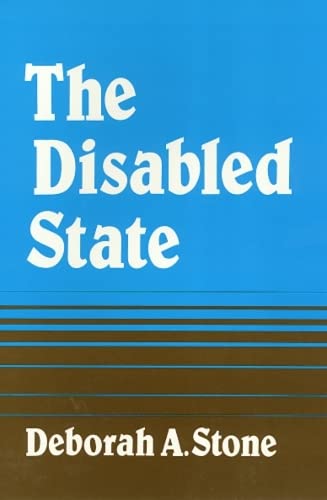
✦What is *The Disabled State* about?
Published in 1984, *The Disabled State* is a constructivist analysis of disability policy[reference:12]. Stone shows that the category of 'disability' is not a scientifically neutral or apolitical status, but a socially constructed one[reference:13]. She demonstrates how the definition of who is 'disabled' is a political tool used to regulate the boundary between those who are expected to work and those who are entitled to state support[reference:14].
✦What is *The Samaritan's Dilemma* and what is its core message?
In this 2008 book, Stone mounts a defense of altruism as a fundamental human trait[reference:15]. She critiques the dominant political and economic discourse that elevates self-interest, arguing that this narrative has convinced people that helping others is harmful[reference:16]. The book is a call to harness altruism, rather than self-interest, as the moral engine of political life[reference:17].
✦What are some of the major honors Stone has received?
Stone received the American Political Science Association's James Madison Award in 2017 for her distinguished scholarly contribution to political science[reference:18][reference:19]. Her book *Policy Paradox* won the APSA's Wildavsky Award for an Enduring Contribution to Policy Studies[reference:20]. She has also received a Guggenheim Fellowship and the Charles McCoy Career Achievement Award, among others[reference:21][reference:22].
✦What is a common misconception about Stone's work?
A common misconception is that Stone's constructivist approach is purely theoretical or detached from practice[reference:23]. In fact, she has been deeply involved in the practical world of policy design and implementation, serving as a consultant to the Social Security Administration, the Institute of Medicine, and the Human Genome Project[reference:24]. Her work demonstrates that understanding how meaning is constructed is essential for effective and democratic policy-making[reference:25].