


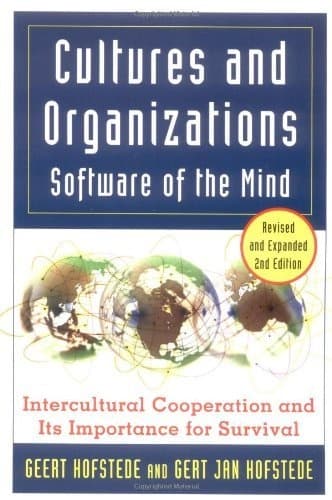
Cultures and Organizations: Software of the Mind

Hofstede's accessible synthesis argues that national cultures function as 'mental software'—collective programming that predates individuals and shapes how they think, feel, and act in organizations. The book translates his IBM survey research into a dimensional framework (power distance, individualism/collectivism, masculinity/femininity, uncertainty avoidance, and later long-term orientation and indulgence/restraint), demonstrating that organizational cultures differ from national cultures and cannot be managed in the same way. Its central mechanism is comparative: by measuring societies against one another on these dimensions, it makes visible the unexamined rules governing cross-cultural cooperation and conflict.
Key Insights
✦What is the central claim of Cultures and Organizations, and what does it reject?
Hofstede argues that national cultures operate as 'mental software'—patterns of thinking, feeling, and potential acting acquired in childhood that distinguish members of one group from another. The book rejects two common assumptions: that organizational culture can be managed in the same way as national culture, and that cultural differences will dissolve under globalization. Hofstede insists that national culture is extraordinarily stable, rooted in family and school, while organizational culture is comparatively shallow and can be partially reshaped. The practical upshot is that multinational managers cannot simply export their home country's assumptions; they must first recognize the unexamined rules their own software has installed.
✦What specific framework did this book introduce to a general audience, and how does it relate to the IBM study?
Cultures and Organizations popularized the dimensional model Hofstede first derived from IBM employee surveys: power distance, individualism versus collectivism, masculinity versus femininity, and uncertainty avoidance. The 1991 edition added long-term orientation, drawing on the Chinese Value Survey developed with Michael Bond. Unlike Culture's Consequences (1980), which was a technical research monograph, this book was written for practitioners and students, using accessible language, country scores, and organizational examples. It effectively became the standard citation for the dimensions in management education, even though the empirical base remained the IBM data collected between 1967 and 1973, supplemented by later collaborations.
✦How does the 2010 third edition differ from the original 1991 text, and what did the new co-authors contribute?
The third edition, retitled with the subtitle 'Intercultural Cooperation and Its Importance for Survival,' added Michael Minkov as co-author and Gert Jan Hofstede, Geert's son. Minkov's analysis of World Values Survey data led to a redefinition of long-term orientation and the identification of a sixth dimension, indulgence versus restraint . The edition also expanded country coverage and addressed the cultural roots of the 2008 financial crisis. This matters for citation: scholars referencing the dimensional framework must specify which edition they mean, because the sixth dimension and revised scores do not exist in the 1991 or 2005 texts. The original 1991 edition had four dimensions plus the newly added fifth; the 2010 edition has six.
✦How has Hofstede's dimensional model been criticized by other scholars, and by whom?
Critics have raised methodological and conceptual objections. Brendan McSweeney argued that Hofstede's use of IBM employee data cannot support claims about national populations, because the sample was occupationally and organizationally narrow. Rachel Wolfin and others questioned whether survey responses capture culture or merely attitudes at a single historical moment. Cross-cultural psychologist Shalom Schwartz developed an alternative value framework with different dimensions, while Edgar Schein's organizational culture model challenges Hofstede's sharp separation between national and organizational levels. More recent critiques invoke cultural hybridity and individual agency, noting that Hofstede's framework risks essentialism by treating national scores as fixed determinants of behavior rather than probabilistic tendencies .
✦Does the book argue that organizational culture cannot be changed?
No—but it draws a sharp distinction between national and organizational culture. Hofstede argues that organizational cultures are comparatively shallow: they consist of shared perceptions of daily practices rather than deep values acquired in childhood. This is why he claims organizational culture can be managed, while national culture cannot. The book's chapter on organizational cultures, drawing on separate research by Hofstede and colleagues, identifies dimensions such as process-oriented versus results-oriented and employee-oriented versus job-oriented. A common misreading treats Hofstede as a cultural determinist who says managers are helpless before national values; in fact, he says managers can change practices, but not the deep national software employees bring to work.
✦How does this book relate to Hofstede's earlier work, particularly The Game of Budget Control and Culture's Consequences?
The Game of Budget Control (1967) was Hofstede's doctoral thesis on how budgetary standards motivate managers, based on interviews in Dutch factories. It established his interest in how organizational systems interact with individual psychology but did not address national culture. Culture's Consequences (1980) was the technical presentation of the IBM survey data and the four original dimensions. Cultures and Organizations (1991) synthesized both strands for a broader readership, translating the dimensional model into accessible prose and extending it with the fifth dimension. In this sense, the 1991 book historicizes the earlier technical work while also marking Hofstede's turn toward application and practitioner relevance.
✦Is the 'software of the mind' metaphor original to this book, and what does it actually mean?
Hofstede used the phrase as the book's organizing metaphor, though the underlying idea—culture as mental programming—draws on earlier social science traditions. The metaphor means that culture is learned, not innate; it is installed through family, school, and community during childhood and becomes so habitual that individuals rarely notice it. Hofstede distinguishes three levels of mental programming: universal human nature, collective culture, and individual personality. The software metaphor has been criticized for implying a deterministic, top-down installation process that leaves little room for individual variation or cultural change. Hofstede's own later work acknowledged individual agency, but the metaphor's popularity has sometimes obscured that nuance.
Wealthy Psyche is an intellectual archive. We do not host, distribute, or sell book copies — physical or digital. We provide structured knowledge to help you think better, faster.