



Fragments and Paradoxes
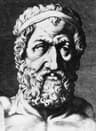
Zeno of Elea wrote nothing that survives as a continuous text; what we possess are fragments quoted by later commentators, above all Simplicius and Aristotle, and reports of his notorious paradoxes. The central framework associated with this material is Zeno's method of refutation by infinite regress: he argues that if things are many, they must be both limited and unlimited, and if motion is real, a runner can never traverse a finite distance because it is infinitely divisible. These arguments were not sceptical stunts but a defence of Parmenidean monism, designed to show that plurality and motion generate contradictions when thought through rigorously.
Key Insights
✦What is the central argumentative strategy shared by Zeno's paradoxes of plurality and motion?
The common structure is refutation by internal contradiction. In the paradoxes of plurality, Zeno argues that if things are many, they must be both limited in number and unlimited because between any two things there is always a third, ad infinitum . In the paradoxes of motion, the same logic of infinite division is applied to distance and time: any finite interval can be halved indefinitely, so motion can never be completed. Karin Verelst has argued that these arguments do not presuppose time in the way later commentators assume, but operate through simultaneous division through and through . Whatever the precise reconstruction, the unifying aim is to show that the everyday world of plurality and change collapses into contradiction when its presuppositions are examined.
✦How do our sources for Zeno's fragments and paradoxes shape what we can know about his original arguments?
We have no autograph text from Zeno. Everything we possess is mediated by later authors, chiefly Aristotle in the Physics and Simplicius in his commentary on the Physics. Aristotle reports four paradoxes of motion and discusses them at length, but his purpose is refutation, not neutral preservation. Simplicius, writing centuries later, quotes Zeno's own words in some passages, particularly for the paradoxes of plurality, drawing on earlier commentators including Alexander of Aphrodisias, Eudemus, Themistius, and Porphyry . The standard collection remains Diels/Kranz, where Zeno is numbered as fragment 29 . Because every report is shaped by its reporter's agenda, any reconstruction of Zeno's original arguments must proceed with caution and attention to the mediating sources.
✦What is the 'Argument from Denseness,' and why does it matter for the plurality paradox?
The Argument from Denseness, preserved by Simplicius, holds that if things are many, they must be both limited and unlimited. They are limited because any collection has a definite number of members. They are unlimited because between any two things there is always another, and between those another, without end . The argument matters because it isolates the conceptual cost of assuming that distinct things exist in space: if distinctness requires separation, and separation requires an intervening third thing, then any plurality generates an infinite regress. Modern mathematics, following Cantor, has shown that infinite collections can have definite cardinalities, which dissolves the contradiction as Zeno formulated it . But the argument remains philosophically significant as an early demonstration that ordinary assumptions about plurality carry hidden commitments.
✦How did Aristotle respond to Zeno's paradoxes, and was his response adequate?
Aristotle addressed the paradoxes primarily in Physics VI and VIII. His central move is to deny that a continuous magnitude is composed of indivisible parts: motion is divisible only potentially, not actually, and the infinite division of a distance does not entail that the distance cannot be traversed . He also identifies a fallacy in the Stadium paradox, where Zeno assumes that a moving object takes the same time to pass a stationary object as it does to pass an equal moving object in the opposite direction . Modern commentators have disagreed about whether Aristotle's response succeeds. Some, following David Bostock and Richard Sorabji, have found his reasoning unconvincing; others have defended it as internally consistent and philosophically plausible when properly understood . The dispute remains open, which is itself a testament to the durability of Zeno's arguments.
✦How has the interpretation of Zeno's target shifted in recent scholarship?
The traditional reading, dominant since Plato's Parmenides, holds that Zeno's paradoxes are directed against the commonsense belief in plurality and motion, defending Parmenides' monism. Recent work has complicated this picture. Georg Köhler has argued, against the communis opinio, that fragments B 1–3 belong to a single argument targeting not plurality as such but the mereological and numerical constitution of individual things: everything with extension is always divisible and therefore a plurality of parts . On this reading, Zeno's target is subtler than a blanket denial of many things; it is the internal coherence of any extended entity. Other scholars have examined the relationship between Zeno's arguments and the atomism of Leucippus and Democritus, suggesting that the paradoxes may have shaped the development of ancient atomism as a response .
Wealthy Psyche is an intellectual archive. We do not host, distribute, or sell book copies — physical or digital. We provide structured knowledge to help you think better, faster.