


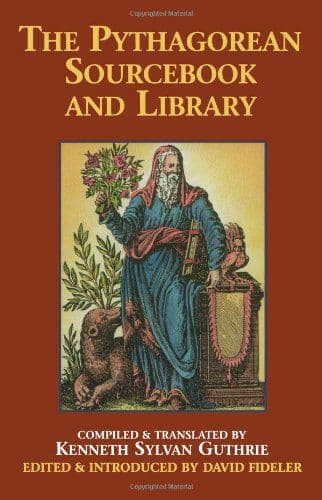
The Pythagorean Sourcebook and Library

This anthology is not a work by Pythagoras but a modern compilation that assembles, for the first time in English, the scattered ancient writings about him and his school. Compiled from translations by Kenneth Sylvan Guthrie and supplemented by Thomas Taylor and Arthur Fairbanks, it gathers the four ancient biographies of Pythagoras alongside ethical, political, and cosmological tractates attributed to Pythagoreans such as Philolaus, Archytas, and Ocellus. Its central value lies in the editorial framing by David Fideler, who presents Pythagoreanism as a coherent tradition organized around harmony, proportion, and the mathematical structure of the cosmos.
Key Insights
✦Is the Pythagorean Sourcebook a primary source written by Pythagoras or his followers?
Neither. It is a modern anthology compiled from translations of ancient texts about Pythagoras and his school, edited by David R. Fideler and published by Phanes Press in 1987. The bulk of the translations were made by Kenneth Sylvan Guthrie, an eccentric scholar who translated Plotinus and other Neoplatonic works in the early twentieth century, with additional translations by Thomas Taylor and Arthur Fairbanks . The volume's contents range from the four ancient biographies by Iamblichus, Porphyry, Photius, and Diogenes Laertius, to ethical tractates attributed to figures like Philolaus and Archytas, to the Golden Verses and Hierocles' ethical fragments . It is a curated modern compilation, not an ancient manuscript.
✦How reliable are Guthrie's translations, and what is the editorial history of this edition?
Guthrie was a prolific but controversial translator who was accused in print of translating from French versions rather than the original Greek, a charge he denied . His translations were self-published during his lifetime and have been described as better where earlier translations existed. The 1987 Phanes edition, however, was not a mere reprint: David Fideler introduced and edited the volume, adding an introductory essay and supplementary apparatus that reframed Guthrie's older material for a contemporary audience . The book also incorporates translations by Thomas Taylor, the eighteenth-century Platonist, and Arthur Fairbanks. For serious scholarly work, the standard critical text remains Diels/Kranz, but the Sourcebook remains valuable as the largest English collection of Pythagorean writings in a single volume.
✦What does the Sourcebook include that distinguishes it from a simple collection of fragments?
The volume is organized in two parts: 'The Pythagorean Sourcebook' and 'The Pythagorean Library.' The first gathers the four ancient biographies of Pythagoras, offering a narrative portrait of his life, travels, and founding of the school. The second part presents over twenty-five Pythagorean and Neo-Pythagorean writings from the Classical and Hellenistic periods, including ethical and political tractates attributed to Philolaus, Archytas, Ocellus, and others . These tractates are significant because they develop the premise that harmony, proportion, and justice govern the cosmos and that individuals and societies flourish when aligned with these principles. The volume also includes Hierocles' ethical fragments and passages from Plato and Aristotle, making it a broad dossier rather than a narrow fragment collection.
✦What is the most common misconception about this book?
The most persistent misconception is that the Sourcebook presents authentic writings of Pythagoras himself. Pythagoras, by the earliest testimony, wrote nothing. The volume's title and its attribution to 'Pythagoras' in library catalogs can mislead readers into expecting a primary text. In fact, the book is an anthology of later reports, biographies, and pseudepigraphic tractates, many of which were composed centuries after Pythagoras's death and reflect later Pythagorean or Platonizing concerns. A related misconception is that the book is a neutral scholarly edition comparable to Diels/Kranz. It is not: it is a curated synthesis with an interpretive agenda, framed by Fideler's interest in Pythagoreanism as a perennial philosophical tradition. Readers should approach it as an introduction and a convenient collection, not as a critical edition.
✦Who was Kenneth Sylvan Guthrie, and how does his background shape the Sourcebook?
Guthrie (1871–1940) was a Scottish-born American scholar with multiple doctorates, an ordained Episcopal priest, a physician, a prohibitionist, a composer, and a poet . He never held a secure academic position and supported himself by teaching children and writing for popular audiences. His translation work focused on neglected Neoplatonic and Pythagorean texts, which he self-published and sold by post. His intellectual interests were broad and idiosyncratic, ranging from Zoroaster to the Popol Vuh. This background shapes the Sourcebook in two ways: it explains the volume's accessibility and its focus on texts that had been neglected by mainstream scholarship, but it also means the translations reflect the enthusiasms and limitations of a marginal, eccentric scholar rather than the systematic rigor of a university critical edition.
✦How does the Sourcebook relate to the Diels/Kranz collection of Presocratic fragments?
The two works serve different purposes. Diels/Kranz, Fragmente der Vorsokratiker, is the foundational critical edition of Presocratic texts, separating direct quotations (B fragments) from indirect reports (A testimonia) and providing the Greek text with apparatus. It remains the scholarly standard for any serious work on Pythagoras and the Pythagoreans. The Sourcebook, by contrast, is a reader's anthology: it offers English translations of a broad range of Pythagorean materials without the Greek text or the critical apparatus, and its selection is shaped by Fideler's interpretive interests in harmony and proportion. For research, Diels/Kranz is indispensable; for a comprehensive English-language introduction, the Sourcebook is the most convenient single volume. The two are complementary rather than competing.
Wealthy Psyche is an intellectual archive. We do not host, distribute, or sell book copies — physical or digital. We provide structured knowledge to help you think better, faster.