


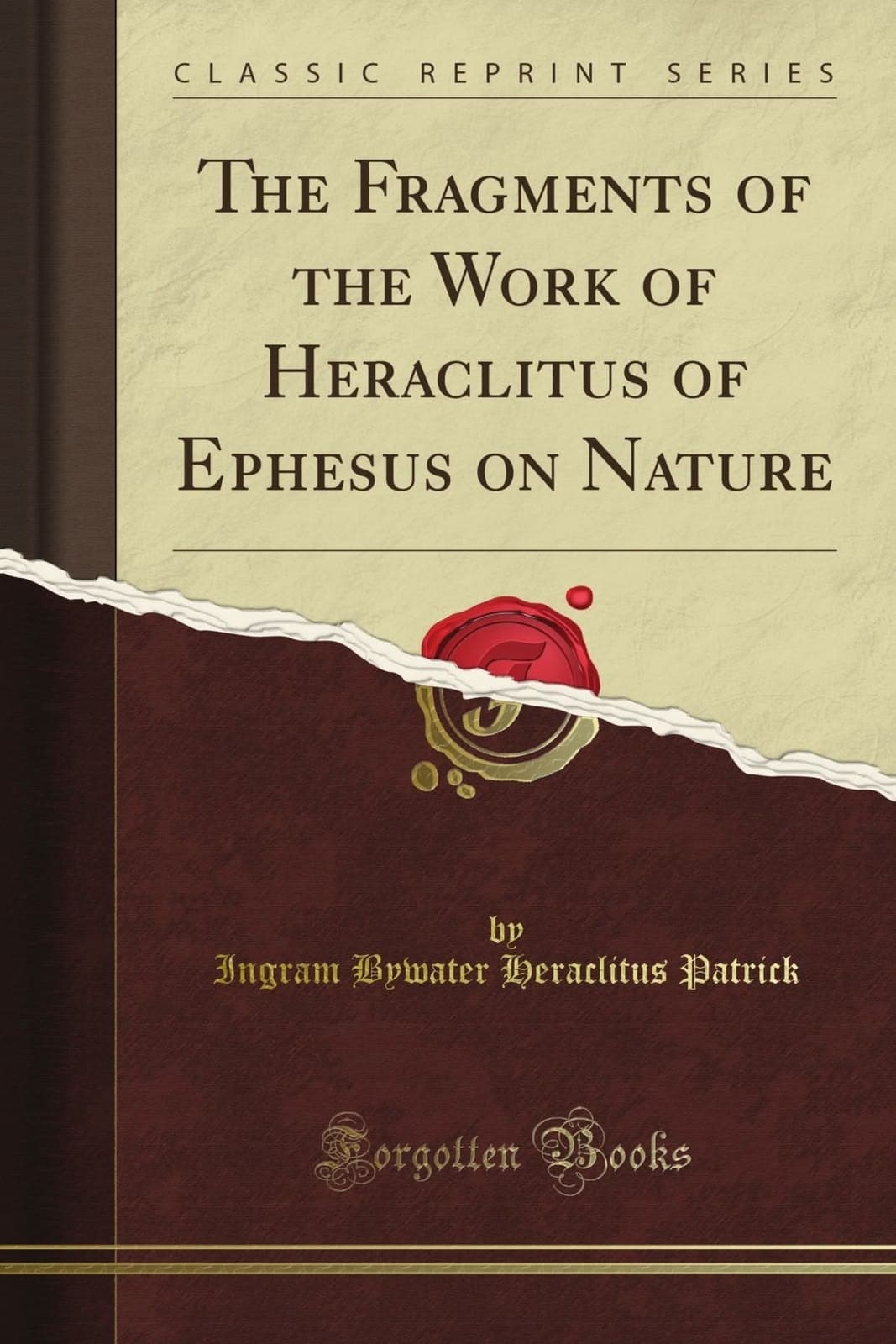
Fragments (Peri Physeos / On Nature)
The Fragments of Heraclitus are the surviving quotations from a lost book, traditionally titled On Nature, by the Ephesian philosopher active around 500 BCE. The book itself does not survive, so the work is a modern editorial reconstruction from citations in later authors. Its central thesis, as the fragments suggest, is that the world is governed by a hidden, rational structure, the logos, which most people fail to grasp. Opposites such as day and night or war and peace are bound together within one ordered process, and change is the medium through which that unity shows itself. The aphoristic, riddling style appears designed to provoke insight rather than to set out a proof.
Key Insights
✦What is the Fragments text, and why is it not a single surviving book?
Heraclitus is reported to have composed one book, which ancient sources sometimes call On Nature, though that title is probably a later label rather than his own. It does not survive intact. Roughly a hundred-odd fragments are known from quotations in later writers, including Plato, Aristotle, Plutarch, Clement of Alexandria, Hippolytus, and Diogenes Laertius. The standard numbering comes from Hermann Diels and Walther Kranz, but editors such as Charles Kahn, Daniel Graham, and M. L. West differ on which items are genuine, how to order them, and where a quotation ends. The original sequence cannot be recovered.
✦What does Heraclitus mean by the logos?
In the opening fragments the logos is something that holds always, yet people fail to understand it. The word can mean account, speech, or rational structure, and scholars debate how much of that range Heraclitus intended. Kahn argues the ambiguity is deliberate, while other interpreters stress a more cosmic reading in which the logos is the law or measure governing all change. Because the context of the fragment is lost, the exact scope of the term is uncertain, and readers should treat any single definition as an interpretation.
✦How should the unity of opposites be understood?
Fragments pair opposites such as up and down, day and night, and war and justice, and suggest they are connected or even one. A crude reading claims Heraclitus denied the law of non-contradiction. More careful interpreters, including Kahn and Jonathan Barnes in different ways, read the claim as saying that opposed states depend on one another within a single process or structure. Gregory Vlastos and others emphasized the idea of measured exchange. The fragments are too brief to settle the matter, so each reading depends on how they are linked.
✦Did Heraclitus really teach that everything flows?
The famous slogan is attributed to him by later writers, notably Plato, and it is not found in the fragments in that form. The river fragments, which themselves have complicated textual problems, can be read as saying that a river persists as a structure while its waters change, so stability and flux coexist. Scholars such as Kahn and Barnes have disputed how far Plato's presentation, which treats Heraclitus as denying stable things, distorts the original. Readers should be cautious about the slogan and look at what the fragments actually say.
✦How does Heraclitus relate to Parmenides and later philosophy?
Heraclitus and Parmenides are often presented as opposites, with Heraclitus championing change and Parmenides denying it. The relationship is disputed, including who came first and whether either responded to the other. Their influence on later thought is clearer: the Stoics adopted the logos and cosmic fire, and Plato and Aristotle discuss Heraclitus as a source of the flux doctrine. Readers should treat the neat opposition as a later construction rather than a documented debate.
✦Which editions and translations should readers consult?
Standard references include Diels and Kranz's Die Fragmente der Vorsokratiker for the Greek and numbering. Kahn's The Art and Thought of Heraclitus gives a Greek text, translation, and commentary, and Graham's The Texts of Early Greek Philosophy provides English translations. T. M. Robinson's and M. L. West's studies offer further perspectives. Because the fragments are short and ambiguous, translations differ considerably, so comparing several and checking the editors' numbering systems is advisable.
Wealthy Psyche is an intellectual archive. We do not host, distribute, or sell book copies — physical or digital. We provide structured knowledge to help you think better, faster.