



On Nature (fragments)
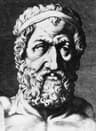
Zeno of Elea's On Nature survives only in verbatim fragments quoted by Simplicius, and these fragments preserve the core of his method: refutation by internal contradiction. The argument proceeds by assuming that things are many and then deriving that they must be both small and large—small enough to have no magnitude, large enough to be infinite—and therefore neither one nor many. This is not scepticism but a defence of Parmenidean monism, showing that the belief in plurality collapses under its own presuppositions. The fragments are brief, but they contain the earliest surviving specimen of sustained dialectical argument in Western philosophy.
Key Insights
✦What survives of Zeno's On Nature, and how do we know it is authentic?
Only a handful of verbatim fragments survive, all preserved by Simplicius in his commentary on Aristotle's Physics, drawing on the earlier commentary of Alexander of Aphrodisias and the history of Eudemus . The fragments are numbered DK 29 B 1–4 in the standard Diels/Kranz collection . Their authenticity is not seriously doubted because Simplicius explicitly quotes Zeno's own words rather than paraphrasing, and the style—terse, repetitive, and argumentative—matches the reports of Zeno's method given by Plato and Aristotle. What does not survive is the overall structure of the book; whether it was a single continuous treatise or a collection of separate arguments remains uncertain, and Plato's description of its purpose in the Parmenides is difficult to reconcile fully with the extant fragments .
✦What is the central argument preserved in the longest fragment, and how does it work?
The longest continuous fragment (DK 29 B 1) argues that if things are many, they must be both small and large: small enough to have no magnitude at all, and large enough to be infinite . The argument for smallness is that if a thing has magnitude, it must have parts separated from one another, and each of those parts must in turn have magnitude, and so on without end. The argument for largeness is that between any two things there is always another, and between those another, ad infinitum. The conclusion is that plurality entails contradictory predicates, and therefore cannot be true. This is the structure that Aristotle identified as the invention of dialectic, and it remains the earliest surviving example of sustained argument by infinite regress .
✦Did Zeno write On Nature to defend Parmenides, or was his target something else?
The traditional answer, going back to Plato's Parmenides, is that Zeno wrote to defend Parmenides' monism by showing that belief in plurality generates worse contradictions than monism does. Plato has Socrates say that Zeno's book argues the same thesis as Parmenides, only in a different way. However, recent scholarship has complicated this picture. The extant fragments do not explicitly mention Parmenides or the One, and the argument against plurality can be read as a standalone exercise in dialectic rather than a partisan defence . Some scholars have suggested that Zeno's target was not plurality as such but the internal coherence of any extended entity. The safest reading is that Zeno's arguments serve the Parmenidean project without being reducible to a simple restatement of it.
✦How does Simplicius's commentary shape what we can know about On Nature?
Simplicius is our sole direct source for the verbatim fragments, and his purpose was not to preserve Zeno for posterity but to refute him in the course of commenting on Aristotle's Physics. He quotes Zeno at length because he needs the exact wording to show where Aristotle's response succeeds or fails. This means the fragments we possess are selected according to Simplicius's polemical needs, not according to a neutral principle of completeness. Simplicius had access to the full text of Zeno's book, which is now lost, and he reports that it contained many arguments . What he chose to quote are the arguments most relevant to Aristotle's discussion of motion and plurality. The fragments are therefore authentic but not representative of the whole work.
✦What is the most common mistake readers make when approaching the On Nature fragments?
The most common mistake is to read the fragments as puzzles or brain-teasers, disconnected from any serious philosophical purpose. This reading, popularized by the later paradoxes of motion, obscures the fact that the plurality argument is a rigorous attempt to demonstrate that a widely held belief—that there are many things—is incoherent. A second mistake is to assume the fragments contain Zeno's complete argument, when in fact they are excerpts selected by Simplicius for his own purposes. A third mistake is to treat Zeno as a sceptic who denied the possibility of knowledge. He did not: he affirmed the Parmenidean thesis that reality is one, and his arguments were meant to establish that conclusion, not to undermine all claims to truth. Reading the fragments as positive arguments for monism, rather than as destructive puzzles, brings their philosophical seriousness into focus.
Wealthy Psyche is an intellectual archive. We do not host, distribute, or sell book copies — physical or digital. We provide structured knowledge to help you think better, faster.