


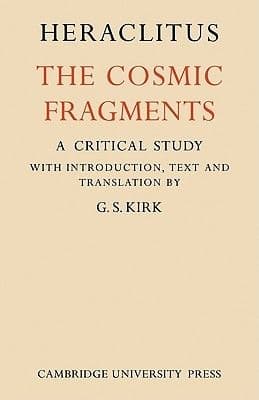
The Cosmic Fragments (Heraclitus; Kahn edition)
The Cosmic Fragments is the title of G. S. Kirk's 1954 study and edition of Heraclitus (Heraclitus: The Cosmic Fragments, Cambridge University Press), not of Charles Kahn's edition, which is The Art and Thought of Heraclitus (1979). The requested pairing therefore mixes two scholarly editions, and no single book of this exact title and editor is known to me. What can be said is that both scholars reconstruct Heraclitus from fragments quoted by later authors, and that they differ in method: Kirk focuses on the cosmological fragments, while Kahn arranges all fragments thematically and stresses literary design, ambiguity, and the logos.
Key Insights
✦Is there a Kahn edition titled The Cosmic Fragments?
Not to my knowledge. Heraclitus: The Cosmic Fragments is G. S. Kirk's edition, published in 1954 by Cambridge University Press. Charles H. Kahn's edition is titled The Art and Thought of Heraclitus: An Edition of the Fragments with Translation and Commentary and appeared in 1979. The catalogue title seems to combine them. Before publishing, an editor should decide which book is intended and correct the title or author attribution accordingly. Because I cannot verify a book with the combined title, this profile is flagged for human review.
✦How do the Kirk and Kahn editions differ in method?
Kirk concentrated on the fragments bearing on cosmology, arranged around themes such as fire, flux, and the logos, and was cautious about attributing a systematic doctrine. Kahn includes the full set of fragments, arranges them thematically, and argues that Heraclitus's ambiguity, paradox, and verbal echoes are deliberate and philosophically meaningful. Jonathan Barnes, in The Presocratic Philosophers, is more skeptical of systematic readings than either. Readers should treat the choice of edition as a choice of interpretive stance.
✦Why is any edition of Heraclitus a reconstruction?
Heraclitus's book does not survive. Its content is known from quotations and reports in later authors such as Plato, Aristotle, Plutarch, Clement of Alexandria, Hippolytus, and Diogenes Laertius. Editors decide which items are genuine quotations, where they begin and end, and how to order them, and the original sequence cannot be recovered. The standard numbering derives from Diels and Kranz, with editors adding their own concordances.
✦What themes do both editions address?
Both deal with the logos, the unity of opposites, and the role of fire in the cosmos. The fragments suggest a rational structure governing change that most people fail to grasp, and opposites such as day and night or war and justice are linked within a single process. Interpretations differ on how literally to take these claims, and the fragments are too short to settle the matter.
✦How is Heraclitus commonly misread?
The slogan that everything flows is attributed to him mainly through Plato and is not found in the fragments in that form. The river fragments can be read as describing a stable structure persisting through changing waters. Another misreading treats him as denying non-contradiction, though more careful interpreters read the unity of opposites as interdependence within a process.
✦Which editions should readers consult?
Diels and Kranz's Die Fragmente der Vorsokratiker provides the standard Greek text and numbering. Kirk's 1954 volume and Kahn's 1979 volume are the two editions at issue here, and Daniel Graham's The Texts of Early Greek Philosophy and M. L. West's Early Greek Philosophy and the Orient offer further perspectives. Readers should check the numbering system of whichever edition they use.
Wealthy Psyche is an intellectual archive. We do not host, distribute, or sell book copies — physical or digital. We provide structured knowledge to help you think better, faster.