


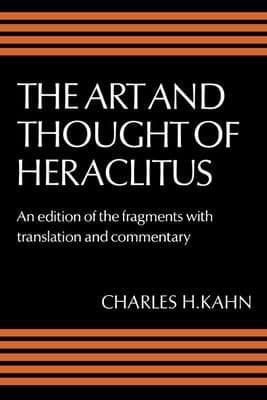
The Art and Thought of Heraclitus: An Edition of the Fragments with Translation and Commentary
Charles H. Kahn's The Art and Thought of Heraclitus is a scholarly edition of the surviving fragments, with Greek text, English translation, and a long interpretive commentary. Its central thesis is that Heraclitus must be read as a literary artist as well as a thinker: his style of ambiguity, paradox, and verbal echo is the vehicle of his philosophy, so that the fragments are not isolated oracles but linked statements built around recurring themes such as logos, the unity of opposites, and the cosmic fire. Kahn arranges the fragments thematically and argues that their patterns of meaning and wordplay disclose a coherent outlook, not a collection of enigmas.
Key Insights
✦What is this book, and why is it not a work by Heraclitus himself?
Heraclitus's own book survives only in quotations and reports by later authors such as Plutarch, Clement of Alexandria, Hippolytus, and Diogenes Laertius. Kahn's volume is a modern edition and commentary that collects these fragments, gives a Greek text with translation, and interprets them. The numbering and order of the fragments are editorial choices, so a reader comparing editions will find different arrangements. Kahn's own order is thematic, not a reconstruction of the original sequence of Heraclitus's book, which cannot be recovered.
✦What is Kahn's central claim about Heraclitus's style?
Kahn argues that Heraclitus's ambiguity, riddling phrasing, and wordplay are deliberate and philosophically meaningful. A statement can carry several meanings at once, and recurring terms link fragments to one another. On this reading, style and doctrine cannot be separated: the paradoxical form enacts the unity of opposites. This approach treats the fragments as the surviving parts of a coherent composition, not as fortune-cookie sayings, and it asks readers to attend to resonance across passages.
✦How does Kahn's approach differ from earlier readings, such as Kirk's?
G. S. Kirk's earlier Heraclitus: The Cosmic Fragments and the Kirk, Raven and Schofield survey treated the fragments more as scattered evidence for cosmological doctrines, with greater caution about reconstructing a unified system. Kahn instead stresses literary patterning and thematic coherence. Others, such as Jonathan Barnes in The Presocratic Philosophers, are more skeptical of finding systematic doctrine at all. Kahn's edition sits toward the more interpretive end of the debate.
✦How does Kahn interpret the logos and the unity of opposites?
For Kahn, the logos is a central, deliberately polysemous term, meaning something like an account or structure that is both speech and the rational order of things, which most people fail to grasp. The unity of opposites is read less as a claim that contradictory things are identical than as a view that opposed states are linked within a single process or structure. These are interpretive claims, and other scholars, including Barnes and M. L. West, read the fragments differently.
✦How is Heraclitus commonly misread, and what does Kahn correct?
A common oversimplification reduces Heraclitus to a slogan that everything flows or that he denied the possibility of stable things. Kahn emphasizes that the river fragments concern the persistence of a structure through change, so that flux and stability belong together. Another popular error treats him as a mystic who rejects reason, whereas Kahn argues that his sayings aim at disclosing a rational order that most people overlook.
✦What should readers know about editions and alternative translations?
Fragment numbering follows the system of Diels and Kranz, and Kahn gives his own numbering with concordances. Readers comparing editions should also consult Daniel Graham's collection in The Texts of Early Greek Philosophy, T. M. Robinson's edition, and M. L. West's work on Heraclitus and Eastern thought. Because the fragments are short and often ambiguous, translations differ markedly, so comparing several is advisable.
Wealthy Psyche is an intellectual archive. We do not host, distribute, or sell book copies — physical or digital. We provide structured knowledge to help you think better, faster.