



Handbook of a Christian Knight (Enchiridion militis Christiani)
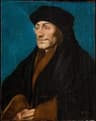
Erasmus's Enchiridion argues that Christianity is chiefly a discipline of inward transformation rather than a matter of ritual observance or institutional membership. Using the image of the soldier armed for lifelong spiritual combat, it equips the lay reader with two weapons, prayer and knowledge, meaning the study of scripture illuminated by the best of pagan wisdom. It sets the inner, spiritual self against the outward, bodily and ceremonial self, and presses the reader to measure devotion by moral conduct. The book thereby gives humanist learning a devotional purpose and offers a program of piety that a layperson can pursue without clerical mediation.
Key Insights
✦What is the central claim of the Enchiridion, and what does it reject?
The book claims that genuine Christian life is a continuous inward struggle, shaped by scripture and prayer, in which moral transformation is the real measure of faith. Erasmus rejects the idea that piety can be satisfied by ceremonies, pilgrimages, relics, or formal observances when these are detached from changed character. He also challenges the assumption that serious religious life belongs mainly to monks and clergy, directing his advice to a layperson living in the world. The result is a program of devotion that is portable, personal, and anchored in reading the Bible with attention to its spiritual meaning.
✦What did the book contribute to Erasmus's idea of the philosophia Christi?
The Enchiridion is among the earliest and clearest statements of what Erasmus later called the philosophy of Christ, a way of life modeled on Christ's teaching rather than on scholastic system. It treats Christian ethics as practical wisdom, to be learned and practiced, and not primarily as a body of speculative doctrine. This emphasis recurs throughout his later writings, including his editions and paraphrases of the New Testament. Readers wanting the origins of his reformist piety, distinct from the doctrinal programs of the Reformers, usually begin here.
✦How does it integrate classical learning with Christian devotion?
Erasmus argues that the study of pagan authors, especially moral philosophers and poets, can prepare the mind for Christian truth if read critically and subordinated to scripture. He draws on Platonic ideas of the divided self, in which reason and spirit are set against bodily impulse, and he adapts them to a Christian account of spiritual warfare. This synthesis typifies humanism's attempt to show that learning and faith are allies. It also drew criticism from more conservative theologians who distrusted the use of pagan sources in religious instruction.
✦Why was the book little noticed at first, and how did its reputation change?
The Enchiridion first appeared in 1503 as part of a collection of Erasmus's writings and did not initially attract wide notice. Its reputation rose substantially after a separate printing in the later 1510s, when it circulated more widely and was reprinted and translated into vernacular languages. Its rise coincided with the period when Erasmus himself became an international figure and when religious reform was a pressing public topic. The work's changing fortunes show how reception depended on timing and printing, not only on the argument.
✦How was the Enchiridion read in the context of the Reformation?
Because it criticized ceremonial excess and emphasized inner piety and scripture, reformers and their sympathizers sometimes found it congenial, while conservative critics saw in it a threat to traditional practice. Erasmus himself insisted he sought to renew the church, not to divide it, and he later broke with Luther over free will. A frequent misreading therefore treats the book as a proto-Protestant manifesto. A more careful view sees it as an expression of reforming Catholic humanism that shares some concerns with the Reformers without adopting their doctrinal conclusions.
✦Which English translations are available, and what should readers check?
The work was written in Latin, so English readers rely on translators. An early English translation appeared in the sixteenth century and has been associated with William Tyndale, though scholars have debated this attribution. Modern readers commonly use the version in the Collected Works of Erasmus from the University of Toronto Press, and other modern renderings exist, often under the title Handbook of the Christian Soldier or Handbook of a Christian Knight. Because the title word miles can be rendered as knight or soldier, and because editions differ in annotation, readers should compare introductions and notes.
Wealthy Psyche is an intellectual archive. We do not host, distribute, or sell book copies — physical or digital. We provide structured knowledge to help you think better, faster.