


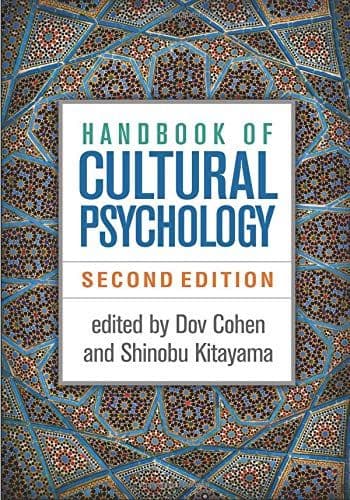
Handbook of Cultural Psychology

Kitayama and Cohen assemble the field's definitive reference, arguing that cultural psychology is not a subdiscipline but a fundamental corrective to psychology's assumption of universality. The volume's mechanism is architectural: over thirty commissioned chapters map how cultural meanings and practices constitute identity, cognition, emotion, motivation, and development, while also presenting the field's core theoretical perspectives and methodological challenges. Its distinctive contribution is to consolidate the Kitayama-Markus research program—experimental, quantitative, and comparative—as the discipline's dominant paradigm, while giving space to anthropological and evolutionary alternatives that complicate any single account.
Key Insights
✦What is the central claim of the Handbook of Cultural Psychology, and what does it reject?
The Handbook argues that cultural psychology is not a niche subdiscipline but a fundamental corrective to mainstream psychology's assumption that its findings describe universal human nature. Kitayama and Cohen organize over thirty commissioned chapters around the claim that cultural meanings and practices constitute—not merely influence—psychological processes including identity, cognition, emotion, motivation, and development . The volume rejects the view that culture is a variable to be added to existing models; instead, it presents culture as embedded in the basic architecture of mind. The editors also acknowledge internal diversity, giving space to anthropological and evolutionary perspectives that complicate the dominant experimental-comparative paradigm .
✦What is the Kitayama-Markus paradigm, and why does it dominate the Handbook?
The Kitayama-Markus paradigm is a quantitative, experimental approach that uses controlled comparisons between Western and East Asian samples to demonstrate cultural variation in self-construal, cognition, and emotion. A review in the Journal of Anthropological Research observed that in the Handbook, 'culture is definitely the modifier, not the noun,' and that the dominant influence is the pragmatic, quantitative model of Kitayama and his collaborator Hazel Markus, with its emphasis on East Asian interdependent collectivism . The reviewer noted that 47 of the 66 contributors were affiliated with psychology departments, only five with anthropology—a disciplinary skew that reflects the paradigm's dominance. The Handbook thus consolidates a particular vision of cultural psychology as rigorous, experimental, and comparative.
✦How does the second edition differ from the first, and does the edition matter?
The second edition, edited by Dov Cohen and Shinobu Kitayama and published in 2019, is over 90 percent new material . It reflects advances in cultural neuroscience, adds a section on economic behavior (money, negotiation, consumer behavior, innovation), and expands into religion, social class, subcultures, and race . The first edition (2007) had 894 pages and 35 chapters organized into seven parts ; the second has 930 pages and a different structure. The edition matters significantly for citation: many chapters and authors differ between editions, and the second edition's supplemental e-book offers selected chapters from the first. Scholars must specify which edition they reference.
✦How was the Handbook received by reviewers, and what criticisms were raised?
Reception was largely celebratory. Endorsements from Carol Dweck, Michael Tomasello, and Richard Shweder praised its scope and authority . PsycCRITIQUES called it 'a landmark work' . However, the Journal of Anthropological Research review raised a substantive critique: the Handbook's contributors generally assume that cultures 'exist as unique, relatively solid, and coherent entities,' and the volume treats culture as 'another (very important) variable that must be taken into account in experimental design' . The reviewer noted that Shweder—who coined the term 'cultural psychology' in 1990—contributes a chapter lamenting that the field did not develop as he hoped, toward an interpretive, pluralistic, humanistic approach rather than the quantitative paradigm that dominates.
✦What role does cultural neuroscience play in the Handbook, and how has it developed?
Cultural neuroscience is one of the Handbook's distinguishing features, particularly in the second edition. The first edition included a chapter by Joan Chiao and Nalini Ambady on 'Cultural Neuroscience: Parsing Universality and Diversity across Levels of Analysis' . The second edition includes a substantially revised chapter by Kitayama, Varnum, and Salvador on 'Cultural Neuroscience,' reflecting the field's growth over the intervening decade . The paradigm investigates how deeply culture influences biological systems of brain and body, using fMRI and other methods to link cultural self-construals and cognitive styles to neural and physiological processes . This commitment to biological grounding is central to the Handbook's argument that culture is not merely 'soft' context but constitutive of human biology.
✦How does the Handbook relate to Kitayama's earlier edited volume with Markus, Emotion and Culture?
The Handbook extends the project begun in Emotion and Culture (1994). That earlier volume, edited by Kitayama and Markus, assembled empirical studies demonstrating that culture penetrates every component of emotion—cognitive, linguistic, physiological—challenging Ekman's basic-emotions paradigm. The Handbook (2007) broadens the scope from emotion to the full range of psychological processes: identity, cognition, motivation, development, and psychopathology. It also consolidates the theoretical framework—independent versus interdependent self-construals—that Markus and Kitayama had developed in their landmark 1991 Psychological Review paper. In this sense, the Handbook is the mature, comprehensive statement of the research program that Emotion and Culture helped launch.
✦What is the significance of Harry Triandis's chapter in the first edition?
Triandis contributed Chapter 3, 'Culture and Psychology: A History of the Study of Their Relationship' . His presence in the Handbook is historically significant: Triandis was a pioneer of cross-cultural psychology whose work on individualism-collectivism and subjective culture predated and influenced the Kitayama-Markus program. His chapter provides a historical genealogy of the field, situating contemporary cultural psychology within a longer tradition of cross-cultural research. The inclusion of Triandis alongside Shweder (anthropological perspective) and Nisbett (psychological perspective) in the commentaries section reflects the Handbook's ambition to represent the field's internal diversity, even as the quantitative paradigm dominates the substantive chapters.
Wealthy Psyche is an intellectual archive. We do not host, distribute, or sell book copies — physical or digital. We provide structured knowledge to help you think better, faster.