


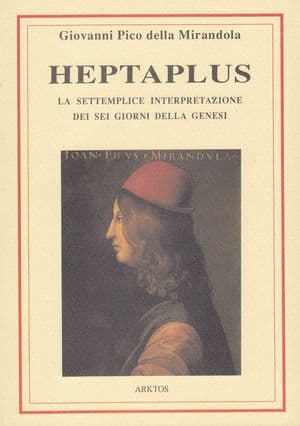
Heptaplus (Heptaplus de septiformi sex dierum Geneseos enarratione)

Pico's Heptaplus is a Latin commentary on the six days of creation in Genesis, built on a sevenfold method of interpretation. Its central thesis is that the biblical creation account can be read at several levels at once, corresponding to the elemental world, the celestial world, the angelic world, and the human being as a microcosm that contains all of them. The seven expositions are structured around this cosmic scheme, so Genesis becomes a compact map of reality in which nature, philosophy, and revelation converge. The work applies Pico's concord project to Scripture, using Platonic, Kabbalistic, and patristic resources to argue for a layered, harmonized reading of Moses.
Key Insights
✦What is the central design of the Heptaplus, and what does it set aside?
The work reads the opening of Genesis through seven expositions, each addressing the text from a different level of reality. Pico's scheme moves through the sublunary, celestial, and angelic worlds and culminates in the human being, who gathers them in himself. This sets aside the idea that the creation narrative has only a literal or purely theological sense, and it also sets aside a sharp separation between natural philosophy and exegesis. The commentary treats Moses as a source of philosophical insight, so that Genesis becomes a unified account of the structure of the cosmos rather than merely a historical report.
✦How does the Heptaplus relate to the Oration and the 900 Theses?
The Heptaplus is generally read as a later, more explicitly religious statement of themes present in Pico's earlier writings. The idea of man as a microcosm, prominent in the Oration, receives systematic cosmological grounding here, while the harmonizing method of the Conclusiones is turned toward a single sacred text. Written after the condemnation of the theses, it also shows Pico working within a more overtly scriptural frame. Scholars debate how far this reflects a change of direction and how far it is continuity, but reading the three works together clarifies how his concord project developed.
✦How does Pico use Kabbalah and Platonism in the Heptaplus?
Pico draws on Platonic ideas about ordered levels of being and on Kabbalistic interpretive practices to support a multilayered reading of Genesis. He treats these traditions as allies of Christian exegesis, in line with the position he defended in the Apologia. The sevenfold structure itself reflects a taste for symbolic number and correspondence. Readers should note that Pico adapts these sources to his own purposes and does not simply report them, so the Heptaplus is better understood as a creative Renaissance synthesis than as a neutral account of any one tradition.
✦Who was the work dedicated to, and in what context did it appear?
The Heptaplus was dedicated to Lorenzo de' Medici and appeared in the late 1480s, after Pico had settled in Florence following the condemnation of his theses. This setting matters because it places the work in the Florentine milieu shaped by Marsilio Ficino and the circle around Lorenzo, where Platonic and biblical study overlapped. The dedication also reflects the patronage that allowed Pico to continue his work after his troubles in Rome. Interpreting the book with this context in mind helps explain its combination of scholarly ambition and religious seriousness.
✦Is the Heptaplus a scientific account of creation or a symbolic one?
A common misreading treats it as a literal or proto-scientific explanation of how the world was made. Pico is more interested in structure and correspondence: the days of creation serve as a framework for describing levels of being and their relation to man. Equally, it would be a mistake to treat it as mere allegory detached from natural philosophy, since Pico takes the cosmological scheme seriously as a description of reality. The text works between these poles, using symbolic reading to express what he regards as real hierarchical order in the universe.
✦Which editions and translations of the Heptaplus should readers consult?
The Heptaplus was written in Latin and is available in modern scholarly editions and in English translation, including versions that appear alongside other works by Pico. Because the text is dense with allusions to Platonic, patristic, and Kabbalistic sources, the introduction and notes largely determine how useful a given edition is. Readers should check which Latin text is followed and whether the commentary identifies Pico's sources, and should compare translations for how they handle his technical vocabulary and the sevenfold structure.
Wealthy Psyche is an intellectual archive. We do not host, distribute, or sell book copies — physical or digital. We provide structured knowledge to help you think better, faster.