


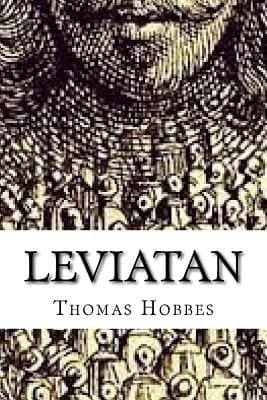
Leviathan, or The Matter, Forme and Power of a Common Wealth Ecclesiasticall and Civil

Leviathan argues that political authority is artificial: it is generated when a multitude authorises a sovereign to act in their name, thereby constituting a single civil person. The book's distinctive mechanism is this theory of representation—the sovereign's acts are attributed to the people because the people have authorised them—which transforms a covenant into a unified commonwealth. Hobbes grounds this construction in a materialist account of human nature and a geometric method, deriving the necessity of absolute sovereignty from the state of nature's war of all against all.
Key Insights
✦What is the central innovation of Leviathan, and how does it differ from Hobbes's earlier works?
The central innovation is the theory of juridical representation. In De Cive and The Elements of Law, the social pact lacks the apparatus to constitute a civil person, so the political edifice, once erected, collapses . Leviathan solves this by introducing the concept of authorisation: the multitude authorises the sovereign to act in their name, and in doing so constitutes a single civil person. This allows Hobbes to explain how a multitude becomes one people without relying on a pre-existing unity. The sovereign's acts are attributed to the people because the people have authorised them. This is a fundamentally artificial, not natural, conception of political authority, and it is the mechanism that makes absolute sovereignty coherent.
✦What is the state of nature, and why is it central to Leviathan's argument?
The state of nature is the condition of humanity without a common power. It is a war of all against all, driven by competition, diffidence, and glory, in which the life of man is 'solitary, poor, nasty, brutish, and short.' The state of nature is not a historical claim about the past but a methodological device: it shows what happens when political authority is absent. It is central because it establishes the necessity of absolute sovereignty: if the alternative to sovereignty is civil war, then any sovereign is better than none. The argument's power depends on the vividness of the state of nature and the plausibility of its derivation from Hobbes's mechanistic psychology of appetite and aversion.
✦What role does religion play in Leviathan, and why was the book so controversial?
Leviathan is as much a theological work as a political one. Hobbes devotes the entire third and fourth parts to Christian Scripture and the kingdom of darkness, arguing that the sovereign is the sole authorised interpreter of Scripture and that the clergy must be subordinate to civil power. This was deeply controversial because it challenged the authority of the church and questioned the immortality of the soul and the nature of hell. Hobbes was accused of atheism and heresy, and the book was condemned by Parliament and the church. The theological argument is not an afterthought; it is essential to Hobbes's claim that sovereignty is indivisible and that the sovereign's authority extends to matters of religion.
✦How was Leviathan received on publication, and what were the main criticisms?
Reception was sharply divided. The book was praised for its power and originality but condemned for its absolutism and its treatment of religion. Critics objected that Hobbes gave the sovereign authority over conscience and Scripture, and that his state of nature was too pessimistic. The book was publicly burned at Oxford, and Hobbes was accused of atheism by many of his contemporaries. Defenders saw it as a powerful response to the chaos of the Civil War. Modern scholarship has recognized the importance of the theological argument, which some earlier readers dismissed. The book's reputation has grown over time, and it is now regarded as one of the foundational texts of modern political philosophy.
✦What is the 'kingdom of darkness,' and why does it matter for understanding Leviathan?
The kingdom of darkness, discussed in Part IV, is Hobbes's name for the forces that obscure the truth and threaten the commonwealth: false philosophy, superstition, and the ambition of the clergy. These forces create 'darkness' by persuading people to accept doctrines that undermine sovereign authority, such as the idea that there is a power independent of the civil sovereign. The kingdom of darkness is not a digression but an essential part of the argument: it shows that the battle for sovereignty is fought not only in the state of nature but in the realm of ideas. Hobbes's analysis of the kingdom of darkness is one of the most politically charged parts of the book, and it explains why the book was so controversial.
✦How did Leviathan's reception change over time, and what is its contemporary significance?
Leviathan was condemned in the seventeenth century for its supposed atheism and absolutism, but its reputation has grown steadily. By the twentieth and twenty-first centuries, it is regarded as one of the foundational texts of modern political theory. Hobbes's theory of representation has been influential in debates about the nature of political authority, and his account of the state of nature remains a standard reference point in discussions of political obligation. The book's distinctive fusion of materialism, psychology, and theology makes it a rich resource for readers who want to understand the origins of modern political thought. Its enduring significance lies in its uncompromising analysis of the problem of order and the nature of sovereignty.
Wealthy Psyche is an intellectual archive. We do not host, distribute, or sell book copies — physical or digital. We provide structured knowledge to help you think better, faster.