


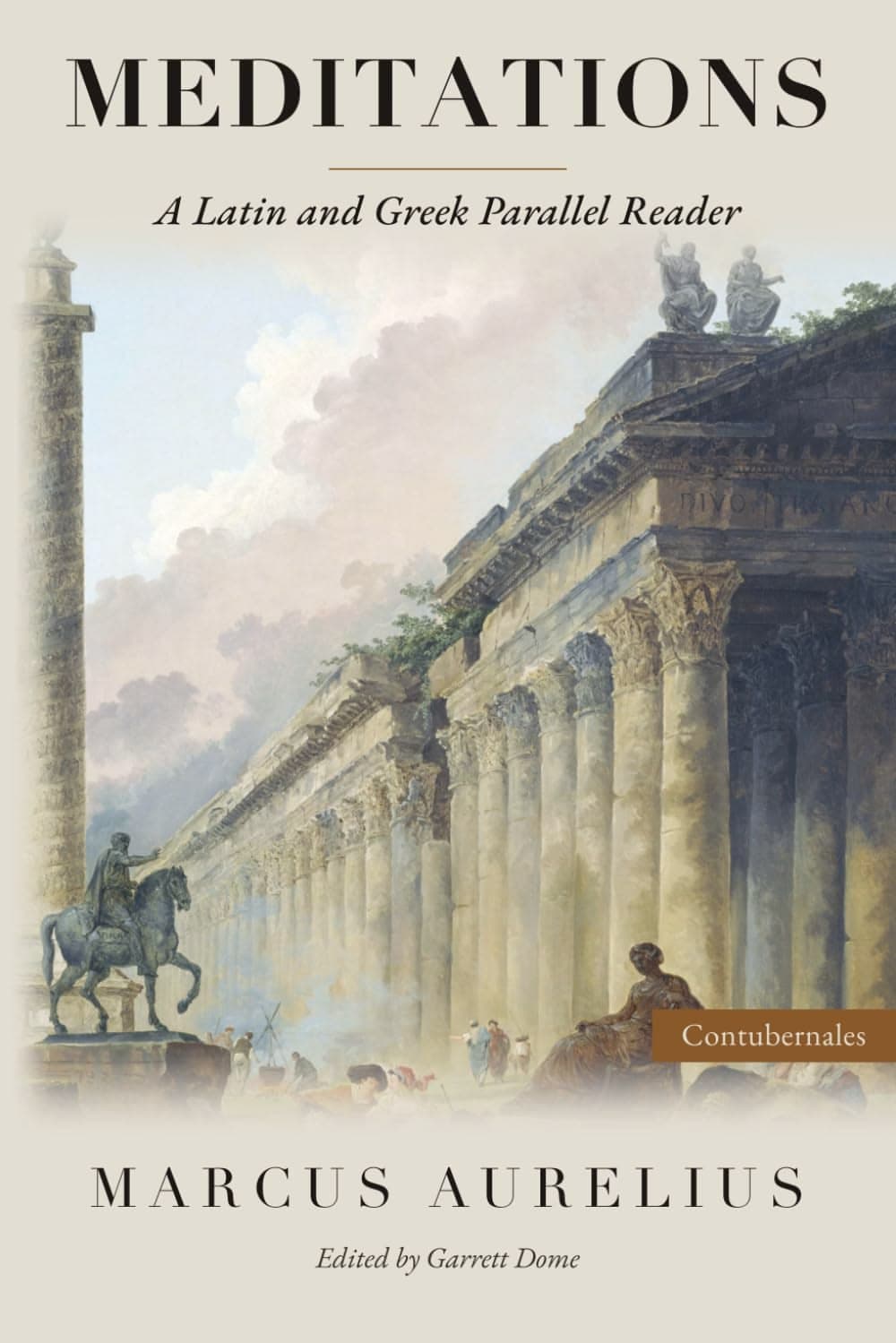
Meditations (Ta eis heauton)

Marcus Aurelius's Meditations, whose Greek title Ta eis heauton means roughly 'to himself', is a set of private notes in twelve books that function as Stoic exercises rather than as a treatise. Its central mechanism is the daily rehearsal of a few doctrines in order to retrain judgment: only one's own assent and choices are up to us, external events are indifferent, the cosmos is a rationally ordered whole in which each person has a role, and life is brief. Marcus applies these ideas to duty, irritation with colleagues, fear of loss, and mortality, so the text records philosophy as lived practice by a Roman emperor.
Key Insights
✦What is the central project of the Meditations, and what is it not?
The notes are exercises in applying Stoic doctrine to daily life, written for the author's own use. Marcus returns to a small core of ideas, such as examining impressions, accepting what fate brings, acting for the common good, and keeping the mind free of anger, and restates them in new forms. It is not a systematic treatise, nor a book composed for an audience. Its repetitions and abrupt shifts are part of its character as practice, which also explains why it can seem aphoristic and uneven to readers expecting a continuous argument.
✦How does the work relate to Epictetus and earlier Stoicism?
Marcus thanks his teacher Rusticus for introducing him to the discourses of Epictetus, and the influence shows in the division between what is up to us and what is not. Yet he does not reproduce a school curriculum. Pierre Hadot, in The Inner Citadel, read the Meditations as organized around three disciplines of assent, desire, and action, drawn from Epictetus, while other interpreters stress Marcus's own emphasis on cosmic perspective and fellowship. The work is best treated as a personal appropriation of Stoicism rather than a compendium of early Stoic logic, physics, and ethics.
✦How Stoic is it, and what are the disputes about its theology?
Scholars disagree about how much metaphysics Marcus assumes. He often writes that the world is governed by providence, and just as often entertains the alternative of atoms and chance, concluding that the right response is the same either way. Hadot saw this as a rhetorical device for securing equanimity under any hypothesis, while others find real uncertainty about Stoic physics. Whether Marcus is strictly orthodox or shows Platonic and other influences remains open, so readers should not assume a fully unified doctrine behind every entry.
✦What is the textual history of the work, and why does it matter?
The Meditations survives through a small manuscript tradition, and the first printed edition was produced by Xylander in 1559. The division into twelve books and the title are not thought to be Marcus's own, and the order of entries may not reflect order of composition apart from notes on where Books One and Two were written. Because the arrangement is editorial and the Greek is sometimes terse or uncertain, editors and translators differ on readings. This affects how readers judge any supposed development of themes across the book.
✦How has the Meditations been misread or oversold?
It is often treated as a self-help book or as the memoir of a serene philosopher-king. The notes in fact show a man repeatedly reminding himself of what he finds hard, including irritation at others and fear of loss, so their calm is aspiration rather than achievement. Another misreading strips away the Stoic framework and presents the maxims as generic wisdom. Readers should also avoid reading it as a political record, since it says little about the events of his reign and is not a guide to how he actually governed.
✦Which translations of the Meditations should readers consult?
The English tradition begins with Meric Casaubon's 1634 translation. Later versions include George Long's nineteenth-century rendering, widely available online, and A. S. L. Farquharson's edition with commentary. Modern options include Robin Hard's translation for Oxford World's Classics, Gregory Hays's Modern Library version, and Martin Hammond's Penguin Classics translation. Hadot's study is a useful companion. Readers should compare how translators render terms such as hegemonikon, the ruling faculty, and how freely they smooth the work's abrupt, note-like style.
Wealthy Psyche is an intellectual archive. We do not host, distribute, or sell book copies — physical or digital. We provide structured knowledge to help you think better, faster.