


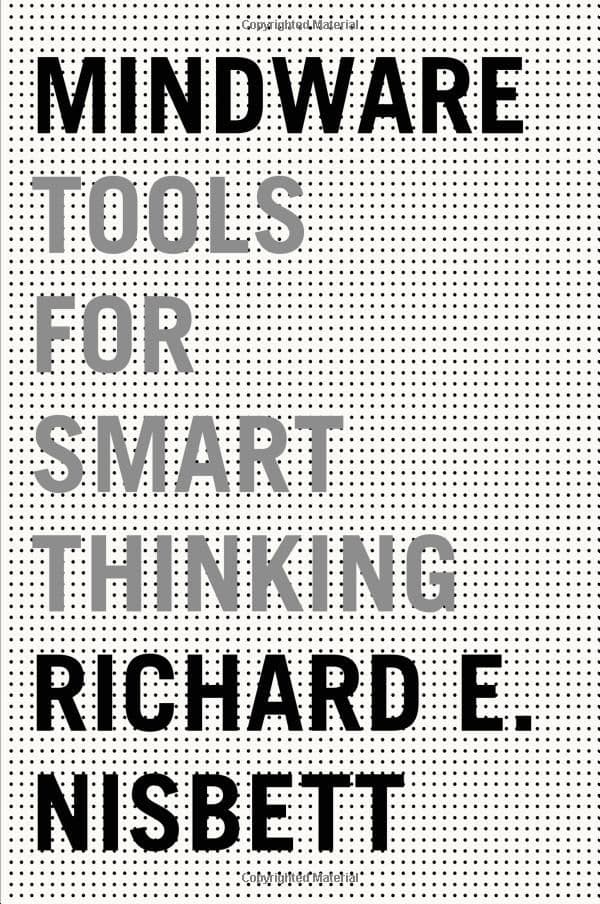
Mindware: Tools for Smart Thinking

Nisbett argues that a small set of concepts from statistics, economics, logic, and psychology can be learned and applied to everyday reasoning, making people measurably smarter without raising their IQ. The book's mechanism is a curated toolkit: the law of large numbers, regression to the mean, sunk and opportunity costs, correlation versus causation, and the power of situational context over dispositional explanation. Nisbett shows how these principles expose systematic errors in intuition—from the fundamental attribution error to loss aversion—and proposes that recognizing these tools is the first step toward using them, even if the application is rarely as effortless as the book's introduction promises.
Key Insights
✦What is the central claim of Mindware, and what does it reject?
Nisbett argues that scientific and philosophical concepts—drawn from statistics, economics, logic, and psychology—can be learned and applied to everyday problems, making people more effective reasoners without raising their IQ. The book rejects the assumption that intelligence is fixed or that common sense is sufficient for sound judgment. Instead, Nisbett contends that many of our intuitive inferences are systematically mistaken because they ignore context, misjudge sample sizes, confuse correlation with causation, or fall prey to sunk-cost reasoning. The remedy is a curated set of 'mindware' tools: principles like the law of large numbers, regression to the mean, opportunity cost, and the fundamental attribution error. The book's introduction promises that these tools can be applied 'automatically and effortlessly,' a claim one reviewer found hyperbolic .
✦How was Mindware received by reviewers, and what criticisms were raised?
Reception was mixed. The New York Times review called it a good survey of its topics but noted 'there isn't much in Mindware that is new' for readers familiar with recent books on decision-making, and observed that Nisbett's dry tone and habit of previewing and reiterating his points give the book 'a textbook feel' . A Numeracy review questioned the introduction's promise of 'automatic and effortless' application, suggesting smarter thinking is rarely either without prior knowledge . Publishers Weekly was more positive, praising Nisbett's ability to make dense material digestible . The harshest assessment came from a Goodreads reviewer who found the writing clumsy and the self-help framing unconvincing, though they still called the analysis of cognitive flaws 'a pure delight' .
✦What role does the fundamental attribution error play in Nisbett's argument, and why is it central?
The fundamental attribution error—the tendency to overestimate dispositional factors and underestimate situational ones when explaining others' behavior—is the book's recurring diagnostic target. Nisbett calls it 'the most pervasive and consequential inferential mistake we make' . The error matters because it exemplifies the broader problem Mindware addresses: intuition systematically ignores context. Nisbett traces the error to a failure to recognize that a brief exposure to a person is a small, often unrepresentative sample of their behavior . The remedy he proposes is not merely intellectual acknowledgment but practical habit: pay more attention to context, recognize social influences, and resist the assumption that a person's behavior in one situation predicts future behavior. This emphasis reflects Nisbett's career-long interest in situationism, developed with Lee Ross and others.
✦How does Mindware relate to Nisbett's earlier work, particularly The Geography of Thought?
Mindware extends Nisbett's cultural psychology research into the domain of practical reasoning. The Geography of Thought (2003) documented profound differences between Western analytic and East Asian holistic cognition, showing that culture shapes even basic perceptual processes. Mindware draws on that framework in its final sections on logic and dialectical reasoning, contrasting Western formal logic with East Asian dialectical approaches to contradiction and change. Nisbett notes that Westerners have historically believed in static dispositions while East Asians have treated change as constant, and he suggests that recognizing this cultural divergence can itself be a tool for better thinking . The book is thus a popular synthesis that applies insights from Nisbett's scholarly career to the practical problem of how ordinary people can reason more effectively.
✦What does Nisbett say about multiple regression analysis, and why did that section attract attention?
Chapter 11, 'Eekonomics,' argues that studies relying on correlation to establish scientific fact can be 'hopelessly misleading,' and that experiments with random assignment are 'in general far superior' to multiple regression analysis (MRA) . Nisbett identifies self-selection as the most frequent culprit: people who choose one path differ systematically from those who choose another, confounding the analysis. He admits that his own 'tribe' of psychologists is as guilty of misusing MRA as economists are. A Numeracy reviewer noted that Nisbett advocates for competently conducted experiments rather than simply trashing MRA, and that MRA remains useful for identifying relationships worth testing experimentally . The chapter's title and polemical tone made it a focal point for quantitatively oriented readers.
✦Is Mindware a self-help book, a textbook, or something else?
It is a popular science book with self-help ambitions that reviewers found uneven. The publisher's description promises 'a powerful toolkit' for making better professional, business, and personal decisions . A Goodreads reviewer noted that the self-help framing doesn't work particularly well because the book is structured around how we get things wrong rather than as a practical toolkit for doing things better . The New York Times observed that it reads like a textbook in tone and organization . The most accurate characterization is that Mindware is an accessible survey of reasoning tools by a leading psychologist, written for a general audience, that stops short of being a systematic self-help manual. Readers seeking actionable protocols will find principles; readers seeking a conceptual map of cognitive pitfalls will find a well-organized guide.
✦What specific tools does Nisbett identify, and where do they come from?
Nisbett draws from four disciplinary wells. From statistics: the law of large numbers, regression to the mean, and the distinction between correlation and causation. From economics: sunk costs, opportunity costs, cost-benefit analysis, and loss aversion. From logic: formal deductive reasoning and the recognition of logical fallacies. From psychology: the fundamental attribution error, the power of situational context, and the rational unconscious. The book's six-part structure reflects this taxonomy, moving from thinking about thought, through economics and statistics, to experiments, logic, and the nature of knowledge . Nisbett's selection criterion was that concepts must be 'important,' 'teachable,' and capable of being 'triangulated' from multiple perspectives . The result is not an exhaustive catalogue but a curated set of high-leverage principles.
Wealthy Psyche is an intellectual archive. We do not host, distribute, or sell book copies — physical or digital. We provide structured knowledge to help you think better, faster.