


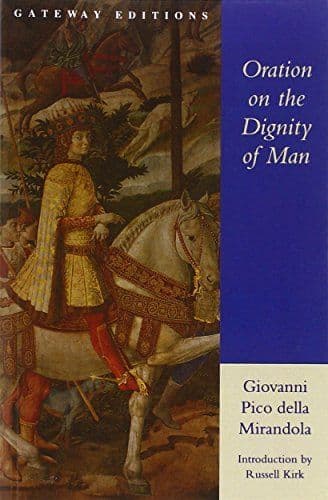
Oration on the Dignity of Man (Oratio de hominis dignitate)

Pico's Oration is a prefatory speech written for the planned Roman disputation of his nine hundred theses. Its famous central claim is that the human being has no fixed nature or assigned place in the cosmic hierarchy. In Pico's creation myth, God completes the world and then fashions a creature free to shape itself, able to descend toward the bestial or rise toward the angelic through its own choices. Dignity therefore lies in indeterminacy and self-formation, cultivated by moral philosophy, dialectic, natural philosophy, and theology. The speech then turns this anthropology into a defense of philosophical concord and of wide learning as the path of ascent.
Key Insights
✦What is the central claim of the Oration, and what does it reject?
Pico claims that humans are distinguished not by a particular rank in the great chain of being but by the absence of a fixed one. In his account, every other creature receives a defined nature, while the human is given the capacity to become whatever he chooses. This rejects the picture of a settled cosmic hierarchy in which each being simply occupies its place. It also shifts the source of worth from inherited position to the exercise of choice. The speech pairs this freedom with a demand: one must cultivate the intellect and the will, because the same freedom permits degeneration as readily as ascent.
✦Was the Oration really a 'manifesto of the Renaissance'?
That description comes largely from nineteenth-century and early twentieth-century interpreters, including Jacob Burckhardt's tradition of reading the Renaissance as the discovery of the individual. Later scholars, notably Paul Oskar Kristeller, argued that the speech is more medieval and religious in its framework than the label suggests, and that dignity of man was a familiar theme with earlier Christian and Neoplatonic precedents. The view that Pico stands as a secular herald of modern autonomy is therefore contested. A balanced reading recognizes its originality in emphasizing self-fashioning while placing it within Christian and Platonic traditions.
✦Did Pico actually deliver the Oration, and what is its relation to the 900 Theses?
The speech was written to open the public disputation Pico planned to hold in Rome, but the debate was halted after the condemnation of a number of his theses, and the speech was apparently never delivered. It was published only after his death. The title by which it is now known was not his own, and the text as a free-standing manifesto of human dignity is largely a later construction. Read in its original setting, it serves the Conclusiones by justifying wide-ranging philosophical inquiry. Readers who know only the Oration therefore miss the technical and polemical program that framed it.
✦How does the Oration use ancient wisdom traditions?
Pico ranges across Platonic, Aristotelian, Hermetic, Chaldean, and Hebrew sources, arguing that diverse philosophers point toward shared truths and that the philosopher should learn from many schools rather than swear loyalty to one. This is the rhetorical counterpart of the concord pursued in the Conclusiones and in De ente et uno. The speech also stages a hierarchy of studies, from moral philosophy to dialectic and natural philosophy to theology, as stages of purification and ascent. Scholars note that his use of sources is selective and serves a Christian framework rather than a neutral comparative project.
✦Is the Oration a celebration of unlimited human freedom?
A frequent oversimplification reads it as an endorsement of limitless self-assertion. Pico's freedom comes with the possibility of falling to a brutish state, and his ideal of ascent requires disciplined study, moral purification, and ultimately contemplation of the divine. The picture is of a vocation, not of unconstrained autonomy. Another distortion treats the work as anti-religious, although its anthropology rests on a creation account and its goal is union with God. Reading it as an exhortation to self-cultivation within a theological horizon is closer to the text.
✦Which editions and translations of the Oration should readers consult?
The Oration was composed in Latin, and several English translations circulate, including the version in The Renaissance Philosophy of Man edited by Ernst Cassirer, Paul Oskar Kristeller, and John Herman Randall Jr., and bilingual scholarly editions with commentary. Translators differ in how they render key terms such as dignitas and in the register of Pico's rhetoric. Because the traditional title and the free-standing treatment of the speech are products of later editorial practice, readers should consult introductions that explain its relation to the planned disputation and check which Latin text the translation follows.
Wealthy Psyche is an intellectual archive. We do not host, distribute, or sell book copies — physical or digital. We provide structured knowledge to help you think better, faster.