


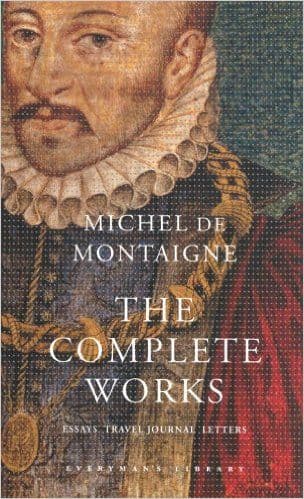
The Complete Works of Montaigne (Essays, Travel Journal, Letters)

The Complete Works of Montaigne is best understood as an editorial assembly rather than a single book with one governing thesis. In the standard English edition, translated by Donald M. Frame, the central text is the Essays, whose method is self-portraiture through inquiry: Montaigne tests judgment against his own habits, body, and memory, and uses the variety of human custom to unsettle dogmatic certainty. Alongside it the volume gathers the Travel Journal and a selection of letters, which show the same curiosity operating in private records. The collection lets readers compare the essayist's polished reflection with his unguarded daily observation and correspondence.
Key Insights
✦What does this collected edition contain, and why does the packaging matter?
The volume brings together the Essays, the Travel Journal, and a selection of Montaigne's letters in a single English translation. The packaging matters because the three bodies of writing are different in kind: the Essays are a deliberately composed and repeatedly revised literary work, the journal is a private diary partly dictated to a secretary, and the letters are occasional and often practical. Reading them together lets a reader see how the essayist's characteristic curiosity about custom, health, and judgment appears in more guarded and more unguarded forms. Readers should note that the Essays dominate the collection in length and importance.
✦What is the central method of the Essays, and what does it reject?
The Essays use the writer's own mind and body as a testing ground, trying out judgments on topics ranging from friendship to cannibals to the experience of pain. Montaigne rejects the pretension of systematic doctrine and the idea that reason can reach certainty by authority alone. Instead he proceeds through qualification, anecdote, and quotation, often turning a classical authority against itself. The result is a form of skeptical humanism in which self-knowledge, however partial, replaces confident system-building. This method is why the work is treated as a founding text of the personal essay.
✦How did the Essays change between editions, and why does it matter?
Montaigne published the Essays in successive versions, adding substantial new material rather than only correcting what he had written. The scholarly convention of marking layers, often labeled by letters for the earliest edition and later additions, lets readers trace how his thought and self-presentation developed. This revision history means the work has no single final shape in the sense of a closed treatise, and it is part of why the Essays feel like an ongoing conversation with himself. Readers using the Frame translation should attend to its markers for these layers.
✦How faithful is the Frame translation, and what are the alternatives?
Donald M. Frame's translation, first published in the 1950s, is widely used for its readability and its scholarly apparatus, and it is a standard English choice for the complete works. Montaigne's sixteenth-century French, with its long sentences and heavy classical quotation, poses real difficulties, and different translators balance fidelity and fluency differently. M. A. Screech's translation of the Essays for Penguin is a frequently cited alternative with extensive notes. Readers doing close study should compare passages across translations and consult annotations identifying his many classical sources.
✦How is Montaigne's skepticism often misunderstood?
A common oversimplification takes his skepticism as nihilism or a refusal to hold any belief. Montaigne doubts the claims of human reason to certainty, especially in the longest essay, the Apology for Raymond Sebond, yet he continues to value custom, moderation, friendship, and a practical, lived wisdom. He also remained a conventional participant in the Catholic religious and political order of his time. His skepticism is better read as a discipline of humility and a spur to examine one's own judgments than as a doctrine of despair.
✦Which parts of the collection should a first-time reader begin with?
Many readers begin with shorter and more accessible essays, such as those on friendship, on cannibals, and on experience, before attempting the long and demanding Apology for Raymond Sebond. The Travel Journal and letters work best as supplements once a reader has some sense of the essayist's voice, since they show how the same interests appear in practical, everyday circumstances. A reader who wants to understand Montaigne's place in humanism should also keep in mind that the collection is an editorial assembly rather than a book he designed as a unit.
Wealthy Psyche is an intellectual archive. We do not host, distribute, or sell book copies — physical or digital. We provide structured knowledge to help you think better, faster.