


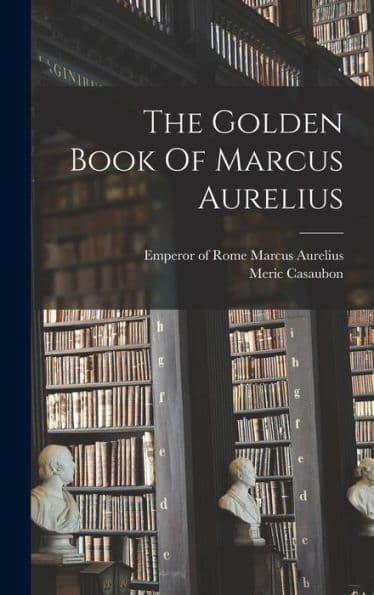
The Golden Book of Marcus Aurelius

The Golden Book of Marcus Aurelius is best understood as an English edition and presentation of the Meditations, not as a separate work with its own thesis. The text it carries is the Stoic notebook of a Roman emperor, in which Marcus rehearses a few doctrines to retrain judgment: only one's own assent is up to us, external events are indifferent, the cosmos is a rational whole in which each person has a part, and life is brief. The title belongs to the English-language publishing tradition, where a translated selection or full text was packaged as an accessible devotional and moral companion.
Key Insights
✦What is The Golden Book of Marcus Aurelius, and is it a distinct work?
It is not a separate composition by Marcus. The title has been used for English editions presenting his Meditations, and the exact contents, translator, and date vary by publisher, so I cannot confidently attribute it to one specific edition. Readers should treat the title as a packaging label and check the title page, translator credit, and introduction of the copy in front of them. If the edition is a selection rather than the full twelve books, it will omit material that matters to the argument, so it is worth confirming what is included.
✦What does the underlying text argue, and what does it set aside?
The Meditations are private exercises applying Stoic doctrine to daily conduct. Marcus returns to a small core of ideas: examine impressions before assenting, accept what fate brings, act for the common good, and keep the mind free of anger. He sets aside the aim of writing a systematic treatise or a work for readers. Its repetitions and abrupt shifts are part of its character as practice, which is why any edition, however titled, can seem aphoristic and uneven to readers who expect a continuous argument.
✦How does the text relate to Epictetus and earlier Stoicism?
Marcus credits his teacher Rusticus with introducing him to the discourses of Epictetus, and the distinction between what is up to us and what is not is central to both. Pierre Hadot, in The Inner Citadel, read the Meditations as organized around the disciplines of assent, desire, and action drawn from Epictetus. Marcus nonetheless offers a personal appropriation rather than a school curriculum, with distinctive emphasis on cosmic perspective and fellowship among rational beings.
✦Why does the edition matter for how the Meditations is read?
The twelve-book division and the title are not thought to be Marcus's own, the manuscript tradition is small, and the Greek is at times terse or uncertain. Translators therefore make interpretive choices, and a popular or devotional edition may smooth the abrupt, note-like style or add thematic headings. Since the titled arrangement of a given Golden Book may differ from the standard Greek order, readers who want to cite or study the text should compare it against a scholarly translation with notes, such as Farquharson's commentary or Hadot's study.
✦How is the Meditations commonly misread in popular editions?
It is often presented as self-help or the memoir of a serene philosopher-king. The notes in fact show a man reminding himself of what he finds hard, including irritation at others and fear of loss, so the calm is aspiration rather than achievement. Another misreading strips out the Stoic framework and offers the maxims as generic wisdom. Attractive gift editions can encourage both errors, so readers should look for introductions that explain the Stoic background.
✦Which translations should readers consult alongside it?
The English tradition begins with Meric Casaubon's 1634 translation. Later versions include George Long's nineteenth-century rendering, which is in the public domain and widely available, and A. S. L. Farquharson's edition with commentary. Modern options include Robin Hard for Oxford World's Classics, Gregory Hays for the Modern Library, and Martin Hammond for Penguin Classics. Because this profile cannot verify which text a particular Golden Book reproduces, compare its wording against one of these and check how it renders terms such as hegemonikon, the ruling faculty.
Wealthy Psyche is an intellectual archive. We do not host, distribute, or sell book copies — physical or digital. We provide structured knowledge to help you think better, faster.