


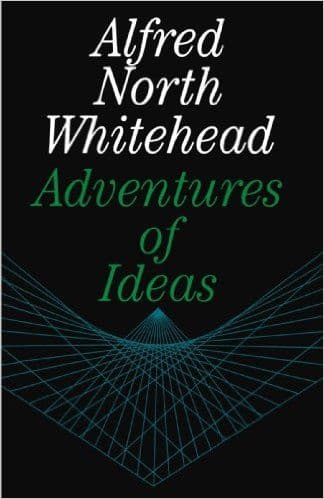
Adventures of Ideas
Whitehead's central thesis is that civilization advances through the interplay of two levels of ideas: particularized notions of low generality that secure immediate practical gains, and philosophic ideas of high generality that lure humanity toward novelty and ideal aims. The book is a speculative adventure in framing a scheme of ideas explanatory of history, tracing the slow drift of mankind toward civilization through the gradual replacement of force by persuasion, and concluding that a civilized society is one whose members participate in Truth, Beauty, Adventure, and Peace.
Key Insights
✦What is the central claim of Adventures of Ideas, and what does it reject?
Whitehead argues that civilization is not a static achievement but an adventure driven by the interplay of two kinds of ideas: particularized ideas of low generality, which are needed to reap the fruits of an attained civilization, and philosophic ideas of high generality, which guide the adventure toward novelty and secure the realization of ideal aims . The book rejects the notion that history is merely a record of force and material interest. Whitehead traces a slow drift from force to persuasion as the defining movement of civilization, and he insists that ideas have real efficacy in history—not as mere epiphenomena but as the lures that draw humanity toward new possibilities of order and beauty.
✦What are the four parts of the book, and how do they relate to one another?
The book is divided into four parts: Sociological, Cosmological, Philosophical, and Civilization . The Sociological part examines the human soul, the humanitarian ideal, freedom, and the shift from force to persuasion. The Cosmological part turns to laws of nature and the relations between science and philosophy. The Philosophical part develops Whitehead's categoreal scheme—objects and subjects, past, present, future, and the grouping of occasions. The final part on Civilization names the qualities that define a civilized society: Truth, Beauty, Adventure, and Peace . The parts are not a deductive system but a progressive narrowing: from historical analysis, through metaphysical framework, to the concrete values that crown a civilized existence.
✦How does Adventures of Ideas relate to Whitehead's Process and Reality?
Whitehead describes the three books—Science and the Modern World, Process and Reality, and Adventures of Ideas—as supplementing each other's omissions or compressions . Process and Reality (1929) is the systematic metaphysical treatise; Adventures of Ideas (1933) is the more accessible, historically oriented companion that applies the categoreal scheme to the philosophy of civilization. As one contemporary reviewer noted, for those who struggled through the mazes of Process and Reality, the cosmological and philosophical chapters of Adventures of Ideas shed considerable light on Whitehead's system . The later book thus functions as both an application and a popularization, showing what the metaphysics of organism means for how we understand history, science, and the values that sustain civilization.
✦What does Whitehead mean by 'Peace,' and why is it the culminating quality of civilization?
Peace, for Whitehead, is not the mere absence of war or the tranquilizing of adventure. It is a 'Harmony of Harmonies,' a grasp of infinitude that arrives as a gift rather than as an achievement of any particular occasion . Whitehead describes it as largely beyond the control of purpose, something that 'comes as a gift' . Peace reconciles the value of what has been achieved with the tragedy of what has been lost, and it becomes the condition of Adventure itself—the ground from which new creative advance becomes possible. It is the final quality in the book's list of civilized virtues because it names the reconciliation that makes the whole adventure of civilization worthwhile, without closing off the possibility of further becoming.
✦How was the book received at the time of its publication?
Contemporary reception was mixed but respectful. A review in the Columbia Spectator (April 1933) found the cosmological and philosophical sections 'clearly and brilliantly set forth,' praising Whitehead's systematic metaphysics for its internal consistency and flexibility . The same reviewer, however, was critical of the Sociological section, complaining that Whitehead's 'genuflections before Christianity are carried to ridiculous extremes,' and found the final section on Civilization 'less lucid,' suggesting it verged on mysticism . The review concluded that the book is 'so rich, so varied, so stimulating' that no follower of modern philosophy could well be without it. The mixed response reflects the book's hybrid character—part history, part metaphysics, part moral meditation—which resisted easy classification even as it impressed readers with its range.
✦What is a common misreading of the book's argument about ideas in history?
A common misreading treats Whitehead as a straightforward idealist who believes ideas alone drive history, or conversely as a determinist who sees ideas as mere reflections of material forces. Whitehead's position is more subtle. He insists that theories are built upon facts and that reports of facts are shot through with theoretical interpretation . Ideas have real efficacy, but they operate within a world of process, persuasion, and contingent occasion. The 'adventure' of ideas is not a Hegelian march of reason but a risky, open-ended exploration in which ideal aims may fail to be realized. Whitehead's emphasis on Adventure as a quality of civilization—alongside Truth, Beauty, and Peace—signals that the outcome is never guaranteed, and that civilization depends on the continual willingness to venture beyond the settled order.
Wealthy Psyche is an intellectual archive. We do not host, distribute, or sell book copies — physical or digital. We provide structured knowledge to help you think better, faster.