


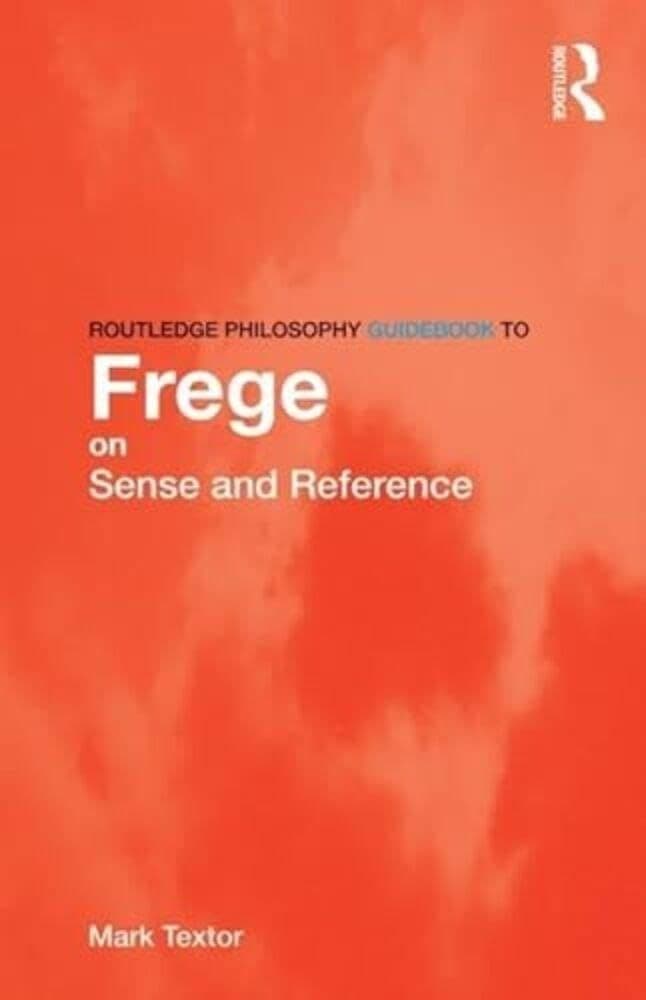
On Sense and Reference
Frege's central argument is that a singular term's meaning has two distinct components: its reference (Bedeutung), the object it designates, and its sense (Sinn), the 'mode of presentation' of that object. This distinction explains how 'the morning star' and 'the evening star' can refer to the same planet yet differ in cognitive value, solving puzzles about identity and substitution. The essay also extends the analysis to whole sentences, arguing that a sentence's reference is its truth-value while its sense is the thought it expresses, and it introduces the machinery of indirect reference for belief contexts.
Key Insights
✦What is the central claim of On Sense and Reference, and what does it reject?
Frege's central claim is that the meaning of a singular term is twofold: it has a reference (Bedeutung), the object it designates, and a sense (Sinn), the mode in which that object is presented. The essay rejects the assumption that a term's meaning is exhausted by its referent, because that assumption cannot explain why 'a = a' and 'a = b' differ in cognitive value when 'a' and 'b' co-refer. Frege's solution is that identity statements are true when the senses of the two terms, not merely their references, are considered. The distinction is thus introduced to account for the informative character of identity claims, and it becomes the foundation for his later analysis of sentences as referring to truth-values.
✦What is the 'morning star' example, and what does it illustrate?
The morning star and the evening star are both names for the planet Venus, so they have the same reference. Yet the statement 'the morning star is the evening star' is informative, whereas 'the morning star is the morning star' is trivial. Frege argues that this difference can only be explained if the two expressions have different senses: the morning star presents Venus as the object appearing in the morning sky, while the evening star presents it as the object appearing in the evening sky . The sense is the 'mode of presentation' of the referent, and it is what a competent speaker grasps when understanding the term. This example remains the most widely taught illustration of the sense-reference distinction and is central to its pedagogical and philosophical appeal.
✦How does Frege extend the distinction from names to whole sentences?
Frege argues that a declarative sentence has both a sense and a reference. Its sense is the thought (Gedanke) it expresses—the propositional content that can be grasped and judged. Its reference, controversially, is a truth-value: the True or the False. A sentence refers to the True if it is true, and to the False if it is false. This extension allows Frege to treat sentences as a species of singular term and to give a uniform account of compositionality: the reference of a complex expression is determined by the references of its parts. The thesis that sentences are names of truth-values has been widely criticized, notably by David Wiggins and Michael Dummett, who argue that the analogy with ordinary names breaks down and cannot explain sentence-sense .
✦What is 'indirect reference,' and why does Frege introduce it?
Indirect reference is Frege's solution to the problem of belief contexts. In a sentence like 'Smith believes that the morning star is the evening star,' the embedded clause does not refer to its customary reference (Venus) but to its customary sense—the thought that Smith believes. Frege introduces this machinery to preserve his principle that a term's reference is what determines the truth-value of sentences in which it appears. If the embedded clause referred to Venus, then substituting 'the evening star' for 'the morning star' would preserve truth, but it does not: Smith may believe one without believing the other. The doctrine of indirect reference has been criticized for generating an infinite hierarchy of senses and for making it difficult to determine the truth-conditions of doubly embedded belief reports .
✦How was the essay received, and what is the standard English translation?
The essay was published in 1892 in the Zeitschrift für Philosophie und philosophische Kritik . Its reception was slow but eventually profound: it is now regarded as one of the founding texts of the philosophy of language and has shaped nearly all subsequent work on meaning, reference, and propositional attitude reports. The standard English translation is by Max Black, first published in the Philosophical Review in 1948 and reprinted in Geach and Black's Translations from the Philosophical Writings of Gottlob Frege (Blackwell, 1952) . Black's translation is generally reliable, though the German 'Bedeutung' is sometimes rendered as 'meaning' rather than 'reference,' and readers should note that Frege's terminology was still developing in 1892.
✦What is a common misreading of the essay's purpose?
A common misreading treats the sense-reference distinction as primarily an epistemological or psychological thesis about how speakers associate ideas with words. Tom Ricketts has argued that many prominent critics and proponents alike have failed to understand the distinction because they overemphasize epistemological considerations at the expense of the logical concerns that originally motivated Frege . For Frege, the distinction is required to do justice to differences between sentences that logic must recognize—differences in cognitive value that cannot be accommodated by a theory of reference alone. The sense is objective, not private; it is the common content that speakers grasp, not a subjective association. Reading the essay as a contribution to psychology of language misses its logical motivation.
✦How does the essay relate to Frege's earlier and later work?
On Sense and Reference extends the project of the Begriffsschrift (1879) and the Foundations of Arithmetic (1884), where Frege had already distinguished the content of a proposition from its truth-value without fully thematizing the distinction. The essay provides the mature semantic framework that Frege would presuppose in The Basic Laws of Arithmetic (1893). It also anticipates the essay On Concept and Object, published in the same year, which develops the related distinction between saturated objects and unsaturated concepts. The sense-reference distinction thus occupies a pivotal position in Frege's career: it is the point at which his logical innovations are given a general semantic interpretation that would influence Russell, Wittgenstein, and the entire analytic tradition.
Wealthy Psyche is an intellectual archive. We do not host, distribute, or sell book copies — physical or digital. We provide structured knowledge to help you think better, faster.