


Collected Works, Vol. I–V

The Collected Works is the definitive scholarly edition of Gödel's writings, assembling his published papers, unpublished lectures and essays from the Nachlass, and selected correspondence across five volumes. The edition's central contribution is editorial: it makes Gödel's German originals available with facing English translations, provides extensive introductory notes that reconstruct the intellectual and historical context of each item, and thereby transforms a scattered and often opaque corpus into a navigable record of twentieth-century logic's most consequential mind.
Key Insights
✦What does the Collected Works contain, and how is it organized?
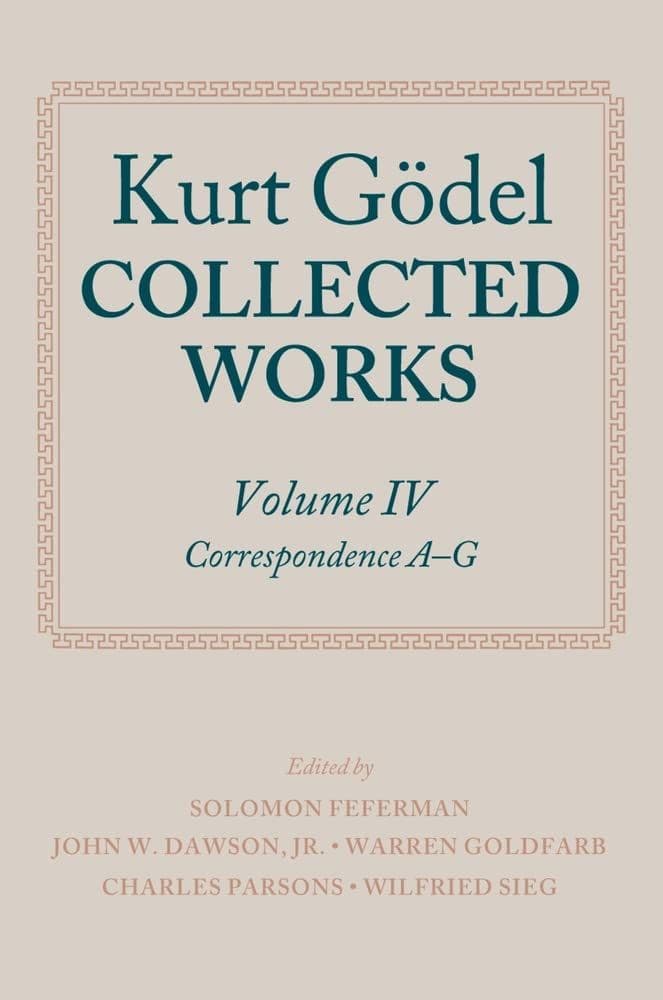
The five volumes divide Gödel's corpus by genre and chronology. Volume I contains the publications from 1929 to 1936, including the completeness and incompleteness papers. Volume II covers publications from 1938 to 1974, including the consistency of the axiom of choice and the continuum hypothesis, and the rotating universe papers. Volume III collects unpublished essays and lectures from the Nachlass, including the Gibbs lecture and the famous 1961 text on Cantor's continuum problem. Volumes IV and V contain selected correspondence, A–G and H–Z respectively, with Volume V also including a full inventory of the Nachlass . The edition was prepared under the auspices of the Association for Symbolic Logic, with Solomon Feferman as editor-in-chief and a board including John W. Dawson Jr., Warren Goldfarb, Charles Parsons, and Wilfried Sieg .
✦How were the translations and editorial apparatus handled, and why does this matter for Gödel scholarship?
German originals are printed with facing English translations, and the editorial notes are extensive enough to constitute a commentary in their own right. Each item or group of items is preceded by an introductory note by a specialist—Burton Dreben and Jean van Heijenoort on the 1929 completeness paper, Stephen Kleene on the 1931 incompleteness paper, Charles Parsons on the 1946 Princeton remarks, and so on . Some Nachlass material in Volume III had to be transcribed from Gabelsberger shorthand, a process that introduces a layer of editorial mediation between Gödel's hand and the printed text . For scholars working on Gödel's philosophical views, the editorial notes and the facing translations are not mere conveniences; they are essential aids to reading texts whose compression and occasional obscurity are legendary.
✦Which volumes contain material unavailable elsewhere, and what is in them?
Volume III is the most significant for material unavailable elsewhere: it contains unpublished essays and lectures, including the 1951 Gibbs lecture, the 1961 text on the continuum problem, and lecture notes on rotating universes and on relativity and idealistic philosophy . Volumes IV and V make available Gödel's correspondence for the first time in a comprehensive edition, though the editors describe the selection as covering letters of 'logical, philosophical, and scientific interest' rather than the complete correspondence . The Nachlass inventory in Volume V provides a guide to what remains unpublished. For readers who know Gödel only through the incompleteness theorems, Volume III is the volume that most alters the picture, revealing the breadth of his philosophical and cosmological interests.
✦How does the Collected Works relate to Gödel's most famous results?
Volume I contains the two papers that made Gödel's reputation: the 1929 doctoral dissertation on the completeness of the predicate calculus, and the 1931 paper on formally undecidable propositions in Principia Mathematica and related systems. The latter is printed with facing German and English text, and Kleene's introductory note reconstructs the context of the result . Volume II contains the 1938–1940 papers on the consistency of the axiom of choice and the generalized continuum hypothesis, which established that these axioms cannot be disproved from the standard axioms of set theory. Together, these volumes give readers direct access to the technical core of Gödel's work, with the editorial apparatus needed to understand its significance and its reception.
✦What is a common misconception about the Collected Works, and what does it actually provide?
A common misconception treats the Collected Works as a complete edition of everything Gödel wrote. It is not. The editors describe it as the 'only comprehensive edition' available, but it is selective: the correspondence volumes include letters of logical, philosophical, and scientific interest, not every letter . The Nachlass inventory in Volume V indicates the extent of material that remains unpublished or available only in archives. Nor is the edition a substitute for the original publications: the facing translations are reliable, but scholars working on fine points of Gödel's German terminology should consult the originals. The Collected Works is a scholarly resource, not a complete archive, and its value lies in the quality of its editorial mediation rather than in exhaustive completeness.
Wealthy Psyche is an intellectual archive. We do not host, distribute, or sell book copies — physical or digital. We provide structured knowledge to help you think better, faster.