


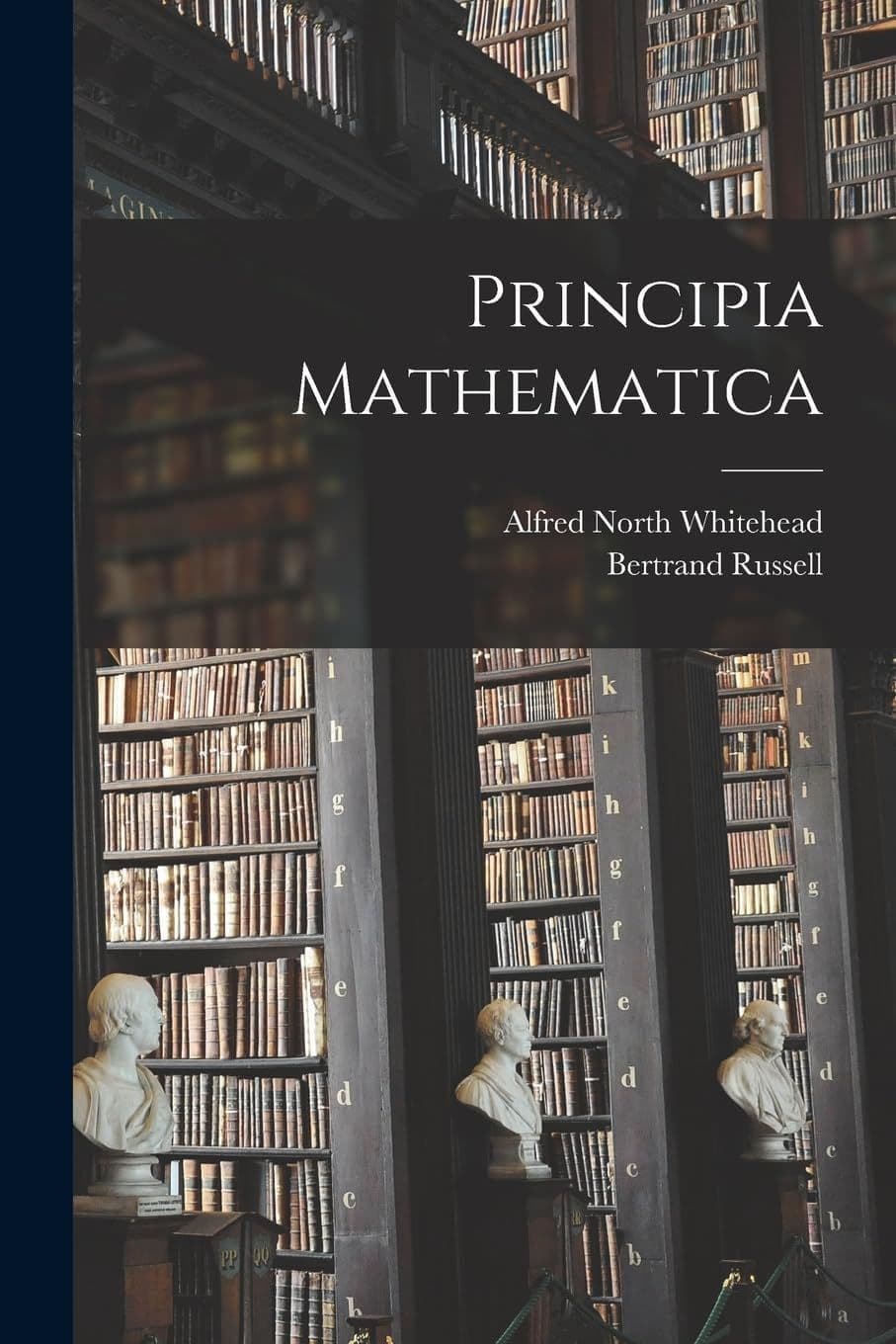
Principia Mathematica
Whitehead and Russell's central thesis is logicism: that all of pure mathematics can be derived from purely logical premises using only concepts definable in logical terms. Across three volumes, they construct a formal system with a ramified theory of types to avoid paradoxes, then laboriously derive arithmetic and set theory from it. The project's controversial reliance on the axiom of reducibility and the axiom of infinity, both arguably non-logical, left the logicist thesis unresolved—yet the work established modern mathematical logic as a discipline and set the stage for Gödel's limitative results.
Key Insights
✦What is the central claim of Principia Mathematica, and what does it reject?
The central claim is logicism: that all of pure mathematics can be derived from purely logical premises and uses only concepts definable in logical terms . Whitehead and Russell reject the view that mathematics requires irreducible mathematical intuitions or axioms that are not logical in character. Their goal is to demonstrate, through detailed formal derivation, that theorems of arithmetic and set theory are theorems of logic. The project is a response to the discovery of Russell's paradox, which threatened the foundations of Frege's logicism, and it seeks to reconstruct mathematics on a secure logical basis using the ramified theory of types to block the paradoxes.
✦What are the axiom of reducibility and the axiom of infinity, and why are they controversial?
Both axioms are arguably non-logical in character, and their necessity undermined the logicist claim. The axiom of infinity assumes that there exists an infinite number of objects—an assumption generally thought to be empirical rather than logical . The axiom of reducibility was introduced to mitigate the effects of the ramified theory of types, which had restricted what could count as a well-formed expression to avoid paradoxes. Critics claimed the axiom of reducibility was ad hoc and philosophically unjustified . Whitehead and Russell defended both on inductive grounds, arguing that self-evidence is never indispensable and that axioms are accepted because many nearly indubitable propositions can be deduced from them . The controversy left open whether mathematics reduces to logic or only to set theory.
✦How did the second edition differ from the first, and who was responsible for the changes?
The second edition was published by Cambridge University Press in three volumes between 1925 and 1927. It reprinted the first edition with corrections but added a new Introduction and three Appendices written by Russell alone . The new material proposed radical changes: replacing the familiar connectives 'or' and 'not' with the Sheffer stroke, and adopting extensionality . Russell also announced the abandonment of the axiom of reducibility, conceding that it was not the sort of axiom with which one could rest content . Frank Ramsey was involved in reading manuscript material for the new edition . Whitehead had largely withdrawn from the project by this point.
✦How did Gödel's incompleteness theorems affect the project?
Gödel's 1931 paper, 'On Formally Undecidable Propositions of Principia Mathematica and Related Systems I,' demonstrated that any consistent formal system powerful enough to express arithmetic contains true statements that cannot be proved within the system. This result contradicted the logicist ambition of deriving all mathematical truths from a single formal logical system, because it showed that no such system can be complete. As one source summarizes: 'Gödel's correction: Arithmetic truths ⊇ Theorems of any consistent formal system. Therefore logic cannot contain mathematics' . The incompleteness theorems did not refute logicism in every sense—they did not show that mathematics is not reducible to logic—but they demonstrated that the specific program of Principia could not achieve its stated goal of capturing all mathematical truth in one formal system.
✦What was the publication history of the first edition, and how was it funded?
Principia Mathematica was first published in three volumes in 1910, 1912, and 1913 by Cambridge University Press . The publication was not commercially viable: Cambridge University Press estimated a loss of approximately £600. The press agreed to assume half this amount, and the Royal Society donated another £200, leaving a £100 deficit. Whitehead and Russell each contributed £50 to see the work through to publication . The collaboration had been expected to take a year but consumed nearly a decade. Russell worked primarily on the philosophical parts, including the Introduction and the theory of descriptions, while both men collaborated on the technical derivations .
✦What was the immediate reception, and how did Whitehead and Russell respond to it?
The reception was largely indifferent among working mathematicians, a response that disappointed both authors. Russell later recalled that 'people were interested in what was said about the contradictions and in the question whether ordinary mathematics had been validly deduced from purely logical premisses, but they were not interested in the mathematical techniques developed in the course of the work' . Even those working on the same subjects did not think it worthwhile to consult Principia. Despite this, the work proved influential in three ways: it popularized modern mathematical logic through its superior notation, demonstrated the power of the formal system concept, and reconnected logicism with metaphysics and epistemology . Today it is recognized as one of the most influential works on logic ever written, second only to Aristotle's Organon .
✦What is a common misreading of Principia's relationship to set theory?
A common misreading assumes that Principia successfully reduced mathematics to logic, or alternatively that it simply reduced mathematics to set theory. Neither is accurate. The work attempted to derive mathematics from logic, but its reliance on the axiom of infinity and the axiom of reducibility—both arguably non-logical—left the question open. As the Stanford Encyclopedia notes, whether mathematics could be reduced to logic, or whether it could be reduced only to set theory, remained an open question after Principia . The ramified theory of types was a logic of propositional functions, not a simple set theory, and the 'no-classes' theory treated classes as logical constructions rather than primitive entities . Reading Principia as a set-theoretic foundation misses its specifically logicist ambition and the technical apparatus designed to avoid paradox without assuming sets as basic.
Wealthy Psyche is an intellectual archive. We do not host, distribute, or sell book copies — physical or digital. We provide structured knowledge to help you think better, faster.