


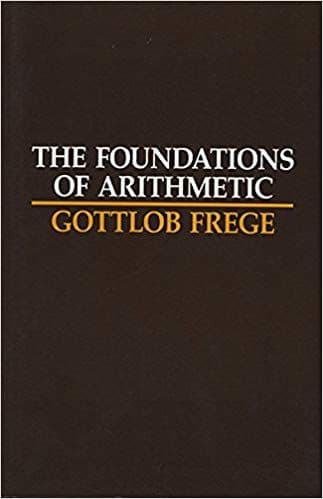
The Foundations of Arithmetic: A Logico-Mathematical Enquiry into the Concept of Number
Frege's central thesis is that arithmetic is analytic—its truths follow from purely logical laws and definitions, not from intuition or empirical experience. To demonstrate this, he applies his 'context principle' (only in the context of a proposition do words have meaning) to define cardinal number via the equivalence of concepts, thereby attacking psychologism, Kant's synthetic a priori, and Mill's empiricism. The book is a philosophical demolition of rival accounts and a constructive analysis of number, introducing the Julius Caesar problem that would haunt his logicist project.
Key Insights
✦What is the central claim of The Foundations of Arithmetic, and what does it reject?
Frege argues that arithmetic is analytic—that its truths are grounded in purely logical laws and definitions, independent of intuition or experience. The book rejects three dominant positions: psychologism (the view that mathematical truths depend on human mental processes), Kant's claim that arithmetic propositions are synthetic a priori, and Mill's empiricist account of number as an abstraction from collections of objects . Frege's strategy is twofold: a destructive critique of these rivals, and a constructive analysis of cardinal number using his context principle, which states that words have meaning only in the context of a proposition. The book is thus both a polemic and a foundational essay in the philosophy of mathematics.
✦What is the 'context principle,' and how does Frege use it to define number?
The context principle is Frege's methodological maxim: never to ask for the meaning of a word in isolation, but only in the context of a proposition . Frege uses this principle to address the question of how numbers are given to us if we have no intuition of them. Instead of defining number as a psychological entity or an empirical property of collections, he defines the sense of propositions in which number words occur. Specifically, he defines 'the number of Fs' contextually via what is now called Hume's Principle: the number of Fs is identical to the number of Gs if and only if the Fs and Gs are equinumerous . This linguistic turn—solving an ontological problem by analyzing propositional context—was later identified by Michael Dummett as a foundational moment for the linguistic turn in philosophy .
✦What is the Julius Caesar problem, and why does Frege raise it?
The Julius Caesar problem is Frege's own objection to his contextual definition of number. If all we have is Hume's Principle—which tells us when two numbers are identical—we still do not know whether any given object, such as Julius Caesar, is a number. Hume's Principle determines identity conditions within the domain of numbers, but it does not determine whether an arbitrary object falls into that domain . Frege raises this problem to show that a purely contextual definition is insufficient; a proper definition of number must also fix the domain of objects to which numbers belong. The problem anticipates the explicit definition of number as an extension of a concept in The Basic Laws of Arithmetic, and it remains a central challenge for neo-Fregean attempts to revive his programme .
✦How does the book attack psychologism, and what is at stake?
Frege attacks psychologism—the view that logical and mathematical truths are relative to human thought processes—by insisting on a sharp separation between the psychological and the logical, the subjective and the objective . His arguments include distinguishing the psychological origins of a proposition from its justification, treating the concept of number as impersonal, and differentiating logical laws from empirical laws of thought . If psychologism were true, Frege argues, mathematical truths would be private and variable ('my two' and 'your two' rather than simply two), and logic could not be a normative science with objective authority. The critique of psychologism is not merely technical: it is a defence of the objectivity of mathematics and, by extension, of science itself.
✦How was the book received, and how does it relate to Frege's later Basic Laws?
The book was not widely read or well received when it was published in 1884 . It drew little attention, though it eventually attracted the attention of Bertrand Russell and Ludwig Wittgenstein, both of whom were heavily influenced by Frege's philosophy . The Foundations is the philosophical and informal presentation of the logicist programme; the full formal derivation was to follow in The Basic Laws of Arithmetic (1893–1903). The later work provides the rigorous concept-script and explicit definitions that the Foundations sketches, including the definition of number as an extension of a concept—a definition that would turn out to be inconsistent due to Russell's paradox, which Frege learned of while the second volume of Basic Laws was in press.
✦What is the English translation history, and how reliable is J. L. Austin's version?
The first English translation was published by Basil Blackwell in Oxford in 1950, translated by J. L. Austin, with a second edition in 1953 and a revised edition in 1960 . Austin's translation is the standard English edition and is generally regarded as careful and serviceable, though it has been criticized for occasionally smoothing over Frege's technical vocabulary. The edition includes the original German text on facing pages, which is invaluable for readers working closely with Frege's terminology. Austin's translation played a significant role in introducing Frege to Anglophone philosophers, and it remains the version through which most English-speaking readers have encountered the Foundations.
✦What is the neo-Fregean revival, and how does it relate to this book?
The neo-Fregean revival, associated primarily with Crispin Wright and Bob Hale, argues that Frege was substantially right in both components of his logicist view, even though his own attempt failed because of Basic Law V . Their central claim is that Hume's Principle, which Frege discusses in the Foundations, can be adjoined to second-order logic to provide a consistent foundation for arithmetic—and that this constitutes a vindication of logicism on a reasonable understanding of that thesis . The neo-Fregeans thus return to the constructive analysis of number in the Foundations, setting aside the inconsistent explicit definition of number as an extension that Frege adopted in the Basic Laws. The Julius Caesar problem remains a central challenge for their programme .
Wealthy Psyche is an intellectual archive. We do not host, distribute, or sell book copies — physical or digital. We provide structured knowledge to help you think better, faster.