


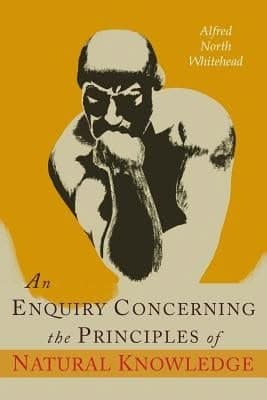
An Enquiry Concerning the Principles of Natural Knowledge
Whitehead's central argument is that natural philosophy must begin from the relational structure of events disclosed in experience, not from Newtonian matter or 'pure' sense data. The book introduces the method of extensive abstraction to derive points, lines, and instants from extended events, and it mounts an early critique of the 'bifurcation of nature'—the split between perceived qualities and scientific quantities. Knowledge of nature is thus grounded in a complex, relational empiricism rather than in the abstractions of classical mechanics.
Key Insights
✦What is the central claim of An Enquiry Concerning the Principles of Natural Knowledge, and what does it reject?
Whitehead argues that natural science must be grounded in a relational ontology of events—spatiotemporal nexuses like a flash of lightning—rather than in the localized matter of Newtonian physics or the 'pure' sense data favored by some empiricists . The book rejects the assumption that scientific knowledge begins with simple, disconnected sensations or with material points possessing 'simple location.' Instead, experience is already structured by relations, and the task of natural philosophy is to describe those relations without introducing unobserved entities. This event-based approach allows Whitehead to address the gap between perceived qualities and scientific quantities, a problem that would become central to his later critique of the 'bifurcation of nature.'
✦What is the method of extensive abstraction, and why is it introduced here?
The method of extensive abstraction is Whitehead's procedure for deriving abstract entities—points, lines, and instants—from the extended relations among concrete events. Rather than positing points as primitive entities, Whitehead constructs them as higher-order abstractions from nested sequences of volumes. Achille Varzi has traced the theory's development from its first purely mereological version in 1916 to the refined formulations in this 1919 Enquiry and The Concept of Nature (1920) . The method is central to the book's argument because it shows how the abstractions of geometry and physics can be grounded in the relational structure of experience, thereby avoiding the bifurcation that would treat mathematical points as more real than the events from which they are abstracted.
✦How does this book relate to The Concept of Nature and Process and Reality?
The Enquiry is the first volume in a triptych of works—alongside The Concept of Nature (1920) and The Principle of Relativity (1922)—that laid the epistemological framework for Whitehead's mature metaphysics . Whitehead himself described The Concept of Nature as a companion volume that supplements the Enquiry, avoiding mathematical notation and assuming the results of the earlier book's deductions . The event-based ontology developed here becomes the foundation for the 'actual occasions' of Process and Reality (1929). While The Concept of Nature is often treated as the first truly philosophical statement of the bifurcation critique, the Enquiry is where Whitehead first works out the technical apparatus—especially extensive abstraction—that makes the critique possible .
✦How was the book received, and what is its reputation among Whitehead scholars?
The Enquiry has always been regarded as a technically demanding work, more so than The Concept of Nature. One reader review calls it 'widely considered the most difficult book of philosophy in the English language,' a judgment that reflects its dense argumentation and mathematical apparatus . Among specialists, it is recognized as a pivotal text: it marks the inauguration of Whitehead's broadly philosophical phase, moving beyond the foundations of mathematical logic that had occupied him previously . A Portuguese translation of its first chapter, published in 2022, notes that it is in this book that Whitehead first expounds his critiques of absolute time and space and debuts his concepts of perception, extension, and relativity . Its reputation is thus that of a foundational but forbidding work.
✦What textual issues affect editions of the Enquiry, and is it in the public domain?
The book was first published by Cambridge University Press in 1919 and entered the public domain decades ago . A second edition appeared in 1925, containing notes added by Whitehead. Modern reprints vary considerably in quality: some are facsimile scans with typographical errors and no searchable text, while others, such as the Cosimo edition, retain the pagination of the original Cambridge edition and include the notes from the 1924/1925 second edition . Readers working closely with the text should seek an edition that preserves the original pagination, as cross-referencing with The Concept of Nature and secondary literature depends on it.
✦What is a common misreading of the book's relationship to empiricism?
A common misreading treats the Enquiry as a work of classical empiricism, reducing experience to sensory data and then attempting to construct the world from them. Whitehead's position is closer to what William James called 'radical empiricism': the full range of experience, including relational structures, is the basis of theory, not just the isolated 'sense data' that the Positivists asserted . The book's ontology of events is meant to capture the concrete, relational character of experience, not to dissolve it into discrete sensations. This is why Whitehead can critique the bifurcation of nature without simply privileging perception over science; both the perceived and the scientific are abstractions from a richer relational ground.
Wealthy Psyche is an intellectual archive. We do not host, distribute, or sell book copies — physical or digital. We provide structured knowledge to help you think better, faster.