


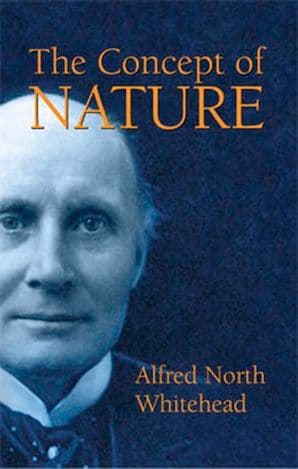
The Concept of Nature: Tarner Lectures
Whitehead's central argument is that nature must be understood as a single, self-contained system of events disclosed in sense-awareness, not split into an apparent world of perception and a causal world of scientific theory. This 'bifurcation of nature' is the fallacy the book exists to destroy. Nature is what we observe—the red glow of the sunset as much as the molecules physics posits—and space and time are abstractions from events, not containers for them. The book develops an alternative account of time, space, and objects grounded in the method of extensive abstraction.
Key Insights
✦What is the central claim of The Concept of Nature, and what does it reject?
Whitehead argues that nature is a single, self-contained system disclosed in sense-awareness, and that philosophy must describe it without introducing entities or qualities that cannot be observed. The book rejects what Whitehead names the 'bifurcation of nature': the division of the world into an apparent, perceptual nature (colors, sounds, warmth) and a causal, scientific nature (molecules, electromagnetic waves) that supposedly underlies it. This split, he insists, is a fallacy inherited from modern philosophy, and it makes the relation between mind and nature unintelligible. Nature includes both the red glow of the sunset and the molecules by which science explains it; philosophy's task is to show how they belong to one system, not to privilege one as 'real' and the other as 'mere appearance.'
✦What is the 'bifurcation of nature,' and why does Whitehead treat it as the book's primary target?
The bifurcation of nature is the assumption that there are two natures: the nature we perceive, with its colors, sounds, and values, and the nature described by physics, consisting of colorless, valueless matter in motion. Whitehead treats this as the fundamental error of modern natural philosophy because it generates insoluble problems—how does mind relate to matter? How does a secondary quality like redness inhere in a primary quality like extension?—while obscuring the fact that both 'natures' are abstractions from the same concrete events of experience. The book's second chapter is devoted to dismantling this fallacy, and the rest of the book constructs an alternative account of time, space, and objects that does not require it. As Whitehead states in his preface, if the reader indulges in the 'facile vice of bifurcation,' the book will be unintelligible .
✦What role do 'events' play in Whitehead's account, and how do they differ from substances?
For Whitehead, the ultimate constituents of nature are events, not substances. An event is 'the specific character of a place through a period of time'—a stretch of nature characterized throughout by a definite quality . Events are not things that persist unchanged; they are processes, and 'wherever and whenever something is going on, there is an event' . Space and time, on this view, are abstractions from events rather than containers in which events occur. This shift from substance to event is the conceptual hinge of the book: it allows Whitehead to avoid the bifurcation because events are directly given in sense-awareness, and the objects of physics (molecules, waves) can be understood as systematic correlations of event-characters rather than as hidden substances behind appearances.
✦How does Whitehead's treatment of time and space relate to Einstein's relativity?
Whitehead accepts the empirical results of Einstein's relativity but criticizes Einstein's method of interpreting them. The book develops an alternative account of the four-dimensional 'space-time manifold' based on the method of extensive abstraction, which derives space and time from the relations of events rather than positing them as absolute frameworks. Whitehead's divergence from Einstein, as he explains in the preface, arises from the fact that he does not accept Einstein's interpretation of simultaneity and the role of measurement conventions. The book's final chapters address the 'ultimate physical concepts' and the adaptation of mathematical physics to the relativity principle, but Whitehead maintains that the philosophical foundations of relativity require an event-based rather than a substance-based ontology .
✦How was the book received at the time, and how has its reputation fared?
The book was widely praised on its publication. A. E. Taylor, writing in Mind, called it 'a great contribution to Naturphilosophie, far the finest contribution, in my own judgement, yet made by any one man,' and J. E. McTaggart in The Cambridge Review described it as 'one of the most valuable books on the relation of philosophy and science which has appeared for many years' . Its reputation has endured, though it is now read primarily as a transitional work in Whitehead's development rather than as a standalone classic. Cambridge University Press reissued it in 2015 with a new preface by Michael Hampe, and it remains a key text for understanding the philosophical motivations that led to Process and Reality. Its critique of bifurcation continues to be cited in contemporary discussions of scientific materialism and the philosophy of perception.
✦What is the relationship between The Concept of Nature and Whitehead's later Process and Reality?
The Concept of Nature is a companion volume to An Enquiry Concerning the Principles of Natural Knowledge (1919) and a precursor to the systematic metaphysics of Process and Reality (1929). Whitehead describes the two earlier books as supplementing each other: the Enquiry draws chiefly on mathematical physics, while The Concept of Nature stays closer to philosophy and physics, avoiding mathematical notation and assuming the results of mathematical deduction . The event-based ontology developed here becomes the foundation for the 'actual occasions' of Process and Reality, and the critique of bifurcation is generalized into the critique of the 'fallacy of misplaced concreteness' in Science and the Modern World. The Concept of Nature is thus the laboratory in which Whitehead works out the natural philosophy that his later cosmology presupposes.
✦What is a common misreading of the book's claim that nature consists only of what the senses perceive?
A common misreading takes Whitehead to be claiming that only immediate sensory qualities are real, and that scientific entities like molecules and electrons are fictions or mere conveniences. This is not his position. Whitehead's point is methodological: philosophy of nature must begin from what is given in sense-awareness, and it must then show how the abstractions of physics are derived from and grounded in that given. He does not deny the reality of molecules; he denies that they inhabit a separate 'causal' nature behind the perceived one. As he puts it, the red glow of the sunset should be as much part of nature as the molecules and electric waves by which science explains it . The book is an argument for the unity of nature, not for the reduction of science to sensation.
Wealthy Psyche is an intellectual archive. We do not host, distribute, or sell book copies — physical or digital. We provide structured knowledge to help you think better, faster.