


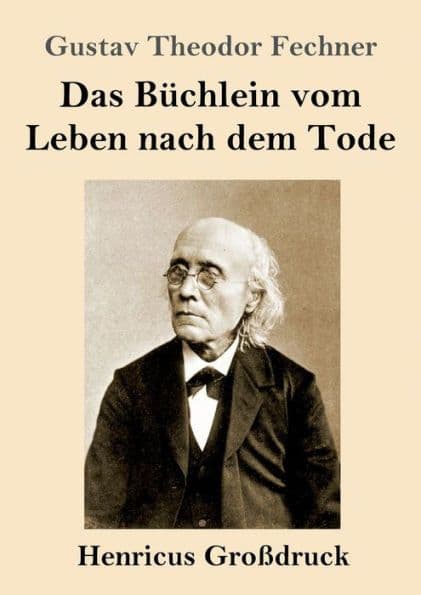
Das Büchlein vom Leben nach dem Tode
Fechner argues that death is not an end but a second birth into a higher form of consciousness, and that human existence unfolds in three stages: a sleeping pre-consciousness before birth, a waking life on earth, and an eternal, liberated wakefulness after death. The book's mechanism is a reversal of conventional metaphor: where European tradition since Heraclitus figures death as eternal sleep, Fechner figures it as eternal waking. Published under the pseudonym 'Dr. Mises' in 1836, it was his greatest popular success and the first serious statement of the panpsychist philosophical views that dominated his later life.
Key Insights
✦What is the central claim of Das Büchlein vom Leben nach dem Tode, and what does it reject?
Fechner argues that human existence comprises three stages: a pre-conscious, sleeping state before birth; the waking-and-sleeping life on earth; and an eternal, liberated wakefulness after death . The book rejects the conventional metaphor, dominant in European culture since Heraclitus, of death as eternal sleep. Fechner inverts it: death is a transition from darkness into light, from separation into connection with other spirits, and ultimately into union with God . The claim is not merely consolatory but metaphysical: the spirits of the dead continue to exist as individuals within the living, and the dead gain a comprehensive consciousness of what the living think of them .
✦Why was this book published under a pseudonym, and how does that affect its interpretation?
Fechner published the book under the pseudonym 'Dr. Mises,' the name he had used for his earlier satirical writings . A Taylor & Francis chapter notes that this was one of his earliest metaphysical writings, written under that pseudonym . The pseudonym is significant because it signals a shift in register: Dr. Mises was associated with satire and parody, but this book is earnest. A literary review notes that it is the only non-humorous work Fechner published under the Mises name, and the only one that went through two subsequent editions (1866 and 1887) . Readers should not mistake the pseudonym for ironic distance; the book's consolatory claims are meant literally.
✦How was the book received, and what is its place in Fechner's career?
It was Fechner's greatest popular success during his lifetime . A Springer reference entry notes that the 1836 Schrift first presented in serious form the philosophical thoughts that, after Fechner's illness of 1840–1843, became his central concern, even as his experimental psychology work continued alongside . A contemporary literary review observes that the book appeared at a time when natural philosophy had failed and Hegelianism had faded, making its announcement of heavenly and otherworldly matters seem like a fantastic dream to the scientific world . Yet it endured: it was reissued in 1866 with added psychophysical notes, and William James later wrote an introduction to the 1904 English translation, calling it 'dogmatic' in character but according its thesis major philosophical weight .
✦How does the book's argument relate to Fechner's psychophysics?
The relationship is one of continuity rather than separation. Fechner himself linked the two: in the second edition (1866), he added many psychophysical explanations in the notes, citing his Elemente der Psychophysik . A conference paper on the book's reception argues that the association between Elemente and The Little Book is not superficial but essential, and that Fechner considered the two works closely related . The psychophysical concept of the threshold, for instance, appears in the book as a wave scheme: just as an image leaves a memory afterglow after it disappears from the eye, so after death the spirit may die into a higher realm of spirits in God . The book is thus not a popular aberration from Fechner's scientific work but an extension of its metaphysical implications.
✦How has the book been received in Japan, and why is that reception notable?
The book has an unusually rich Japanese reception history, with five separate translations: by M. Hirata (1910), K. Tamiya (1916), M. Ueda (1948), M. Sakuma (1948), and C. Hattori (2008) . A study of this reception argues that the early translators shared a common anxiety: they feared that the abrupt influx of Western science and materialism after the Meiji Restoration might deprive the Japanese of their traditional spirituality . Hirata's introduction describes an 'age of science' that conceals a 'spiritual defect,' while Tamiya asks whether it is justified to dismiss mystic phenomena as nonsensical . The book thus functioned in Japan not primarily as psychology but as a resource for resisting materialism, a use quite different from its original German context.
✦What editions and translations exist, and does the edition matter for citation?
The first edition appeared in Dresden in 1836 from the Verlag der Ch. F. Grimmerschen Buchhandlung . A revised and expanded second edition was published in Leipzig by Leopold Voß in 1866, and a third in 1887 . The first English translation, by Hugo Wernekke, appeared in London in 1882 from Sampson Low, Marston, Searle, & Rivington . A more widely cited English edition, translated by Mary C. Wadsworth with an introduction by William James, was published by Little, Brown in Boston in 1904 and reprinted by Arno Press in 1977 . The edition matters because the 1866 second edition contains Fechner's added psychophysical notes, and the James introduction has shaped English-language reception.
Wealthy Psyche is an intellectual archive. We do not host, distribute, or sell book copies — physical or digital. We provide structured knowledge to help you think better, faster.