


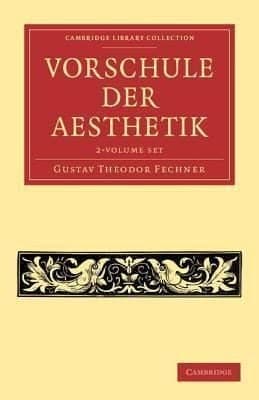
Vorschule der Aesthetik
Fechner argues that aesthetics should proceed 'from below,' deriving general principles of beauty from systematic empirical observation rather than from philosophical definitions of the beautiful. The book's mechanism is methodological: it applies the experimental and inductive approach of psychophysics to aesthetic preference, most famously through his cardboard-rectangle experiments testing the golden section. By tabulating preferences across hundreds of subjects, Fechner demonstrated that aesthetic judgments could be measured and generalized. The work's two volumes combine this experimental program with applied analyses of art, establishing him as the founder of experimental aesthetics.
Key Insights
✦What is the central claim of Vorschule der Aesthetik, and what does it reject?
Fechner argues that aesthetics must proceed 'from below'—inductively, from empirical observation of what people actually find pleasing—rather than 'from above,' by deducing principles from a philosophical definition of the beautiful. In his preface, he explicitly states that the book renounces the attempt to conceptually fix the objective essence of beauty and develop a system from that definition . It rejects the speculative, system-building aesthetics dominant in German philosophy. Instead, Fechner treats 'beautiful' as a working concept and focuses on the empirical conditions of immediate liking, giving primary weight to the laws of pleasure rather than to conceptual elaboration . The result is a program for experimental aesthetics grounded in the methods of psychophysics.
✦What specific experiments did Fechner conduct on the golden section, and what did they show?
Fechner cut ten rectangles of equal area from white cardboard, ranging from a square (1:1) to a long narrow rectangle (2:5), one of which embodied the golden section ratio of approximately 21:34 . He presented these to several hundred people over several years, asking them to express preferences independent of use and association. The judgments were tabulated, and he found that preference peaked near the golden section and sloped sharply downward at both extremes . He also studied objects in common use—books, visiting cards, stamps, picture frames—and found that the square was seldom used while ratios close to the golden section were frequent . Fechner distinguished between 'dimension ratios' (side-to-side relationships) and 'division ratios' (dividing a line), finding the golden section favored for the former but not the latter .
✦How was the book received by contemporaries, and what was the nature of its reception?
Reception was split—what a Springer editorial commentary describes as a 'zwiespältige Rezeption' (ambivalent reception) in the professional world of his time . Fechner's empirical approach challenged the philosophical establishment, and some contemporaries resisted reducing aesthetic judgment to tabulated preferences. A 2018 scholarly edition by Christian Allesch, combining the original text with extensive commentary, explicitly documents the historical conditions of Fechner's empirical turn, his intentions and methodological self-understanding, and this divided contemporary response . The 1897 second edition, reprinted by Cambridge University Press in 2013, testifies to the work's enduring importance even as its specific conclusions were later revised . Modern experimental aesthetics has rejected many of Fechner's findings but retained his point of view and problem-solving approach .
✦What does 'aesthetics from below' mean, and how does it relate to Fechner's psychophysics?
'Aesthetics from below' means starting with concrete empirical observations of aesthetic response and inducing general principles from them, in contrast to 'aesthetics from above,' which begins with abstract philosophical concepts and deduces what beauty must be. Fechner explicitly adopts this inductive stance in the preface, stating that his path goes 'from below upward' rather than 'from above downward' . The approach applies the same logic as his psychophysics: just as Elements of Psychophysics (1860) derived the logarithmic law of sensation from measurable just-noticeable differences, Vorschule der Aesthetik derives laws of aesthetic preference from measurable judgments of liking. The book is thus an application of psychophysical method to a new domain, extending Fechner's quantitative program from sensation to beauty .
✦How does the book differ from Fechner's earlier Elements of Psychophysics?
The two books apply the same empirical, quantitative orientation to different domains. Elements of Psychophysics (1860) established the logarithmic law relating physical stimulus intensity to psychological sensation, founding psychophysics as a discipline. Vorschule der Aesthetik (1876) applies that methodological commitment—systematic measurement, tabulation, and inductive generalization—to aesthetic preference rather than sensory magnitude. Where the earlier book derived a mathematical law from just-noticeable differences, the later book derives empirical regularities from preference judgments about shapes and proportions. The relationship is one of application: Vorschule extends Fechner's psychophysical method into aesthetics, making it the founding work of experimental aesthetics as a field .
✦What are the two volumes of Vorschule der Aesthetik about, and how do they differ?
Volume 1 is methodological and general, identifying new experimental methods and advocating the inductive study of 'aesthetics from below' . It addresses the conceptual and lawful relations of the aesthetic domain, including the golden section experiments and the distinction between dimension and division ratios. Volume 2 applies the previously established principles to the analysis of different works of art, moving from general principles to concrete aesthetic objects . This structure enacts Fechner's program: first establish the empirical laws of liking through controlled experiments, then use those laws to illuminate actual works of art. The second edition, published posthumously in 1897, was reprinted by Cambridge University Press in 2013 as a two-volume paperback set .
✦Is there an English translation of Vorschule der Aesthetik, and does the lack of one matter for its reception?
No complete English translation of Vorschule der Aesthetik has been identified in searchable scholarly catalogs . While partial translations or excerpts may exist in anthologies, the full two-volume work remains untranslated into English. This absence matters for reception: Fechner's experimental aesthetics is known in the Anglophone world primarily through secondary accounts, summaries, and the golden-section experiments cited in textbooks, rather than through direct engagement with the full text. Scholars who do not read German must rely on intermediaries. The Cambridge University Press reprint of the 1897 second edition reproduces the German text without translation, serving the scholarly market for the original . Readers seeking Fechner's aesthetics in English must consult the secondary literature or translations of his other works.
Wealthy Psyche is an intellectual archive. We do not host, distribute, or sell book copies — physical or digital. We provide structured knowledge to help you think better, faster.