


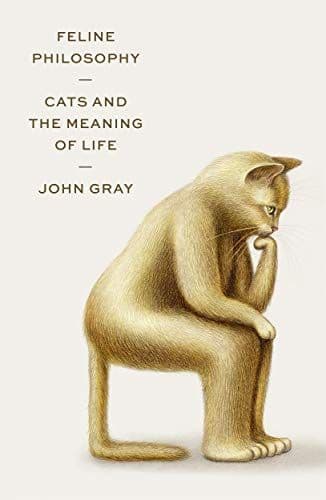
Feline Philosophy: Cats and the Meaning of Life

Gray's late work turns his anti-humanist deflation of philosophy toward cats, who live without the self-narration, anxiety, and fear of death that philosophy has endlessly tried to cure. The book's mechanism is contrast: philosophers from Spinoza to Berdyaev offer palliatives for human disquiet, while cats simply live, unburdened by the search for meaning. Gray does not claim cats are wise; he claims they lack the disease philosophy claims to heal. The result is a lighter, more personal iteration of his familiar themes—human exceptionalism is a folly, and the examined life may not be worth living.
Key Insights
✦What is the central claim of Feline Philosophy, and what does it reject?
Gray's argument is that cats offer a model of living unburdened by the self-consciousness, anxiety, and fear of death that philosophy has historically tried to cure. He rejects the premise that the examined life is superior: Montaigne's cat, on Gray's reading, may have lived the life more worth living precisely because it did not examine itself . The book is not a claim that cats are philosophers or that humans should literally become cats. It is a deflationary thought experiment: if the disease philosophy treats is human self-narration, then a creature without that disease has nothing to cure. Gray's target is the vanity of human exceptionalism, dressed here in fur rather than argument.
✦How does this book relate to Straw Dogs and The Silence of Animals?
Feline Philosophy is a lighter, more personal application of the same anti-humanism that drives Gray's earlier work. Straw Dogs diagnosed humanism as a Christian inheritance and progress as a myth; The Silence of Animals explored self-forgetting through attention to non-human life. Feline Philosophy continues that trajectory but with a shift in tone: it is shorter, wittier, and more anecdotal, drawing on Gray's own decades of living with cats as well as literary cat stories . The continuity is unmistakable—the same suspicion of human self-importance, the same interest in what non-human creatures can teach us by example rather than argument. But the register is gentler, closer to Montaigne than to Schopenhauer.
✦What did critics identify as the book's main weakness?
Publishers Weekly offered a representative critique: the premise is intriguing but 'falls flat' because Gray spends considerable space on canonical philosophers like Montaigne and Spinoza rather than on elucidating the nature of cats . The reviewer noted that the book 'likely won't be enough to keep cat-loving readers from prowling elsewhere for more satisfying insight into their four-legged companions.' The criticism is not that Gray's philosophy is wrong but that the book promises a feline focus and delivers a humanist one. Readers expecting a sustained meditation on cats may find instead a series of anecdotes about philosophers who liked cats, interspersed with Gray's familiar themes. The book's brevity (128 pages) intensifies the sense of a premise underdeveloped.
✦Does Gray actually recommend imitating cats, and if so, how?
Gray is careful to say that humans cannot become cats, and he treats literal imitation as impossible. What he recommends is more modest: observing cats can help humans detach from their obsessive self-narration, making the stories we tell about our lives shorter and less consuming . In interviews, he has suggested that if one cannot find a faith or a philosophy that works, the honest alternative is to immerse oneself in ordinary life—romance, career, news—without regret, as cats live without regret . This is not a program for happiness but a counsel of acceptance: the search for ataraxia has failed for millennia, and the cat's indifference to that failure is its own kind of instruction.
✦How does the book treat the relationship between cats and morality?
Gray uses cats to challenge the assumption that moral self-consciousness is a mark of superiority. Cats, he observes, are 'selfless egoists'—they lack a self-image to maintain and therefore do not perform virtue for others, but they also lack the human capacity for killing for ideas . A mother cat will risk her life for her kittens, but beyond that natural attachment, cats have no sense of moral obligation. Gray does not present this as a model for human ethics; he presents it as a contrast that exposes the peculiarity of human morality, which is capable of both extraordinary sacrifice and extraordinary cruelty, often in the same gesture. The point is not that cats are good but that human goodness is less distinctive than we like to think.
Wealthy Psyche is an intellectual archive. We do not host, distribute, or sell book copies — physical or digital. We provide structured knowledge to help you think better, faster.