


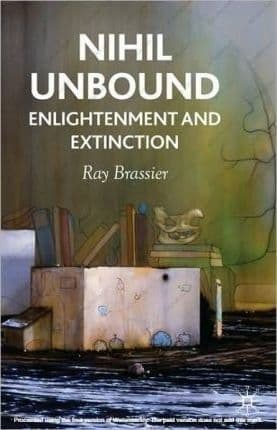
Nihil Unbound: Enlightenment and Extinction
Brassier's central move is to refuse the philosophical consensus that nihilism is a threat to be overcome. Instead, he argues that nihilism is the unavoidable consequence of the Enlightenment's own logic of disenchantment, and that philosophy should push it to its conclusion rather than seek refuge in meaning. His mechanism is a deliberate short-circuit: he plugs eliminative materialism from the Anglo-American tradition directly into the anti-phenomenological realism of French philosophy, bypassing the post-analytic truce between Heidegger and Wittgenstein. The result is a 'transcendental nihilism' that treats extinction not as a human tragedy but as the structural horizon of thought itself—a speculative opportunity rather than a crisis.
Key Insights
✦What is the central claim of Nihil Unbound, and what does it reject?
Brassier's governing proposition is that nihilism is not a philosophical affliction to be cured but the logical outcome of the Enlightenment's own commitment to disenchantment. He rejects the dominant contemporary strategy of safeguarding 'meaning'—characterized as the defining feature of human existence—from the incursions of science . Instead, he argues that philosophy should push nihilism to its ultimate conclusion, treating extinction not as a human tragedy to be mourned but as the structural horizon within which thought must operate. The book's method is a deliberate short-circuit: it bypasses the post-analytic consensus that unites Heidegger and Wittgenstein against scientism, linking instead eliminative materialism and speculative realism to produce what Brassier calls 'transcendental nihilism' .
✦What specific framework did Brassier develop by combining Laruelle with Freudian psychoanalysis?
Brassier's distinctive contribution is his use of Laruelle's concept of the 'real' as a non-dialectical identity that determines thought unilaterally, without being determined in return . Where Laruelle himself, on Brassier's reading, becomes trapped in textual exegesis—a 'bootless exercise in extravagant sterility'—Brassier supplements the Laruellean framework with Freudian psychoanalysis to perform the negation that non-philosophy cannot . The result is a theory of extinction as a future trauma that thought can 'bind' rather than merely suffer. This binding is what makes nihilism speculative rather than merely destructive: thought, by identifying with the real as extinction, becomes an object determined by the real rather than a subject projecting meaning onto it.
✦How does Nihil Unbound relate to the broader speculative realism movement?
Nihil Unbound is one of the founding texts of speculative realism, published the same year as the Goldsmiths conference where Brassier coined the term alongside Meillassoux, Harman, and Grant. The book's engagement with Meillassoux's critique of correlationism is implicit rather than explicit, but its shared target—the Kantian assumption that we can only access the correlation between thought and being, never reality itself—places it squarely within the movement's core problematic . Brassier's version of speculative realism is distinctive for its uncompromising naturalism: where Harman develops object-oriented ontology and Meillassoux argues for the absolute contingency of nature, Brassier insists that scientific thought discloses a reality indifferent to human meaning, and that philosophy must align itself with that indifference rather than seek consolation.
✦What are the main criticisms of the book's argument, and who has made them?
A significant critical response comes from Andrea Lehner and Felipe Cuervo Restrepo, who challenge Brassier's speculative nihilism through a defense of Hans Jonas and Keiji Nishitani. They argue that Brassier's radicalization of the Enlightenment is 'unresponsive to the need for having an ethics of nature,' and that Jonas and Nishitani—from entirely different perspectives—offer philosophical responses to the nihilistic purposelessness of a mind-independent reality that Brassier simply accepts . The criticism is not that Brassier misreads the texts he engages with but that his position leaves no room for the ethical or ecological response that the current conjuncture demands. Brassier's refusal of consolation, on this view, becomes a refusal of responsibility.
✦What does the title mean, and how does 'unbound' function as a philosophical term here?
The title's 'unbound' operates on two levels. On the surface, it signals that nihilism has been released from the restraints philosophy has imposed on it—the various attempts to contain, domesticate, or overcome it. Nihilism is 'unbound' in the sense that Brassier refuses the usual strategies of sublimation and instead lets it run to its conclusion. More technically, 'unbound' refers to the Freudian concept of binding (Bindung): trauma is 'unbound' when it cannot be integrated into a meaningful narrative. Brassier's wager is that extinction, the ultimate trauma, can be 'bound' by thought—not in the sense of being made meaningful, but in the sense of being thought as the structural horizon that determines thought from the outside. The title thus names both the problem (nihilism unleashed) and the solution (a binding that is not a consolation).
Wealthy Psyche is an intellectual archive. We do not host, distribute, or sell book copies — physical or digital. We provide structured knowledge to help you think better, faster.