


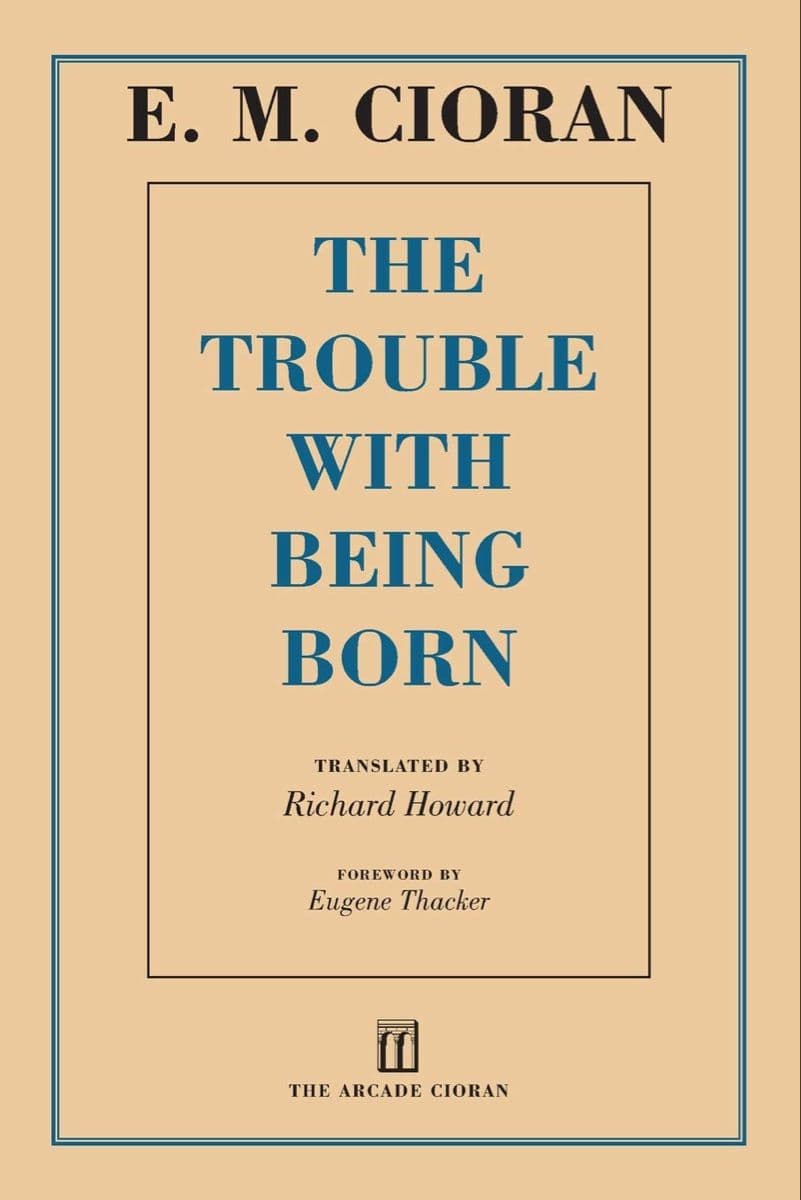
The Trouble with Being Born

The Trouble with Being Born is Cioran's most concentrated assault on the fact of birth itself, composed of 883 aphorisms and first published in 1973. Its central framework is a reversal of the usual existential complaint: the disaster is not death but birth, 'that laughable accident.' Cioran argues that to be born is to be exiled into time, consciousness, and the absurd hope of continuation, and that the only honest response is a lucid, often comical disgust. The aphorism is his chosen weapon because it refuses the consolations of system, allowing contradiction, fatigue, and a perverse joy in despair to sit side by side.
Key Insights
✦What is the central argument of The Trouble with Being Born, and what does it reverse?
The central argument is that the real disaster is not death but birth. Cioran reverses the usual existential complaint: we fear death, but the 'laughable accident' of being born is the misfortune that makes death a problem in the first place [citation:1][citation:10]. To be born is to be exiled into time, consciousness, and the futile hope of continuation. The book's 883 aphorisms circle this insight from every angle, meditating on God, metaphysical exile, decay, suicide, and the wisdom of cultivating detachment [citation:1][citation:4]. Cioran does not argue for a program or a solution; he diagnoses a condition. The aphorism is the form because it refuses the consolations of system and allows contradiction to stand.
✦Why did Cioran choose the aphorism as the exclusive form for this book, and what does it achieve?
Cioran said he used aphorisms because 'explaining bores me terribly' and because the form allows him to place contradictory thoughts side by side without justification [citation:4]. The aphorism is scorned by 'serious' people, he noted, but it is precisely this unseriousness that lets it capture the fragmented, contradictory nature of lucidity. The Trouble with Being Born consists of 883 fragments across twelve chapters, ranging from 37 to 101 aphorisms each [citation:6]. The form enacts the book's argument: a life is not a system but a series of disconnected moments, and the aphorism respects that discontinuity. It also permits the dark humor that runs through the book, the sense that despair and comedy are not opposites but companions.
✦How was the English translation received, and what role did Richard Howard play?
Richard Howard's 1976 English translation won the PEN Translation Prize, and it remains the standard version through which Cioran is known in English [citation:4][citation:6]. Howard was a celebrated poet and translator, and his rendering captures the compression, coldness, and black humor of Cioran's French. The translation was first published by Viking Press and has been reissued by Arcade Publishing, most recently in 2012 with a foreword by Eugene Thacker . The book became a Penguin Modern Classic in 2020, a sign of its enduring appeal beyond academic philosophy [citation:4]. Howard's translation is significant because it established Cioran's voice for Anglophone readers; without it, his French-period aphorisms might have remained a minority taste.
✦How has the book been received by critics, and what are the main criticisms?
The reception has been polarized but increasingly favorable. The Independent's Nicholas Lezard praised Cioran's 'genuine, all-inclusive, and yet perversely generous' loathing, arguing that 'only someone so doubtful of the world's fundamental givens can be trusted' [citation:4]. The Irish Times called it 'an orgy of cynicism and philosophical violence' that is also 'visceral euphoria' to read, noting that Cioran is 'nihilistic but never devoid of humour' [citation:8]. Critics have described it as 'impenetrable to the casual curious reader' and 'boring and repetitive' [citation:5][citation:14]. The main criticisms concern the performative nature of Cioran's pessimism and the question of whether 883 aphorisms amount to a philosophy or merely a posture. Defenders reply that the posture is the point: lucidity has no system, only incisions.
✦How does The Trouble with Being Born relate to Cioran's earlier works, particularly A Short History of Decay?
The book belongs to Cioran's mature French period and represents a formal departure from his earlier essay collections. A Short History of Decay (1949) was composed of longer essays; The Trouble with Being Born (1973) is composed entirely of aphorisms, some as short as a single sentence [citation:4]. This shift matters: the earlier work builds a cumulative diagnosis of civilization's decay, while the later work isolates moments of insight and refuses the continuity that essays imply. The themes remain consistent—exile, time, God, decay, the futility of action—but the aphoristic form makes them sharper, more volatile, and more resistant to summary. The book is often considered Cioran's most concentrated expression of his essential position, and it is the one most frequently recommended to new readers.
✦What is the most common misunderstanding of The Trouble with Being Born?
The most common misunderstanding is that the book is a straightforward expression of despair, a howl of pessimism with no philosophical discipline. In fact, it is a highly crafted literary and philosophical work, and its aphorisms are the product of a controlled intelligence. Cioran is not merely complaining about existence; he is diagnosing the structures of consciousness that make existence unbearable. A related misunderstanding is that the book offers a solution or a way of life. It does not: Cioran is not interested in therapy or consolation. The Irish Times noted that 'any divine Architect is a drunkard and a hooligan' in Cioran's view, and that even suicide 'isn't worth the effort' [citation:8]. The book is an exercise in lucidity, not a handbook for living.
Wealthy Psyche is an intellectual archive. We do not host, distribute, or sell book copies — physical or digital. We provide structured knowledge to help you think better, faster.