


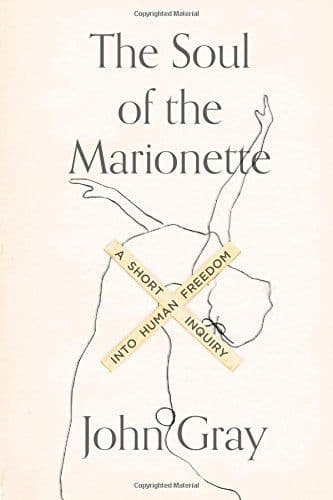
The Soul of the Marionette: A Short Inquiry into Human Freedom

Gray's target here is not determinism but the human aspiration to freedom itself. Taking his cue from Heinrich von Kleist's essay on marionettes—puppets that move with a grace humans cannot achieve because they are unburdened by choice—Gray argues that what people actually want is not more freedom but release from the burden of choosing. Drawing on Gnosticism, science fiction, and the history of sacrifice, he suggests that the modern faith in knowledge as a path to liberation is a secularized Gnostic dream. The only freedom available to flawed creatures is the freedom to accept our limitations and live in accordance with our natures.
Key Insights
✦What is the central claim of The Soul of the Marionette, and what does it reject?
Gray's argument is that the human obsession with freedom rests on a misidentification of what people actually want. Drawing on Kleist's essay on marionettes, he suggests that puppets, because they lack consciousness, move with a grace and certainty humans can never achieve—they are free from the burden of choice, not free to choose . Gray rejects the standard philosophical debate about free will and determinism as beside the point. His target is the modern conviction that knowledge and science can liberate us from our limitations, which he reads as a secularized version of Gnosticism: the belief that we can escape the fallen world through awakening . The freedom Gray endorses is not liberation from constraints but acceptance of them.
✦How does Kleist's essay on marionettes function in Gray's argument?
Kleist's short essay, 'On the Marionette Theatre,' provides Gray with his central image and his method. In the essay, a dancer argues that marionettes possess a grace humans lack because they are not weighed down by affectation or self-consciousness—they move as if weightless, while humans stumble . Gray extends this into a broader thesis: what the marionette lacks is not freedom but the burden of choice, and this lack is precisely what makes its movement enviable. The image allows Gray to sidestep the conventional free-will debate and ask a different question: not whether we are free, but whether freedom is something we should want. His answer is that humans, unlike puppets or gods, are condemned to choose, and the only freedom available is accepting that condition .
✦What role does Gnosticism play in the book's critique of modern science?
Gray argues that the modern faith in scientific progress as a path to human liberation is structurally identical to ancient Gnosticism. The Gnostics believed the material world was created by a malevolent or incompetent deity and that salvation lay in awakening to this fact and escaping the flesh . Gray sees contemporary scientism as a secular mutation of this narrative: the belief that knowledge will free us from our biological and physical limits, that we can transcend the human condition through technology or understanding. His criticism is not that science is false but that it has inherited a religious structure it does not acknowledge. The Gnostic dream of escape persists, disguised as rationalism, and Gray treats this as evidence that secular modernity has not escaped myth but merely repressed it.
✦What are the main criticisms of the book, and who made them?
The criticisms cluster around two charges: that the book is not really an argument, and that its pessimism is a counsel of despair. Library Journal described it as reading like 'a collection of anecdotes strung together by a jaded, unreliable narrator' rather than a sustained inquiry . A Guardian review by Tim Adams noted that Gray 'invites this charge of pessimism by not stressing clearly that it is possible both to seek improvement and expect that this can only be done partially and incrementally' . The reviewer also observed that Gray's claim that secular thinking is shaped by repressed religion is hardly news to most atheists, undercutting the provocation. The common thread is that Gray's aphoristic method, while entertaining, leaves the book's central thesis under-defended against obvious objections.
✦How does this book relate to Gray's Straw Dogs and The Silence of Animals?
The Soul of the Marionette is a direct continuation of the anti-humanist project developed in those earlier books. Straw Dogs argued that humanism is a secularized Christianity and progress a myth; The Silence of Animals explored self-forgetting through attention to non-human life. This book applies the same deflationary lens to the concept of freedom, arguing that the liberal obsession with choice is itself a symptom of the human disease rather than its cure . The continuity is thematic and tonal: the same suspicion of uplift, the same erudite eclecticism, the same preference for acceptance over striving. Where The Silence of Animals found a possible release in the silence of other creatures, The Soul of the Marionette finds it in the image of the puppet—a being whose grace comes from having no choices to make.
Wealthy Psyche is an intellectual archive. We do not host, distribute, or sell book copies — physical or digital. We provide structured knowledge to help you think better, faster.