


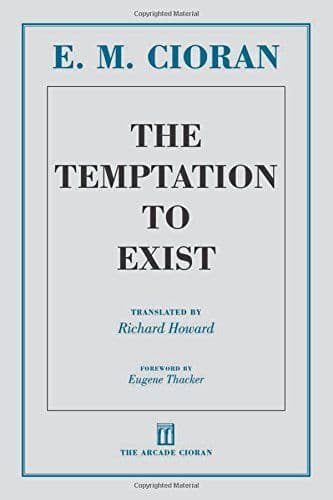
The Temptation to Exist

The Temptation to Exist is a collection of eleven essays in which Cioran develops his central paradox: the desire to exist, to affirm life and the self, is inseparable from the lucidity that dissolves it. Writing against himself, he argues that thought at its most acute turns against the thinker, and that Western civilization, exhausted by its own consciousness, can only cultivate its decline. The essays range over the writer's vocation, the death of the novel, mysticism, and the benefits of tyranny, all delivered in an aphoristic prose that Susan Sontag placed in the tradition of Kierkegaard, Nietzsche, and Wittgenstein.
Key Insights
✦What is the central paradox of The Temptation to Exist, and how does Cioran develop it?
The central paradox is that the temptation to exist—to affirm life, the self, and action—is inseparable from the lucidity that dissolves it. Cioran writes of 'thinking against oneself,' a mode he associates with Nietzsche, Baudelaire, and Dostoevsky, in which thought turns against the thinker and broadens 'the sphere of our disease' . The more acute the consciousness, the less it can justify existence; yet the refusal to exist is itself a form of existence. The essays operate within this paradox: Cioran seeks the void where existence can be separated from being and thus asserted, while never abandoning time and society . The result is not a doctrine but a series of meditations that enact the impossibility of resolving the tension they describe.
✦How did Susan Sontag's introduction shape the book's reception, and what did she claim for Cioran?
Susan Sontag's introduction, included in the 1968 English edition, was instrumental in presenting Cioran to American readers. She called him 'the most distinguished figure writing today in the tradition of Kierkegaard, Nietzsche and Wittgenstein' . This framing positioned Cioran not as a marginal pessimist but as a legitimate heir to the great tradition of aphoristic, anti-systematic philosophy. The introduction also warned against historicizing Cioran, arguing that his thought should be taken on its own terms rather than reduced to its context . Sontag's endorsement gave the book a credibility it might not otherwise have had in the United States, and it helped establish the 'underground classic' status the book later acquired .
✦How was The Temptation to Exist received when it first appeared in English, and what criticisms were raised?
The reception was mixed. Time magazine praised Cioran's 'dark vision' and compared his essays to Dostoevsky writing in the style of Pascal, noting that his gloom defies easy classification . But the Los Angeles Times, reviewing the 1986 reissue, was more critical: it warned that a style so self-aware risks drifting 'over the boundary between meaning and posture,' and that Cioran's persona as the 'tired European intellectual' may bore readers . The reviewer also noted that the book had 'aged and entered history,' despite Cioran's own admonitions against historicizing . The main criticisms, then and now, concern the performative nature of Cioran's pessimism and the question of whether his aphorisms amount to a philosophy or merely a posture.
✦How does The Temptation to Exist relate to Cioran's earlier and later works?
The book belongs to Cioran's French period, written after he abandoned Romanian and adopted French as his literary language. It was first published by Gallimard in 1956, following A Short History of Decay (1949) and preceding History and Utopia (1960). It shares with the earlier work the aphoristic mode and the preoccupation with decay and disillusion, but it is more explicitly concerned with the act of writing and the vocation of the intellectual . The essays on the novel, the writer, and the fate of Western civilization anticipate themes that Cioran would develop in later collections like The Trouble with Being Born (1973) and Anathemas and Admirations (1986). The book is thus a central document of his mature French style, where the Romanian's 'passionate emptiness' is transmuted into a colder, more controlled French prose.
✦What is the significance of Richard Howard's translation, and how does it shape the English text?
Richard Howard's translation, first published in 1968 and reissued by the University of Chicago Press in 1998, is the standard English version of The Temptation to Exist . Howard was a celebrated poet and translator, and his rendering of Cioran's French is widely praised for capturing the compression and epigrammatic force of the original. Cioran himself described French as 'a restricting but beloved straitjacket,' and Howard's translation transcribes that taut correctness into English . The translation is significant because it introduced Cioran to American readers and established the voice through which he would be known in English. As with all translations of Cioran, the stylistic extremity of the original is mediated, but Howard's version remains the most authoritative English rendering available.
✦What is the most common misunderstanding of The Temptation to Exist?
The most common misunderstanding is that the book is a systematic treatise on nihilism, offering a coherent philosophical position that can be summarized and assessed. It is not: Cioran is an unsystematic thinker who refers to his essays as 'fragments,' and his arguments are presented in ironic, aphoristic prose that almost defies criticism . A related misunderstanding is that the book is purely destructive or negative. In fact, the essays are exercises in 'thinking against oneself,' a discipline that requires as much rigor as any constructive philosophy. The book is not a manifesto for despair but a performance of lucidity, and its value lies in the quality of its attention to the illusions it dismantles, not in any doctrine it proposes.
Wealthy Psyche is an intellectual archive. We do not host, distribute, or sell book copies — physical or digital. We provide structured knowledge to help you think better, faster.