


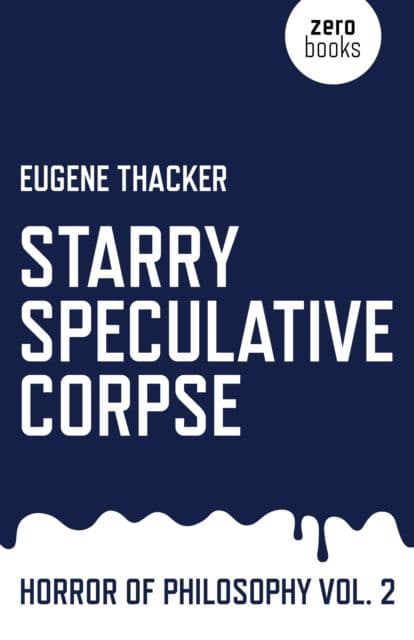
Starry Speculative Corpse

The second volume of Thacker's Horror of Philosophy trilogy reverses the usual question: instead of asking what horror is, it reads philosophy itself as a horror story. Its spine is the claim that philosophical thought, when pushed to its limit, confronts a darkness it cannot master—a 'thought that undermines thought.' Thacker traces this limit-experience through Descartes' demon, Kant's depression, and Nietzsche's laughter, then through the negative theology of Eckhart and John of the Cross, the Kyoto School's absolute nothingness, and Schopenhauer's cosmic pessimism. The result is not a theory of horror but a demonstration of philosophy's own unthinkable core.
Key Insights
✦What is the central claim of Starry Speculative Corpse, and what does it reject?
The book's governing proposition is that something philosophically interesting happens when philosophy is taken not as a heroic feat of explaining everything but as the confrontation with a thought that undermines thought itself . Thacker rejects the standard framing in which philosophy either dismisses horror as irrational or domesticates it as an aesthetic genre. Instead, he reads canonical philosophical texts—Descartes' Meditations, Kant's pre-critical writings, Nietzsche's aphorisms—as records of thought stalling at its own limit. The abyss is not outside philosophy; it is what philosophy encounters when it takes its own ambitions seriously. This reversal, from a philosophy of horror to a horror of philosophy, is the book's distinctive contribution.
✦How does this volume differ from In the Dust of This Planet?
The first volume moved between philosophy, black metal, witchcraft, and popular culture to sketch the idea of a 'world-without-us.' Starry Speculative Corpse narrows the focus almost entirely to philosophy proper. Its chapters proceed through close engagements with Descartes, Kant, Nietzsche, the Christian mystics, the Kyoto School, and Schopenhauer, with far fewer pop-cultural reference points . Readers who found the first book accessible may find this one denser and more demanding of prior philosophical background. The payoff is a more sustained argument: where In the Dust of This Planet suggested the unhuman world as a horizon, Starry Speculative Corpse shows how canonical philosophers have already glimpsed that horizon in moments of crisis, doubt, and mystical negation.
✦What role does negative theology play in the book's argument?
Negative theology—the tradition running from Dionysius the Areopagite through Meister Eckhart, Angela of Foligno, The Cloud of Unknowing, and John of the Cross—provides Thacker with a crucial precedent for thinking the unthinkable. These writers describe a darkness that is not the absence of light but an excess of divine radiance beyond conceptual grasp. Thacker reads this 'divine darkness' alongside later philosophical attempts to articulate nothingness: Heidegger's Nothing, Sartre's nothingness, Badiou's void, and the Kyoto School's absolute nothingness . The connection is not merely historical. It suggests that the philosophical problem of nihilism inherits a structure from mystical theology: the attempt to say what cannot be said, and the collapse of language that follows.
✦How does Thacker read Schopenhauer, and what does 'cosmic pessimism' mean here?
The chapter on Schopenhauer, titled 'Prayers for Negation,' is where the book's pessimism becomes most explicit. Thacker engages Schopenhauer's claim that life is characterized by a striving that can never be satisfied, and reads this not as a psychological observation but as a metaphysical structure. 'Cosmic pessimism' names the position that this futility is not a human projection onto an indifferent universe but something the universe itself, so to speak, expresses . Thacker is careful not to turn this into a celebration of despair. The term functions analytically, marking a tradition that includes Schopenhauer, Mainländer, and later figures like Brassier, whose 'eliminativism' Thacker discusses in the final chapter. The question is whether thought can affirm this futility without converting it into a new consolation.
✦What is a common misreading of the Horror of Philosophy trilogy?
A persistent misreading treats the trilogy as a survey of horror fiction or a philosophical defense of the horror genre. This is understandable given the titles and the first volume's engagement with black metal and pulp fiction. But Starry Speculative Corpse makes the project's real ambition clearer: it is a work of metaphysics in the negative mode, using horror as a lens for a problem that predates the genre. The 'horror' in the title refers less to scary stories than to the vertigo thought experiences when it confronts its own limits. Reading the book as genre criticism misses the argument's stakes. It is closer to a brief history of meontology—the discourse on non-being—than to a taxonomy of monsters .
✦Where does Starry Speculative Corpse sit within Thacker's broader intellectual trajectory?
The book occupies a middle position between the systematic historical work of After Life and the more experimental, fragmentary later volumes. After Life established Thacker's genealogical method: tracing contemporary concepts of life back to their Scholastic and Aristotelian foundations. Starry Speculative Corpse applies a similar method to the concept of darkness, moving from mystical theology through German idealism to twentieth-century pessimism. The final volume, Tentacles Longer Than Night, returns to the pop-cultural register of the first book. Read together, the trilogy enacts the tension Thacker describes: philosophy's drive toward system and its repeated collapse into fragment, aphorism, and the confession that thought has reached its edge.
Wealthy Psyche is an intellectual archive. We do not host, distribute, or sell book copies — physical or digital. We provide structured knowledge to help you think better, faster.