


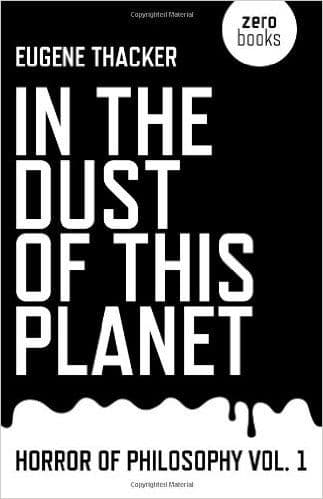
In the Dust of This Planet: Horror of Philosophy, Vol. 1

The first volume of Thacker's Horror of Philosophy trilogy introduces the 'world-without-us': a planetary reality that precedes and exceeds human cognition. Its mechanism is a deliberate inversion—Thacker reads supernatural horror (Lovecraft, black metal, occultism) not as philosophy's illustration but as a mode of thought confronting the limits of human understanding. Philosophy becomes 'the thought of the limit of all thought,' and horror supplies the vocabulary for a world increasingly unthinkable in the face of planetary disaster and extinction. The book is less an argument about nihilism than a performance of thought pressed against its own outer edge.
Key Insights
✦What is the 'world-without-us,' and why does it require horror rather than philosophy?
The 'world-without-us' is Thacker's term for a planetary reality that precedes and exceeds human cognition—a world that does not include the human as its center or measure . The problem is not that this world is mysterious in a solvable sense, but that philosophy's standard tools (logic, argument, definition) presuppose a human subject for whom the world is an object. Horror, particularly supernatural horror, offers a different mode of access: it enacts the collapse of that subject-object relation through monsters, madness, and the unknowable. Thacker's claim is not that horror explains the world-without-us but that it performs the limit of explanation, which is the closest thought can come to confronting a reality indifferent to it.
✦How does In the Dust of This Planet differ from later volumes in the trilogy?
The first volume is the most wide-ranging and formally experimental of the three. Its chapters are organized as medieval scholarly forms—lectio, quaestio, disputatio—and its materials include black metal, witchcraft, demonology, and popular film alongside canonical philosophy . Starry Speculative Corpse narrows the focus to canonical philosophers read as horror, and Tentacles Longer Than Night reverses the operation by reading horror writers as philosophers . The first book is thus the trilogy's broadest entry point and its most atmospheric: it establishes the 'world-without-us' as a problem, while the later volumes pursue different strategies for thinking it without resolving it.
✦What is a documented criticism of the book's philosophical rigor?
A recurring criticism, visible in reader reviews and academic reception, concerns the looseness of Thacker's argumentation. One critical reviewer noted that the introductory chapter promises a sustained inquiry that the subsequent chapters do not deliver, describing the book as 'a catalogue of interesting tidbits' that lacks philosophical substance . The criticism is not that Thacker's readings are wrong but that he moves associatively rather than argumentatively, juxtaposing Lovecraft, black metal, and mysticism without demonstrating why these juxtapositions produce knowledge rather than atmosphere. Thacker anticipates this objection by disclaiming logical rigor, but the question remains whether the book's performative method is a legitimate philosophical strategy or an evasion of argument.
✦How does the book relate to Thomas Ligotti's The Conspiracy Against the Human Race?
The relationship is one of shared terrain and divergent method. Ligotti's book is an explicit argument for antinatalism: it claims that human existence is a mistake and that consciousness is a curse. Thacker cites Ligotti approvingly and the two writers are often grouped together, but In the Dust of This Planet does not advocate for any position on human existence. Where Ligotti writes to persuade, Thacker writes to map. Ligotti's pessimism is moral and programmatic; Thacker's is ontological and diagnostic. The connection is documented in the book's reception—Ligotti provided a blurb for In the Dust of This Planet—and in Thacker's broader engagement with pessimism as a tradition rather than a doctrine.
✦Why did this book achieve popularity outside academic philosophy?
The book's unexpected visibility owed much to its association with popular culture. It appeared as a fashion motif on Jay-Z's clothing line and was mentioned by designer Kenneth Cole . More substantially, it served as an acknowledged influence on the philosophical atmosphere of True Detective's first season, whose protagonist Rust Cohle embodied a popularized version of cosmic pessimism . This reception is somewhat ironic: a book arguing that the world is fundamentally unthinkable became a fashionable accessory for a certain kind of brooding intellectualism. The popularity has not necessarily deepened engagement with the book's argument, but it has made Thacker a recognizable name outside the academy.
Wealthy Psyche is an intellectual archive. We do not host, distribute, or sell book copies — physical or digital. We provide structured knowledge to help you think better, faster.